
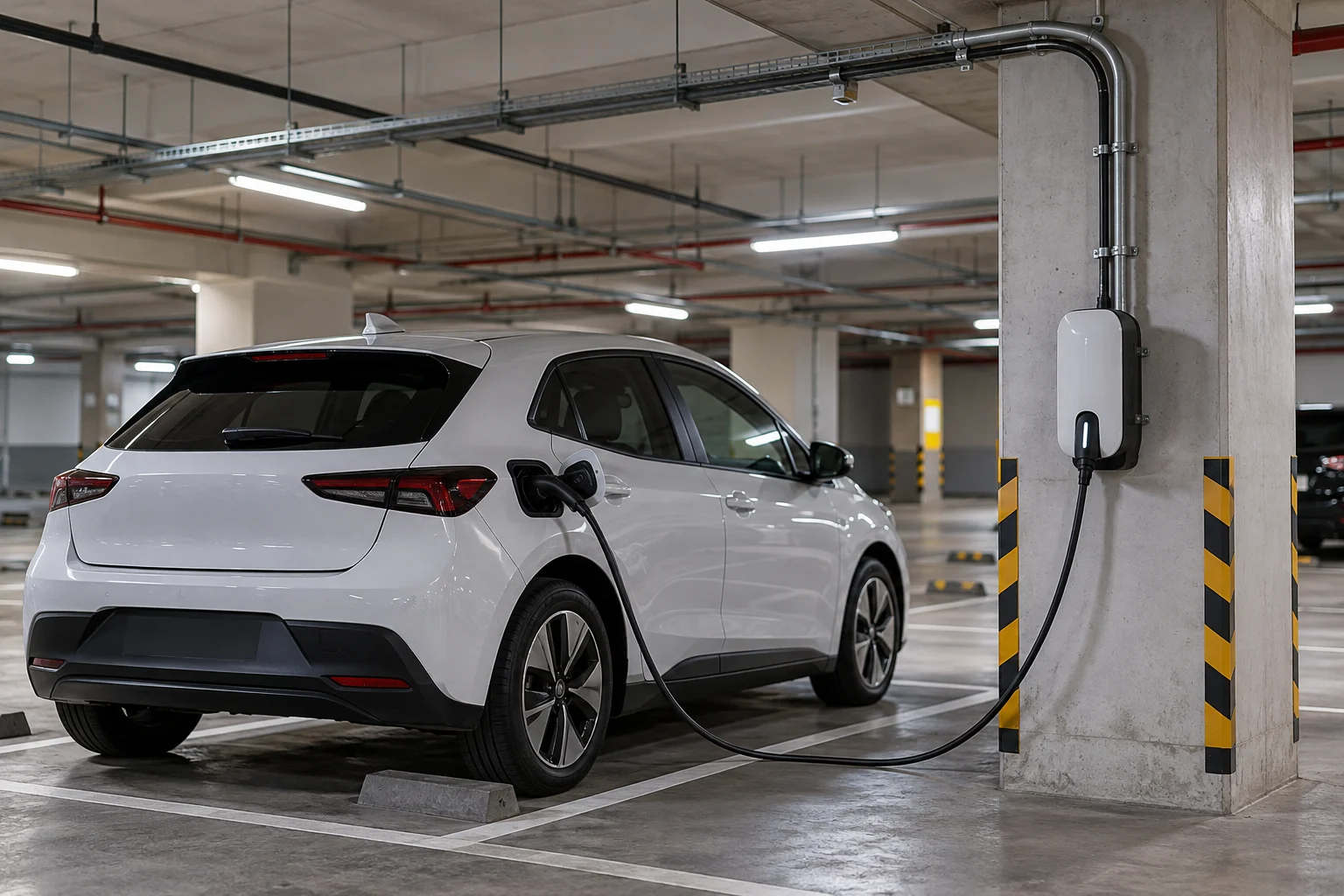
The installation extended beyond the parking bay. The court's account describes a charging box on the shared wall behind the bay, conduit mounted along the ceiling, and a connection through the common electrical panel to the meter used by the resident.
On June 22, 2022, the Taiwan High Court's Kaohsiung Branch dismissed the resident's appeal in case 111年度上字第132號. It upheld removal of the equipment and restoration of the affected areas. The required consent had not been obtained before equipment was added to the shared wall, ceiling and electrical panel.
From the charger to the electrical panel
According to the judgment's undisputed facts, the resident installed a charging box, mounted conduit using ceiling suspension rods, and added a circuit breaker inside the electrical panel. The court treated the wall, ceiling and panel as common parts and facilities. The reference to the resident's meter does not establish ownership of that meter.
Calling the work additional wiring in an area for exclusive use did not match the places it actually occupied.
Two sources governed consent. Article 11 of the Condominium Administration Act requires demolition, major repair or improvement of common parts and related facilities to follow a resolution of the unit owners' meeting. The court applied it to this installation. Article 15 of the building's bylaws additionally required management-committee permission and a power-company safety inspection for added wires and conduit.
Under Article 6(1)(5), residents must comply with other laws or the bylaws; the court held that this installation breached those obligations. After the committee sought coordination through a certified letter, the equipment remained in place, allowing it to ask the court to intervene under Article 6(3).
Article 6(1)(4) also addresses installation of pipes or wiring and necessary use of common areas. The court expressly held that this case did not fall within the situation asserted under that provision. Its reasoning depended on the actual locations and the bylaws, so it cannot be turned into a rule that every parking-space charger requires the same vote (paragraphs 5 and 6 of the judgment).
Switching it off did not answer the consent issue
The resident said a switch had been fitted, use had stopped and the equipment was locked, and expressed willingness to hand the key to the management committee. Even if true, the court held, those assertions did not remove the duty to dismantle the equipment and restore the area. The judgment did not establish that the key had already been delivered.
Power was only part of the dispute. Equipment could remain unauthorized at those locations even while no electricity passed through it.
What belongs on the installation drawing
A quote identifying only the parking-space number would leave out much of this case. An installer can draw the position of the charging box, the walls and ceiling used by the conduit, and the panel where it connects. That drawing can then be compared with the property records, bylaws and existing owners' resolutions.
Approval needs a defined proposal. An application to the management committee can describe the work and ask which bylaw governs, whether the committee or the owners' meeting must decide, and what documents are missing. If approval has already been given, the approved route, equipment and conditions still need to match the version the installer will build.
Kaohsiung's subsidy announcement of May 2026 included EV charging cable trays in apartment buildings' common areas. Applications closed on September 30. The program reflects a need to plan shared wiring; it does not supply the consent or construction procedures for a particular building.
For a stop-work or removal demand, or a disagreement over the bylaws, an email to the firm can set out the disputed work, the relevant clause and the response deadline. Before signing an installation contract, the parties can also settle whether work may start before approval and who bears costs if approval is refused. An unresolved route need not become a second dispute over the installation bill.
Sources checked October 25, 2026. This account concerns the identified Kaohsiung judgment; later proceedings and finality have not been confirmed. Equipment locations, rights and bylaws require a separate assessment in each building.
Official sources
- Judicial Yuan, Taiwan High Court, Kaohsiung Branch, civil judgment 111年度上字第132號, June 22, 2022.
- Condominium Administration Act, Article 6 and Article 11.
- Kaohsiung City Government, 2026 subsidy for EV charging cable trays in apartment buildings' common areas, May 29, 2026; application period closed.
Frequently Asked Questions
- Can I install a charger and wiring because the parking space is for my use?
- The equipment's location and the full wiring route still need checking. This installation used a shared wall, ceiling and electrical panel. The court considered that scope, the law and the building's bylaws, and rejected the argument that the work was merely additional wiring in an area for exclusive use. The layout and bylaws of another building may require a different assessment.
- Does switching off and locking the charger remove the obligation to dismantle it?
- The resident said the equipment was no longer used and was locked, and offered to give the key to the management committee. The court held that even if those assertions were true, they would not remove the duty to dismantle the installation arising from the breaches of the common-area rules and bylaws. It did not decide that removal is the only possible outcome in every charger dispute.
- Can a government subsidy replace the building's consent?
- Subsidy eligibility and permission to use common areas are separate. The 2026 Kaohsiung program discussed here included EV charging cable trays in common areas, but its September 30 application deadline had passed. That policy did not itself authorize an individual resident to carry out work in shared areas.
This article provides general information and is not legal advice on any individual matter.


