"In incidents involving only property damage, drivers should photograph the scene and move their vehicles to a safe location before reporting the incident, rather than waiting for police to arrive." That was the advice of Wu Tung-ling (吳東凌), director-general of the transport ministry's Department of Railways, Highways and Road Safety, as reported by the Taipei Times. He was worried about secondary collisions on highways, with six reported in August.
It is safety advice. It is also the law.
What the rule requires
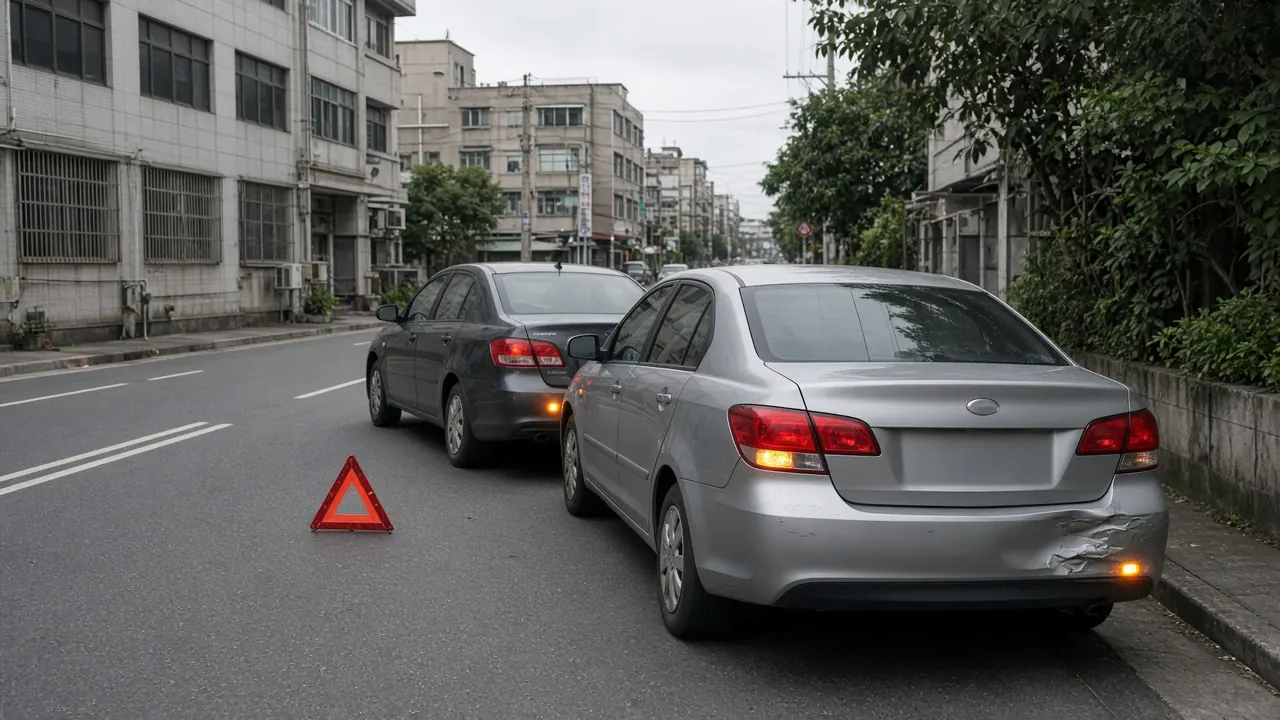
Taiwan's Road Traffic Accident Handling Regulations (道路交通事故處理辦法), Article 3(1)(4), generally forbids moving crash vehicles and marks on the road. Where nobody is hurt or killed and the vehicles can still be driven, drivers must first mark the vehicles' positions and the evidence at the scene, then move the vehicles to a place where they do not obstruct traffic. For these crashes, Article 3(2) allows the marking to be done by photo or video.
On a traffic lane or shoulder, a warning triangle or other visible device goes behind the crash and comes away once the scene is cleared (Article 3(1)(1)). Article 4 sets the distances: 100 meters on a national freeway; 80 meters on an expressway or where the speed limit exceeds 60 km/h; 50 meters where the limit is above 50 and up to 60 km/h; 30 meters at 50 km/h or below; and 5 meters in congestion or below 10 km/h. Rain or fog calls for more.
Photos that stand in for chalk marks
Once the cars are at the curb, the photos are the scene. The Taoyuan District Court had a parking-lot scrape in front of it that was not repaired until 53 days later (114 Hsiao-Shang No. 37, small-claims appeal decided September 30, 2025, final).
Photos sent by messaging app on the evening of the crash showed scratches and a dent on the right front bumper and fender, where both drivers said the cars had touched. With no sign of another accident in between, the delay alone did not break the link. Two items billed for the left front fender did not match the point of impact and were cut, and the NT$52,089 claim became an NT$33,887 award.
Fault, after the cars are gone
Taiwan's Civil Code, Article 191-2, makes the driver of a motor vehicle liable for damage caused while it is in use, unless the driver shows that reasonable care was taken to prevent it. Breaking a traffic rule written to protect others raises a presumption of negligence under Article 184(2). When the injured party was also at fault, a court may reduce the award or deny it (Article 217(1)).
Calling the police, or settling on the spot
Your insurer has a say before any roadside deal. Article 93 of the Insurance Act (保險法) lets an insurer provide that it is not bound by an admission, settlement or payment you make to the other side without its participation, unless you notified it and it refused to take part, or stalled, without good reason. Notice of the accident is due within five days of learning of it, unless the law or the policy says otherwise (Article 58).
The reporting rule itself allows a roadside deal. Drivers must normally report a crash and cooperate with the police, but not when no one is hurt or killed and the parties settle with each other on the spot (Handling Regulations, Article 3(1)(5)). Skipping the police has a cost in paper: no party registration slip at the scene, no scene diagram or photos to request after seven days, and no preliminary analysis report after thirty (Article 13). Our column on when police accident records become available covers how to request them. If the police did come but you could not give a statement at the scene, you contact the handling unit within seven days to complete the record (Article 10(3)).
Who pays for the repairs
Not the compulsory policy. The Compulsory Automobile Liability Insurance Act (強制汽車責任保險法) defines a covered accident as one in which passengers or people outside the vehicle are injured or killed (Article 13). Repairs come from the driver at fault, from that driver's voluntary liability policy, or from your own collision cover.
The amount is set by Article 196 of the Civil Code: the decrease in value caused by the damage, which courts usually measure by necessary repair costs. New parts replacing old ones are depreciated. In a 2025 Keelung small-claims judgment (114 Chi-Hsiao No. 952, first instance, June 18, 2025), a collision insurer had paid NT$51,894 and sued the motorcyclist at fault. Parts of NT$34,934 on a car almost five years old were written down to NT$3,494; labor was not. The court awarded the insurer NT$20,454, because an insurer subrogated under Article 53 of the Insurance Act can claim no more than its insured could have. The motorcyclist's appeal was dismissed as procedurally defective on September 23, 2025 (114 Hsiao-Shang No. 27), with no further challenge allowed.
If the other driver is insured, Article 94 of the Insurance Act bars the liability insurer from paying its own policyholder before the injured party is compensated, and lets the injured party claim directly from the insurer, within the policy limit, once liability is established. Before that point, the insurer may pay the injured party directly on its policyholder's notice (Article 95).
Small claims and the two-year clock
Both cases above were small-claims matters. That procedure covers money claims of NT$100,000 or less, and parties can agree in writing to use it up to NT$500,000 (Code of Civil Procedure, Article 436-8). The claim itself expires two years after you know of the damage and who is liable, or ten years after the crash (Civil Code, Article 197(1)). Appealing a first-instance small-claims judgment from overseas has its own limits, set out in our column on small-claims appeals from abroad.
A Taiwan lawyer can request the police scene diagram and preliminary analysis report for you, read what you signed or texted at the roadside to see what it commits you to, and send a repair demand to the other driver or that driver's insurer before filing a small-claims case. If an insurer sues you after paying for the other car, the lawyer can check whether replaced parts were depreciated, as the Keelung court required, and whether the bill matches the damage. Consultations with an English-speaking lawyer in Taipei are available through Hovering International Law Firm at wei@hoveringlaw.com.tw; see also our civil matters page. Taipei office: 7F-2, No. 35, Sec. 1, Chengde Rd., Datong Dist., Taipei City 103 (臺北市大同區承德路一段35號7樓之2).
On a city street with a 50 km/h limit, the rule comes down to a triangle 30 meters back, a few photos taken before anything moves, and a car at the curb.
Sources
Checked October 28, 2026.
- Road Traffic Management and Penalty Act (道路交通管理處罰條例), Article 62
- Road Traffic Accident Handling Regulations (道路交通事故處理辦法), Article 3
- Road Traffic Accident Handling Regulations, Article 4
- Road Traffic Accident Handling Regulations, Article 9
- Road Traffic Accident Handling Regulations, Article 10
- Road Traffic Accident Handling Regulations, Article 13
- Civil Code (民法), Article 184
- Civil Code, Article 191-2
- Civil Code, Article 196
- Civil Code, Article 197
- Civil Code, Article 216
- Civil Code, Article 217
- Insurance Act (保險法), Article 53
- Insurance Act, Article 58
- Insurance Act, Article 93
- Insurance Act, Article 94
- Insurance Act, Article 95
- Compulsory Automobile Liability Insurance Act (強制汽車責任保險法), Article 13
- Code of Civil Procedure (民事訴訟法), Article 436-8
- Judicial Yuan judgment database: Taoyuan District Court, 114 Hsiao-Shang No. 37 (臺灣桃園地方法院114年度小上字第37號), September 30, 2025 (small-claims appeal; not appealable)
- Judicial Yuan judgment database: Keelung District Court, Keelung Summary Division, 114 Chi-Hsiao No. 952 (臺灣基隆地方法院基隆簡易庭114年度基小字第952號), June 18, 2025 (first instance); Keelung District Court, 114 Hsiao-Shang No. 27 (臺灣基隆地方法院114年度小上字第27號), ruling of September 23, 2025 (appeal dismissed)
- Taipei Times, "Elderly traffic fatalities rise 3%, ministry says", October 28, 2026
Frequently Asked Questions
- Can I really be fined for leaving my car where it stopped?
- Yes, if nobody was hurt, the car can still be driven and leaving it there blocks traffic. Article 62(2) of the Road Traffic Management and Penalty Act fines a driver NT$600 to NT$1,800 for failing to mark the car's position and move it promptly to the roadside. If neither the driver nor the owner moves a car that is obstructing traffic, the police may move it themselves (Article 9(1)(9) of the Road Traffic Accident Handling Regulations). Failing to handle a no-injury crash as the rules require is a separate fine of NT$1,000 to NT$3,000, and driving off adds a one- to three-month license suspension (Article 62(1)).
- Will Taiwan's mandatory auto insurance pay to fix my car?
- No. The Compulsory Automobile Liability Insurance Act covers accidents in which passengers or third parties outside the vehicle are injured or killed (Article 13). Car repairs are claimed from the driver at fault or paid under a voluntary policy. If the other driver carries liability insurance, you can claim directly from that insurer, within the policy limit, once the driver's liability has been established (Article 94(2) of the Insurance Act). A rental car while yours is in the shop, or lost resale value, is a separate loss you would have to prove (Civil Code Article 216).
- How long do I have to bring a repair claim, and which court process applies?
- A tort claim expires two years after you learn of the damage and who must pay, and in any case ten years after the accident (Article 197 of the Civil Code). Claims of NT$100,000 or less go through small-claims procedure, and parties can agree in writing to use it for claims up to NT$500,000 (Article 436-8 of the Code of Civil Procedure).
This article provides general information and is not legal advice on any individual matter.