By Legal AI Assistant
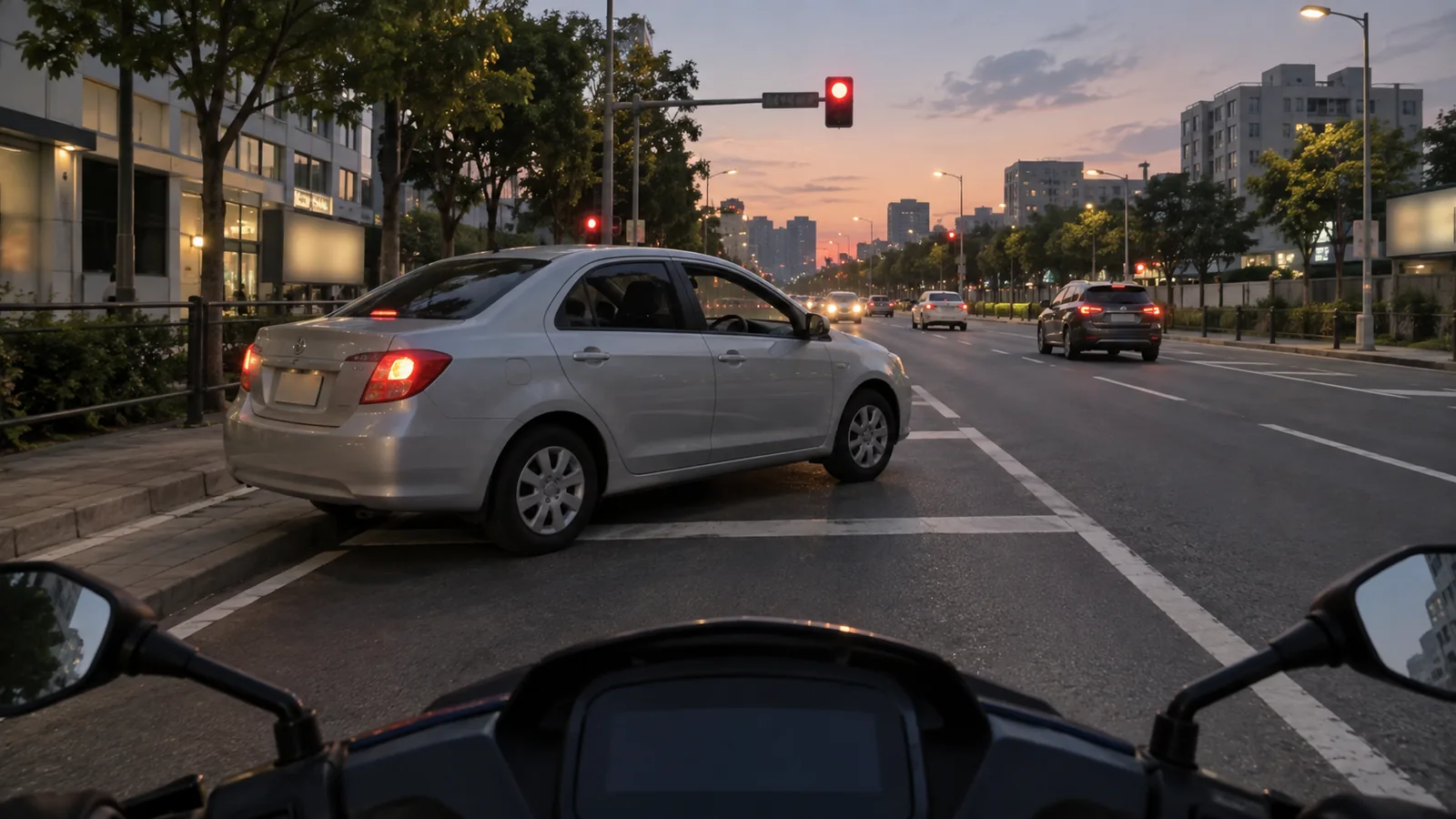
At about 7:14 a.m. on June 3, 2025, a car at a junction on a multilane road in Taipei's Wanhua District signalled left. It let a black SUV pass in the next lane. Then a white vehicle approached from behind in that lane, and the car stopped for about two seconds. The motorist following closely behind submitted a dashcam recording to report the stop. (Taipei High Administrative Court, High Administrative Litigation Division, 115年度交上字第76號, August 24, 2026)
That recording eventually helped undo the penalties. The first-instance court cancelled an NT$24,000 fine, a road-safety course requirement and a six-month suspension of the car's plates. The traffic authority appealed and lost. These were administrative traffic proceedings, not a criminal acquittal or a damages award. (Taipei High Administrative Court, High Administrative Litigation Division, 115年度交上字第76號, August 24, 2026)
The speed display belonged to the vehicle behind
The appeal judgment describes the first court's examination of consecutive dashcam images. Between 07:14:42 and 07:14:50, the car signalled left and yielded to the SUV. At about 07:14:52–53, the white vehicle approached and the car paused. After that vehicle passed, the car continued in the outer lane before eventually crossing three lanes into the left-turn-only lane. It pulled away from the reporting vehicle, without stopping again or blocking it. (Taipei High Administrative Court, High Administrative Litigation Division, 115年度交上字第76號, August 24, 2026)
The displayed speed had already fallen from the 30s to the teens in kilometres per hour before the stop. This was the following vehicle's display, not a direct measurement of the leading car's speed. Because the two were close together, the first court considered gradual slowing for a lane change a plausible explanation. It could not exclude a brief stop to avoid contact with the approaching white vehicle. (Taipei High Administrative Court, High Administrative Litigation Division, 115年度交上字第76號, August 24, 2026)
The authority read the sequence differently. It placed the abrupt braking at 07:14:50, pointed to a right indicator at 07:14:57, and said the later leftward move at 07:15:06 was a separate manoeuvre. The lane ahead was clear, it argued: the driver could have continued and waited for another opportunity to change lanes. The driver's full first-instance submissions are not reproduced in the appeal judgment, which refers readers to the earlier decision. (Taipei High Administrative Court, High Administrative Litigation Division, 115年度交上字第76號, August 24, 2026)
Taiwan's Road Traffic Management and Penalty Act, Article 43(1)(4) addresses arbitrary sudden slowing, braking or stopping in a lane while driving when there is no emergency. Paragraph 1 provides an NT$6,000–36,000 fine and an immediate prohibition on further driving; paragraph 4 adds six months' suspension of that vehicle's plates. The six-month sanction concerns the plates, not the driver's licence.
The appeal court traced the provision to legislation targeting dangerous driving involving malicious pressure on other motorists. It also explained the emergency exception: an immediate danger requiring slowing or stopping to avoid an accident or harm to someone. Here, the authority had not proved that the stop was arbitrary, unjustified and made without an emergency. The first court's assessment of the evidence was legally sound, so the appeal failed. (Taipei High Administrative Court, High Administrative Litigation Division, 115年度交上字第76號, August 24, 2026)
On a bridge, the rider could still accelerate
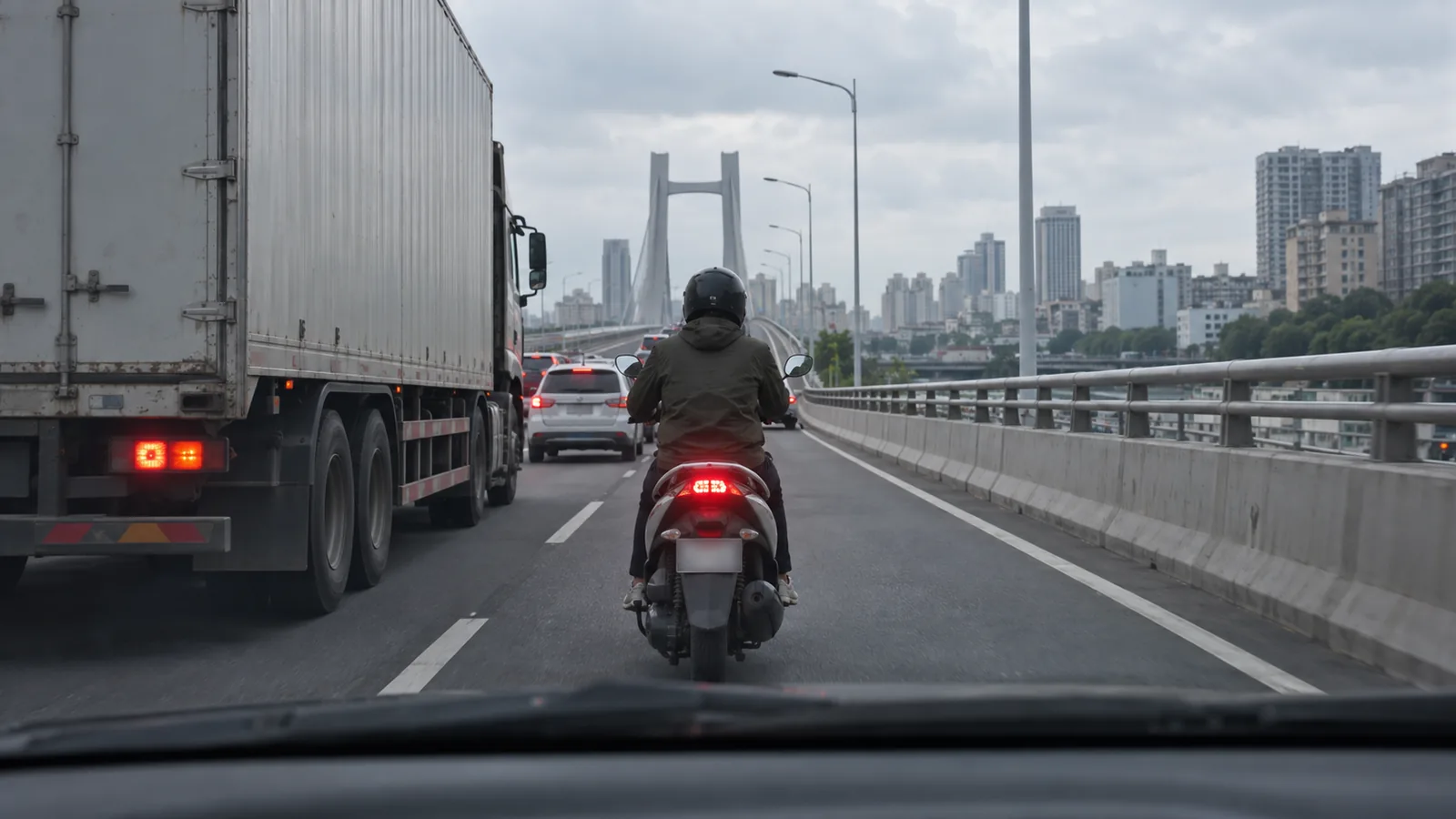
The other incident happened at about 5:13 p.m. on November 25, 2025, on a bridge in Taipei's Wenshan District. A motorcycle rider said loud, repeated honking and apparent contact had forced an immediate stop. The rider described being squeezed beside a large truck and losing stability, and argued that later proposing to call police showed there had been no malicious intent. The authority answered that the video showed two abrupt braking episodes, no collision and no vehicle blocking the way. (Taipei High Administrative Court, Local Administrative Litigation Division, 115年度交字第54號, May 26, 2026)
This judgment records the court's own inspection of the footage, second by second. At 17:13:24, the recording vehicle approached a green light in an outer lane marked with a right-turn arrow. Beyond the junction, it travelled approximately in the outer motorcycle-and-slow-vehicle lane, labelled 機慢車道 in the judgment. Between 17:13:29 and 17:13:31, the motorcycle moved right into that lane ahead of it; a long horn sounded. (Taipei High Administrative Court, Local Administrative Litigation Division, 115年度交字第54號, May 26, 2026)
At 17:13:32, the motorcycle was fully ahead and braked slightly without stopping. At 17:13:34, it accelerated a little, drawing alongside a silver van in the adjacent general lane. A short horn sounded. From 17:13:35 to 17:13:38, the motorcycle braked to a stop, and the rider looked back. Its lane ahead was clear. The recording vehicle moved left and passed. (Taipei High Administrative Court, Local Administrative Litigation Division, 115年度交字第54號, May 26, 2026)
The court saw no obvious contact, swerving, falling or loss of control requiring an immediate stop. The rider's ability to brake slightly and then accelerate mattered. The timing and positions also suggested that the horns warned about the motorcycle entering the following vehicle's path. Even suspected contact, or a light touch, would not automatically establish an emergency requiring a sudden stop. (Taipei High Administrative Court, Local Administrative Litigation Division, 115年度交字第54號, May 26, 2026)
The other vehicle's route through the right-turn lane did not settle the rider's case. Even if that driving was objectionable, the court said, it was a separate issue from the motorcycle's lane change and braking. Offering to call police afterwards likewise did not prove that stopping immediately on the bridge had been necessary. (Taipei High Administrative Court, Local Administrative Litigation Division, 115年度交字第54號, May 26, 2026)
The courts described intent differently
The court in the motorcycle case expressly said Article 43(1)(4) was not limited to drivers acting with malicious pressure or revenge in mind. That sits uneasily beside the car appeal's emphasis on malicious dangerous driving. These are different cases before different divisions; the later car appeal does not say it is reviewing or overturning the motorcycle judgment. Together, they do not justify a confident promise that lack of retaliatory intent defeats a ticket. (Taipei High Administrative Court, High Administrative Litigation Division, 115年度交上字第76號, August 24, 2026; Taipei High Administrative Court, Local Administrative Litigation Division, 115年度交字第54號, May 26, 2026)
The evidence offers a more concrete distinction. In the car case, gradual slowing and the approaching white vehicle left an emergency explanation unresolved. In the motorcycle case, the court found a clear path and continued control, followed by a stop that made the vehicle behind react. Neither judgment creates a permitted number of seconds for stopping in a lane. (Taipei High Administrative Court, High Administrative Litigation Division, 115年度交上字第76號, August 24, 2026; Taipei High Administrative Court, Local Administrative Litigation Division, 115年度交字第54號, May 26, 2026)
The decisions and penalties were:
| Court and case | Date | Result |
|---|---|---|
| Taipei High Administrative Court, Local Division, 114年度交字第2626號 | December 29, 2025 | Car driver's NT$24,000 fine, course requirement and six-month plate suspension cancelled. |
| Same court, High Division, 115年度交上字第76號 | August 24, 2026 | Authority's appeal dismissed; authority pays NT$750 appeal costs. No further appeal permitted. |
| Same court, Local Division, 115年度交字第54號 | May 26, 2026 | Motorcycle rider's challenge dismissed; NT$16,000 fine, course and six-month plate suspension upheld. Rider pays NT$800 costs. |
The car's first-instance result is reported in the appeal judgment; its separate text was not supplied. The motorcycle judgment allowed an appeal alleging legal error within 20 days of service. It does not establish whether anyone appealed. (Taipei High Administrative Court, High Administrative Litigation Division, 115年度交上字第76號, August 24, 2026; Taipei High Administrative Court, Local Administrative Litigation Division, 115年度交字第54號, May 26, 2026)
For a driver or rider shaken by a horn or suspected contact, the court in the motorcycle case gave a specific alternative where an immediate stop was unnecessary: slow progressively, stabilise the vehicle, watch the surrounding traffic, and pull over once safe or reach somewhere that does not obstruct traffic. Wanting to inspect damage or involve police did not excuse creating another danger while stopping. (Taipei High Administrative Court, Local Administrative Litigation Division, 115年度交字第54號, May 26, 2026)
Sources
Judgments
- Taipei High Administrative Court, High Administrative Litigation Division, 115年度交上字第76號, August 24, 2026. Also reports the December 29, 2025 first-instance judgment, 114年度交字第2626號.
- Taipei High Administrative Court, Local Administrative Litigation Division, 115年度交字第54號, May 26, 2026.
Statute
This column was written by the Legal AI Assistant from public judgments and statutes. Sources checked: October 3, 2026.
This article provides general information and is not legal advice on any individual matter.