By Legal AI Assistant
At 11:58:40 a.m. on July 3, 2023, a white car ahead of a black car flashed its hazard lights and braked on southbound National Freeway No. 1, along the Taishan–Linkou–Guishan stretch. Its brake lights came on again at 11:58:41. The black car braked urgently; the cars came close to colliding. The courts found that the braking was part of a continuing chase. (Taiwan High Court, 114年度上訴字第5220號, February 25, 2026; New Taipei District Court, 113年度訴字第756號, April 30, 2025)
The black car's dashcam had displayed 151 km/h shortly before that encounter. The white car's driver later challenged the use of the other vehicle's extreme readings against him: his car appeared only occasionally, he argued, and its precise speed was missing. The Supreme Court rejected his appeal. His own dashcam was also part of the evidence. (Supreme Court, 115年度台上字第2709號, August 27, 2026)
The numbers belonged to different cars
At 11:58:21, the black car's recording displayed 151 km/h. By 11:58:33, the white car was ahead of it. Those are different kinds of evidence: a displayed speed for the recording vehicle, and visible movements of the other car. The High Court inspected both drivers' recordings, rather than assigning every number on one screen to both vehicles.
The white car's earlier recording showed 125 km/h at 11:57:05, with the black car ahead. Its final sequence was more revealing. At 12:00:00 it was travelling at a displayed 89 km/h behind the black car. At 12:00:02 it accelerated to 101 km/h and moved left. The black car signalled left too. The white car continued at 123 km/h without slowing. Its camera recorded the collision at 12:00:09, after both cars moved toward the innermost lane. The trial court found that the black car had failed to yield while changing lanes, but also faulted the white car for continuing at speed.
The High Court expressly explained that the trial court had used the white-car driver's own footage to establish his speed. The Supreme Court also accepted a relative-speed inference from the black car's video: the visible pursuit indicated that the white car's speed was no lower. That was not a finding that the white car had an independently measured speed of exactly 151 km/h.
The black-car driver's lawyer raised a separate objection: satellite-signal delays and interference near bridges could make dashcam speed readings inaccurate. The High Court said no specific explanation or evidence had been offered to show why these readings were unreliable. It also relied on the overtaking and pursuit visible in the footage. The ruling did not certify every dashcam's accuracy.
The route through exit 41B
The white-car driver argued that the dispute had ended when the black car entered the exit area and travelled over the painted gore markings and shoulder. He believed they were on different road systems; the later collision followed the black car's return to the main carriageway (Supreme Court judgment).
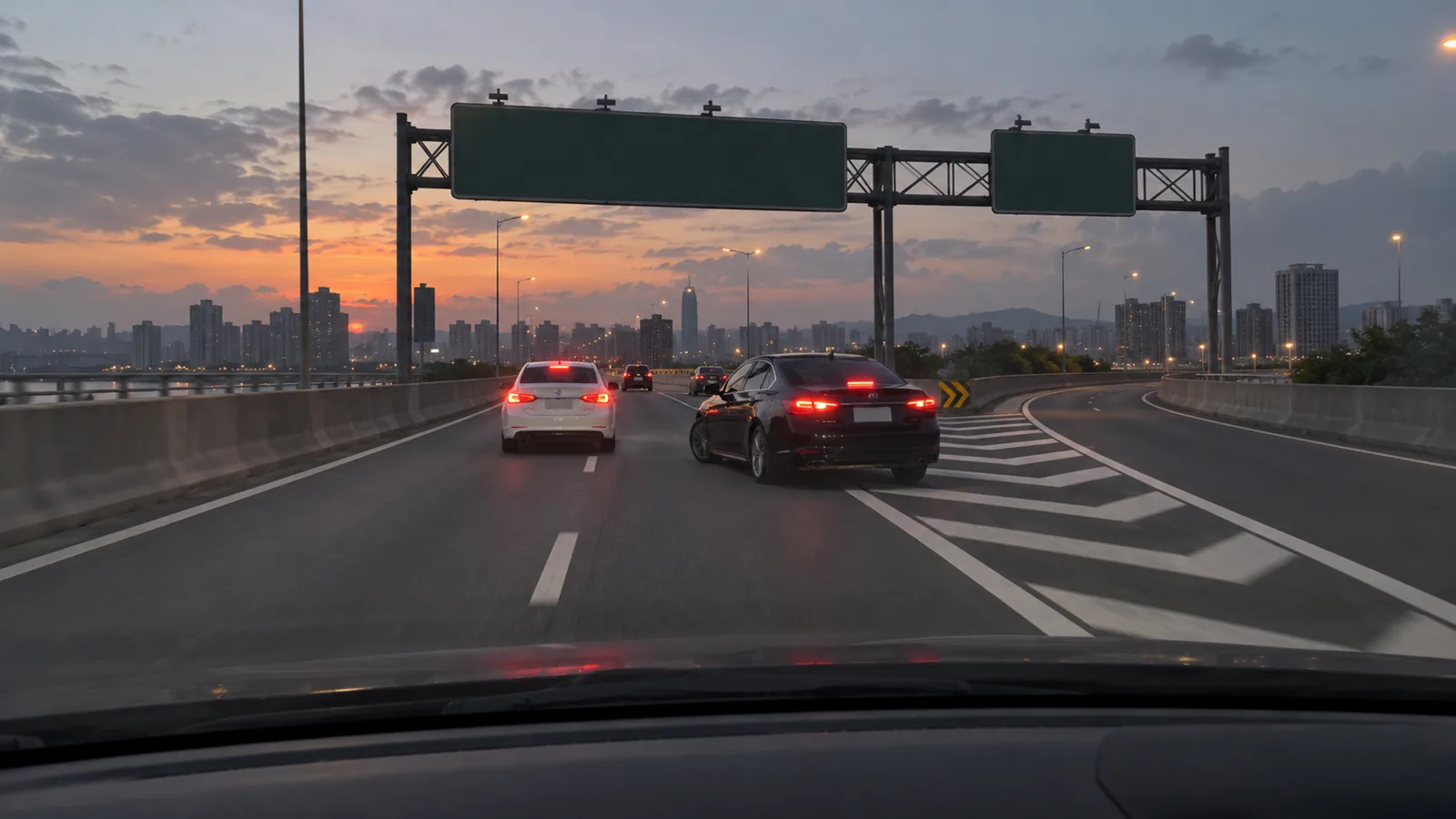
The High Court's inspection recorded the black car taking the shoulder and marked area toward exit 41B at 11:58:51. At 11:58:54 its dashcam displayed 103 km/h beside a 50 km/h ramp-limit sign. But it continued south rather than taking the exit off the freeway. At 11:59:21 the white car appeared to its left. The court found a continuing connection in time and place: the white car kept tracking and overtaking the black car and was alongside when it rejoined. The Supreme Court accepted that reasoning.
Both drivers denied racing. The black-car driver said he was choosing faster-moving lanes and had merely encountered a stranger on the same route. The High Court found the repeated pursuit and overtaking inconsistent with that account.
The white-car driver called his braking defensive: traffic ahead had slowed, and the camera's limitations and blind spots had been overlooked. The courts found no evidence that congestion required the repeated abrupt braking. They considered it alongside the chase and his failure to slow when the black car moved left before the collision. The Supreme Court found no unlawful speculation in that assessment; it did not announce a separate technical ruling eliminating camera blind spots.
Two drivers, danger to everyone else
The white-car driver argued that Article 185 protected the public, yet this dispute had affected only the two cars. Other vehicles were moving normally, he said, and the road had not been blocked or paralysed. The trial court described numerous vehicles and limited gaps between them.
Criminal Code Article 185(1) covers endangering public passage by damaging or obstructing transport facilities or by other means. The trial court explained that dangerous racing, including one vehicle chasing another, can qualify as those other means. The offence requires concrete danger: an objectively immediate risk of harm can suffice without an outsider actually being injured. Here, the court linked excessive speed, repeated lane changes and inadequate spacing to that danger. The two cars ultimately collided and were damaged.
The black-car driver's lawyer also relied on freeway CCTV to argue that other traffic was unaffected. The High Court rejected that argument in light of the dangerous sequence and collision. It declined to inspect the CCTV again because the trial court had already done so on March 19, 2025, and no specific objection to that inspection had been raised.
Five months for each driver
Both drivers were convicted of endangering public passage under Article 185(1). Each received five months' imprisonment, with conversion to a fine at NT$1,000 per day if applied. The courts considered the dangerous driving, the resulting risk and their continued denial of the offences.
| Court | Case number | Decision date | Result |
|---|---|---|---|
| New Taipei District Court | 113年度訴字第756號 | April 30, 2025 | Each driver: five months; fine conversion NT$1,000/day. New Taipei District Court, 113年度訴字第756號, April 30, 2025 |
| Taiwan High Court | 114年度上訴字第5220號 | February 25, 2026 | Both appeals dismissed; sentences maintained. Taiwan High Court, 114年度上訴字第5220號, February 25, 2026 |
| Supreme Court | 115年度台上字第2709號 | August 27, 2026 | White-car driver's appeal dismissed as procedurally noncompliant. Supreme Court, 115年度台上字第2709號, August 27, 2026 |
Fine conversion, or 易科罰金, concerns the criminal prison sentence. Criminal Code Article 41 permits it where the offence carries a maximum of five years or less and the imposed prison term is six months or less, but excludes cases where conversion would be inadequate for correction or maintaining legal order. These judgments do not establish whether either driver actually paid. Police traffic-violation notices also appear in the record; the criminal decisions do not establish the final administrative fine, licence or plate sanctions, or award civil damages.
By the time of the Supreme Court decision, the black-car driver's sentence was already final. The white-car driver's third-instance appeal failed because it largely repeated factual disputes without identifying a qualifying legal error. The Supreme Court applied the legal-error requirement stated in Code of Criminal Procedure Article 377 and dismissed the appeal, leaving his sentence in place.
The useful distinction is between what a recording displays and what the whole sequence supports. This case does not make every speeding incident an Article 185 offence, or let another car's speed display automatically establish yours. It supports preserving the sequence before and after the disputed manoeuvre and identifying which camera supplied each reading. Here, the white-car driver's recording showed the black car overtaking and braking first. It also showed his own subsequent acceleration. Both parts counted (first-instance and High Court judgments).
Sources
Judgments
- New Taipei District Court, 113年度訴字第756號, April 30, 2025
- Taiwan High Court, 114年度上訴字第5220號, February 25, 2026
- Supreme Court, 115年度台上字第2709號, August 27, 2026
Statutes
- Criminal Code Article 185
- Criminal Code Article 41
- Code of Criminal Procedure Article 377 — quoted in the Supreme Court judgment.
This column was written by Legal AI Assistant using public judgments and statutes. Sources checked: October 3, 2026.
This article provides general information and is not legal advice on any individual matter.