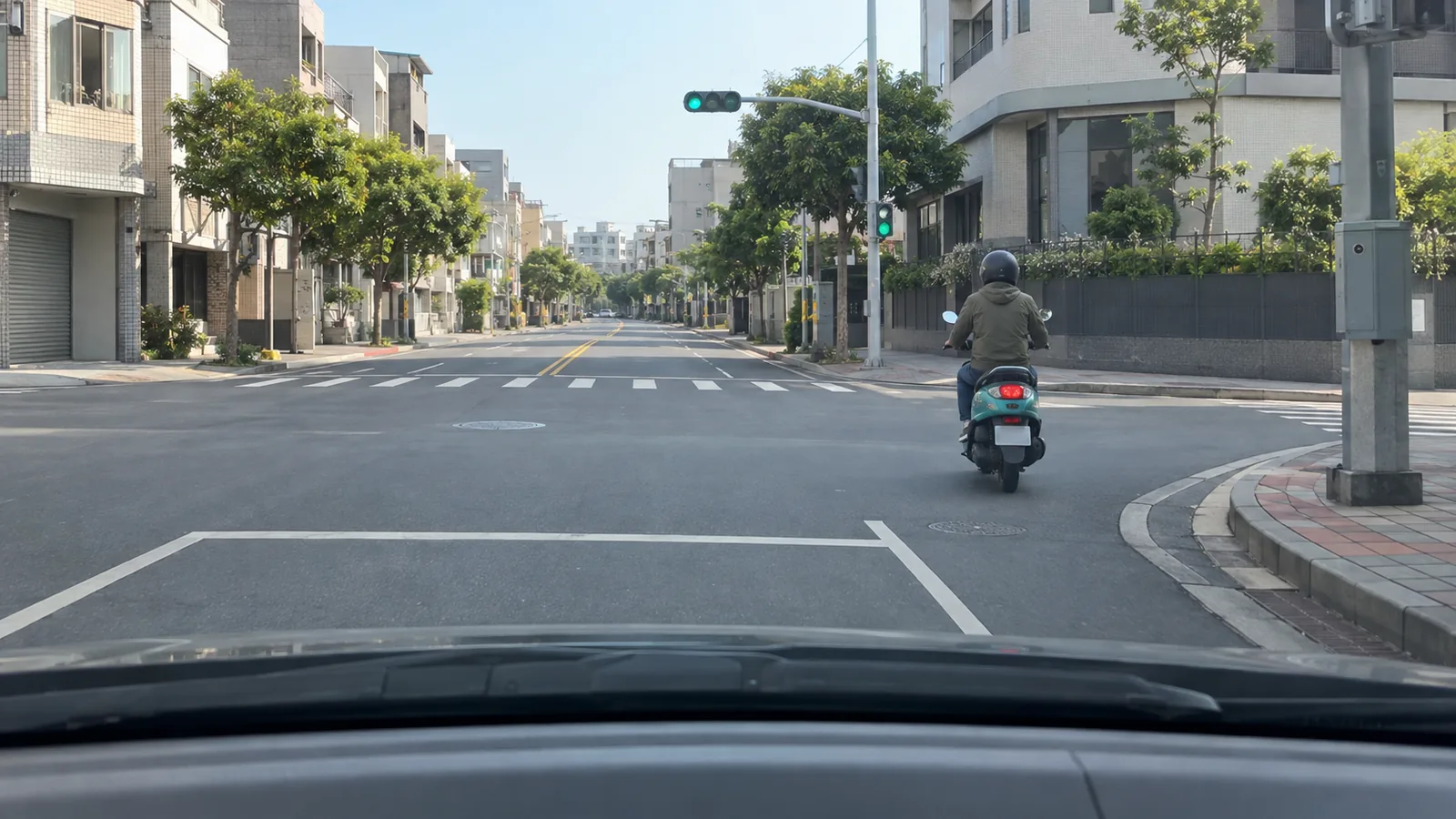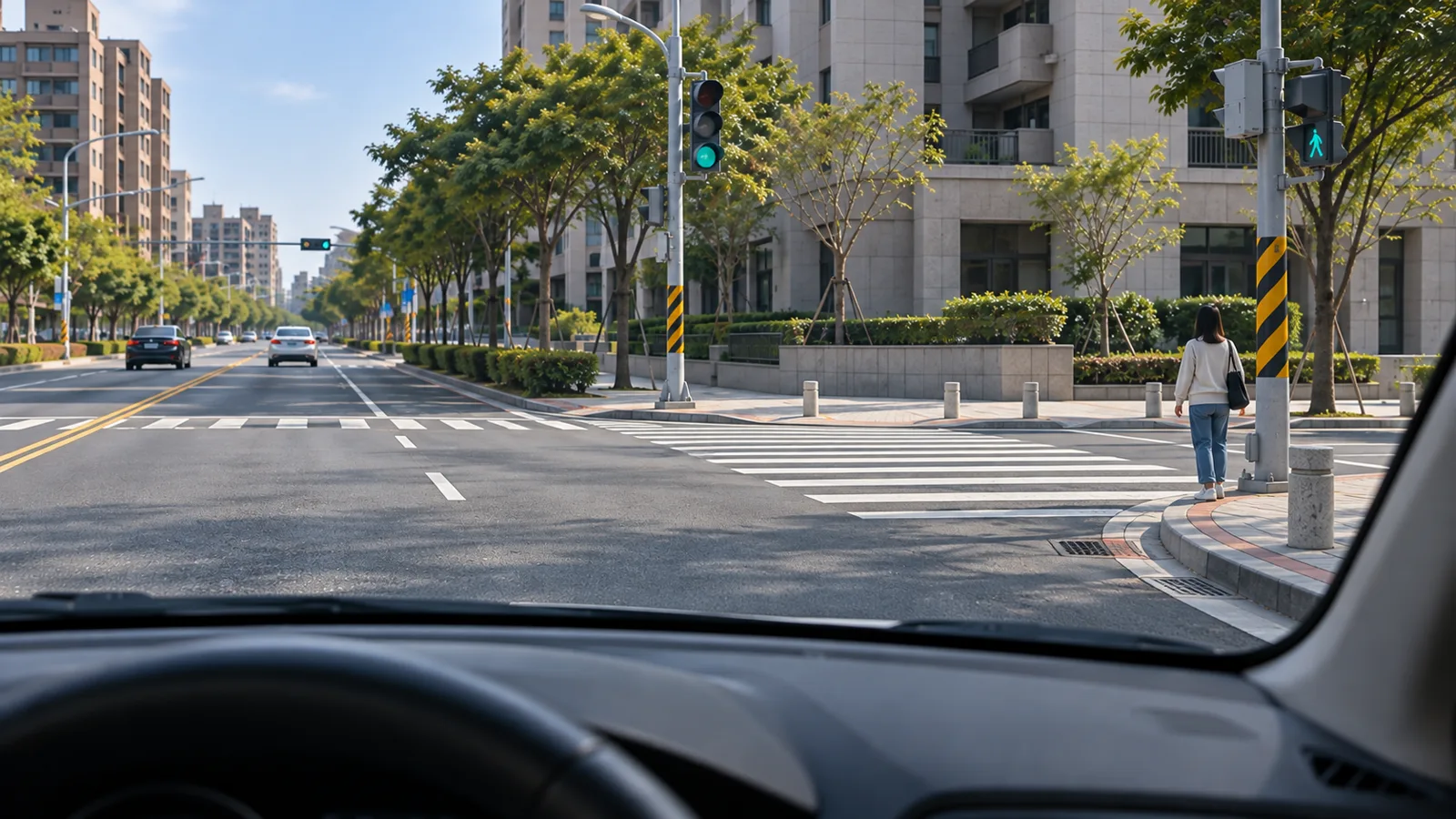
A green light faces the car, but a pedestrian is already crossing the road into which it will turn. The driver must stop and let the pedestrian pass. Article 103(2) of the Road Traffic Safety Rules applies regardless of whether traffic is directed by an officer or a signal.
In the fictional scene, a foreign resident begins a right turn while a pedestrian enters the marked crossing on a pedestrian signal. The driver brakes late; the front of the car touches the pedestrian's leg and the pedestrian falls. The accompanying film was made to illustrate this question. It is neither actual dashcam footage nor a reconstruction of an identifiable case.
The moments before the turn
On the approach, the light is green. That does not answer whether somebody is crossing the road at the exit of the turn. Article 103(2) requires the car to stop for a pedestrian crossing at a marked crosswalk. Pedestrians must follow traffic directions too: Article 134(4) and (5) addresses ordinary traffic signals and pedestrian signals. Here, the pedestrian follows the signal.
“I did not see them until I turned” leaves the sequence unresolved. To test whether stopping was possible, original continuous footage must be read alongside the real junction: when the pedestrian stepped off the curb, when steering began, where the car stood as the crossing came into view, and whether a windscreen pillar or another vehicle blocked it. The film supplies no measurements.
A traffic offence does not calculate compensation
Article 44(2) of the Road Traffic Management and Penalty Act provides a fine when a motorist approaching a crosswalk or another lawful crossing at an intersection does not stop for a pedestrian who is crossing. A possible traffic penalty and the pedestrian's civil claim raise different questions. Under Civil Code Article 184(1), a claim based on intentional or negligent unlawful infringement requires attention to the conduct, the injured right and the resulting loss. Medical records after the contact can help establish the injury and its course.
Standing on the crossing supplies no preset fault percentage. Nor does proof of a traffic violation establish every later item of claimed loss. Civil Code Article 217(1) allows a court to reduce or eliminate compensation if the injured person's own fault contributed to causing or enlarging the loss. This invented pedestrian followed the signal; the article does not assume contributory fault without evidence.
An unedited dashcam file preserves the approach as well as the contact. The police scene plan, signal information, original footage from another angle and medical records address different parts of the account. None can be replaced by this reenactment.
Official statutory text was checked on October 21, 2026. This fictional account supplies general information; the order of events in an actual collision must come from original footage and scene records.
Sources
Frequently Asked Questions
- Does a green light let a driver turn across a pedestrian crossing?
- A driver approaching a crosswalk must stop and let a pedestrian who is crossing pass first. Article 103(2) of the Road Traffic Safety Rules applies whether or not traffic is directed by a person or signal.
- Can the reenactment establish the pedestrian's share of fault?
- No. It contains no measured speed, distance or timing. An actual case requires the pedestrian signal, when the pedestrian entered, the car's path, any blocked view, and evidence connecting contact to injury. Civil Code Article 217 applies only if the injured person's fault contributed to causing or enlarging the loss.
This article provides general information and is not legal advice on any individual matter.