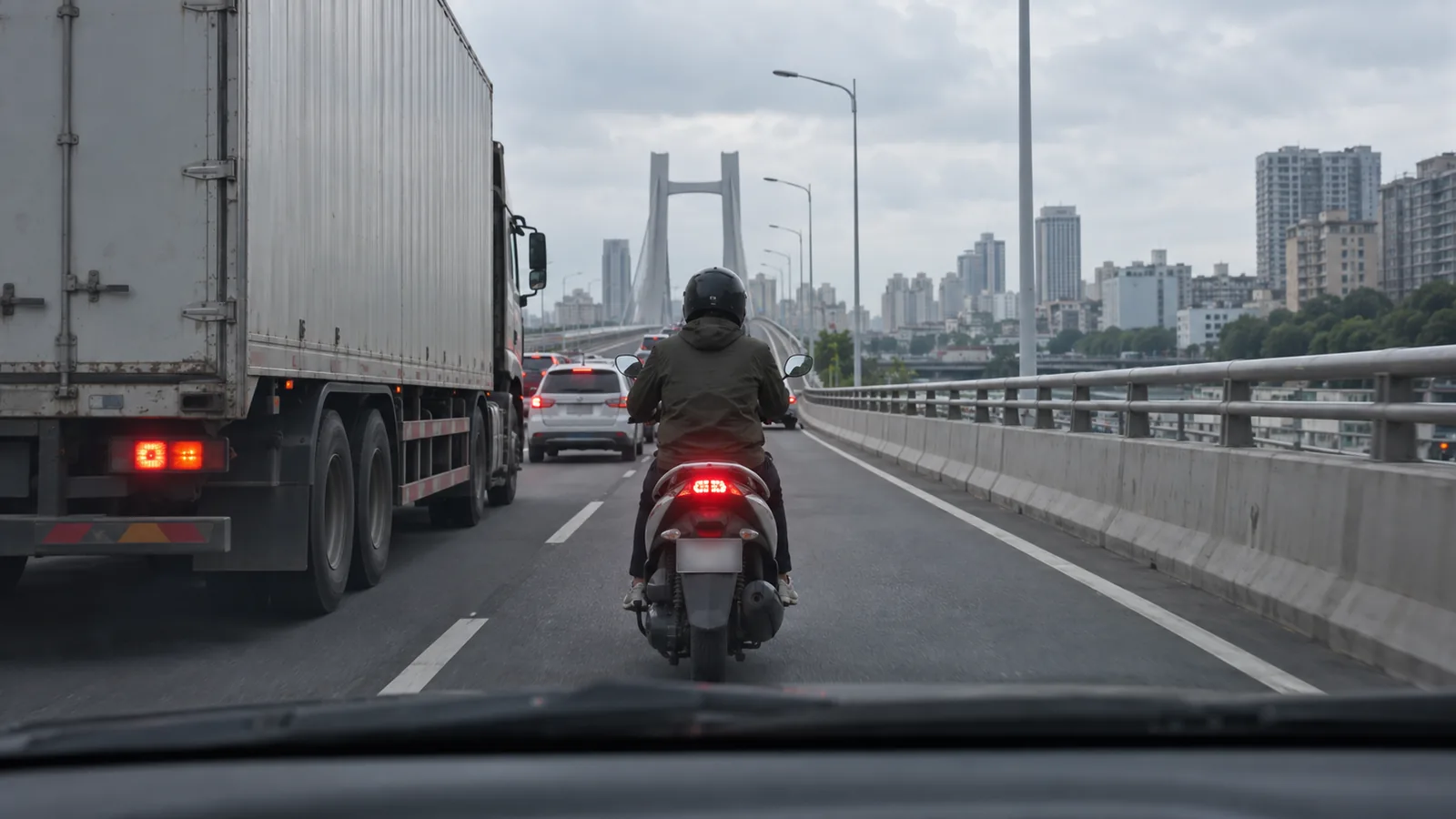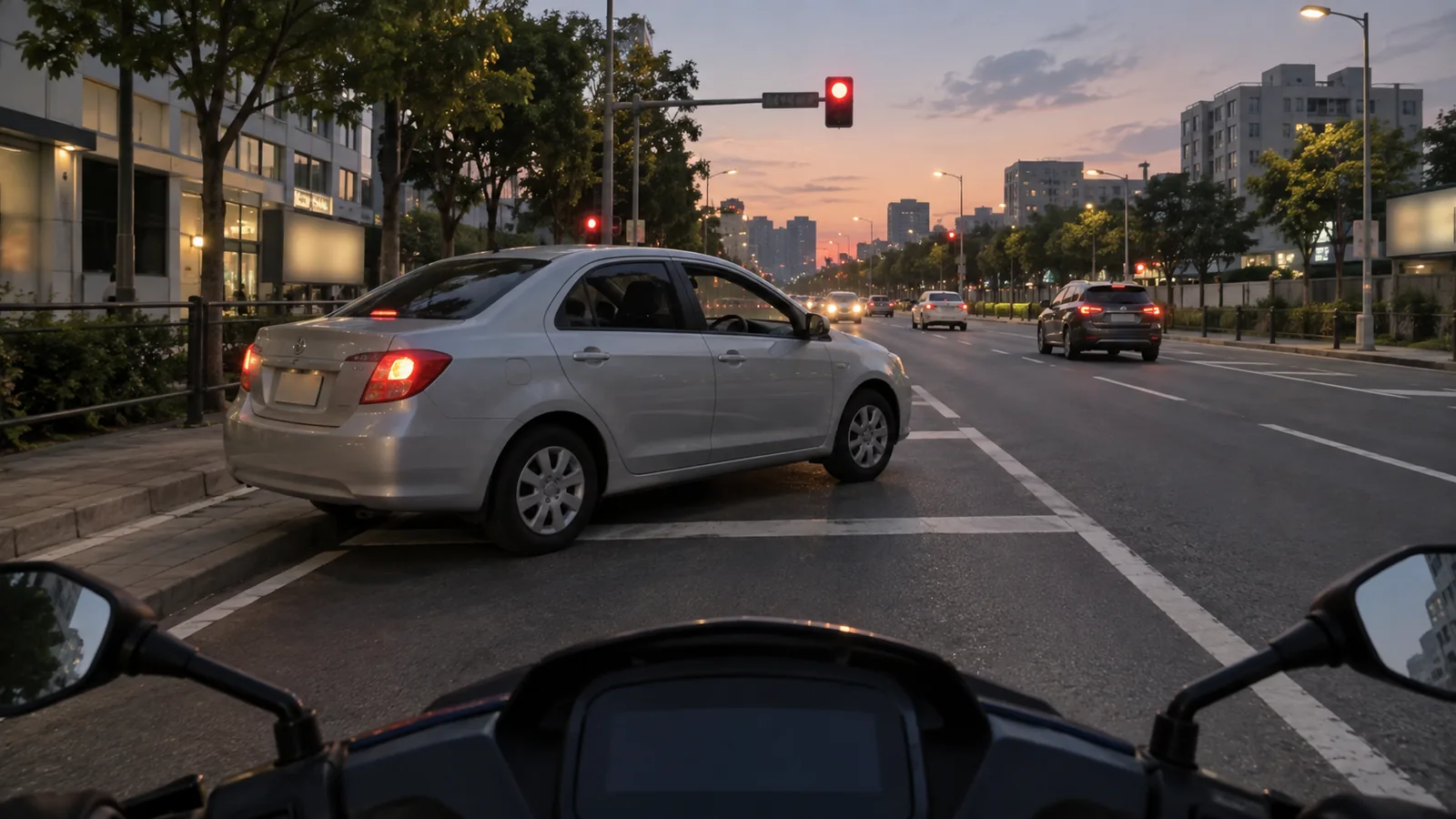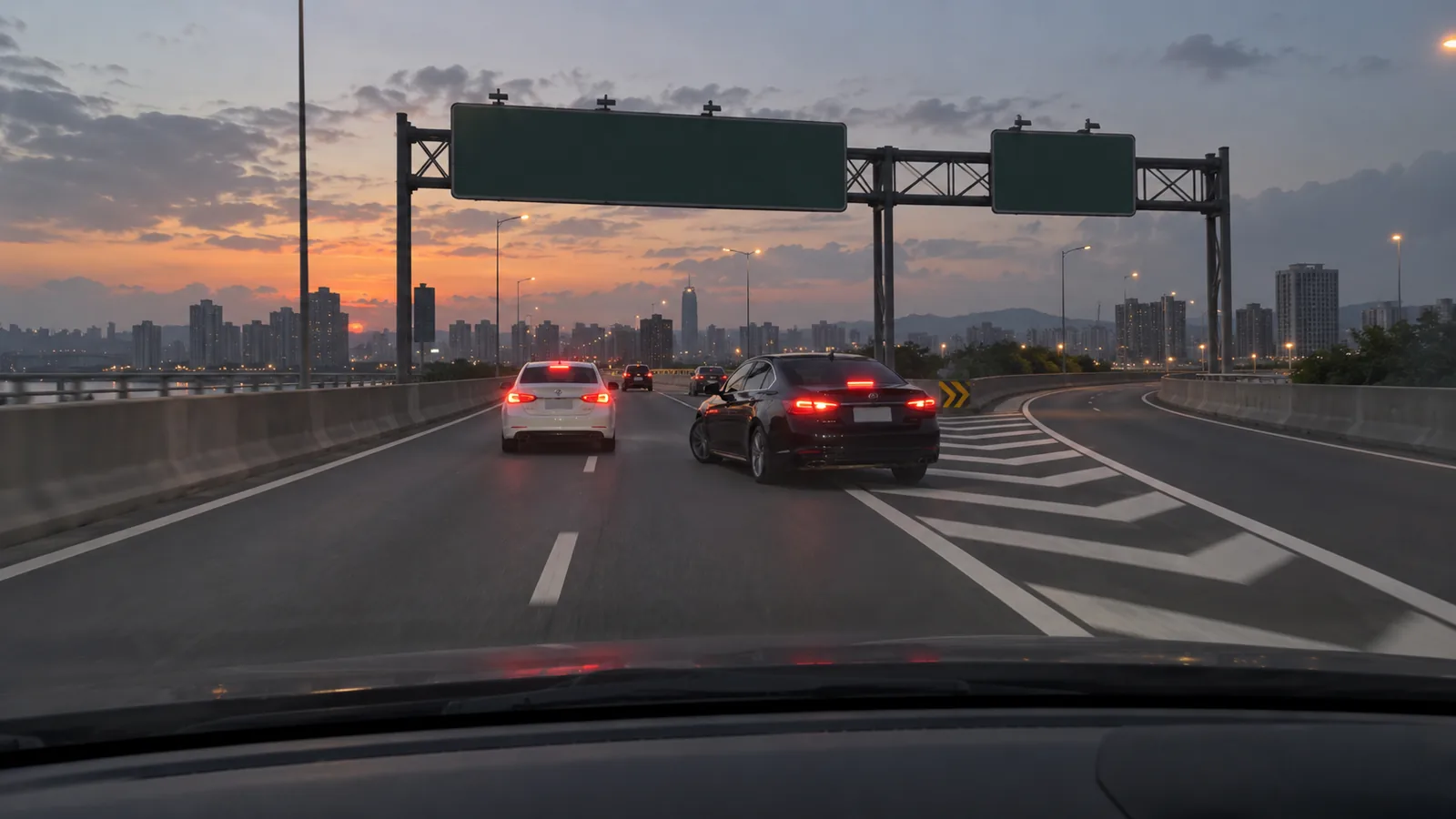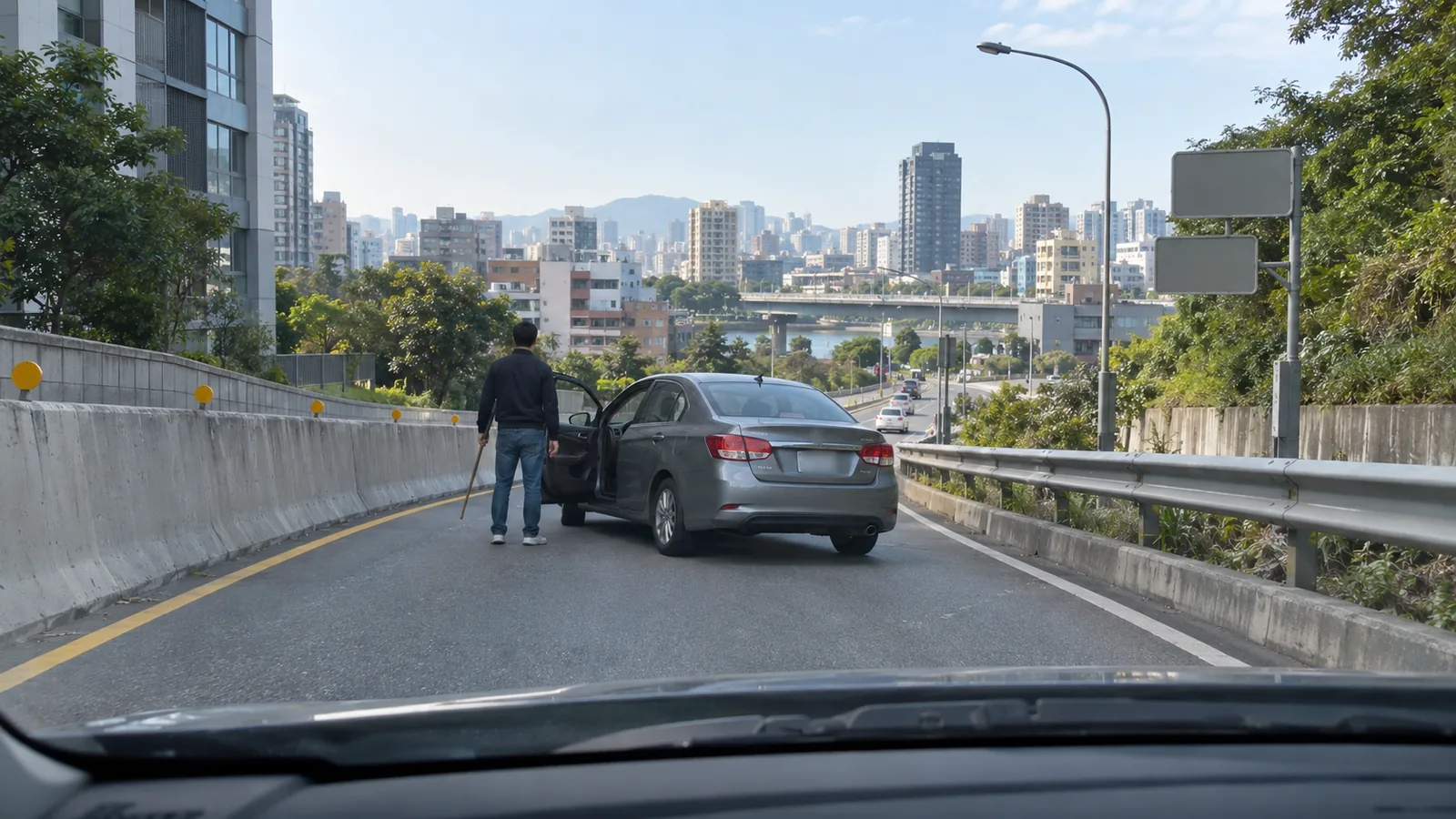
A passenger car changes lanes and stops in front of another in the lane that leads from the Nangang exit of a freeway interchange towards Jiuzong Road. Its driver gets out holding an unidentified stick-like object. The car behind drives on for six minutes. Then the first car is on the left of the double yellow line in the frame, travelling against the flow of traffic, before it moves back into the right-hand lane. When the second car goes to turn left, the first follows it into the turn and blocks its way, and both come to a halt in the middle of the road. The driver gets out again, this time holding a wooden baseball bat, and says:
你媽的,你叭什麼意思,你叭誰啊
An expletive, then "What do you mean by honking? Who are you honking at?" (Shilin District Court 115年度易字第383號, June 26, 2026).
The Shilin District Court (臺灣士林地方法院) recorded that sequence after inspecting the second driver's dashcam footage at the hearing, a step the judgment calls 勘驗. It refers to the driver who did the blocking as the defendant and to the driver who was blocked as the complainant (告訴人). It gives no date and no time of day. The court used the abbreviated form that Article 310-1 of the Code of Criminal Procedure permits for lighter outcomes, among them imprisonment of six months or less that can be converted into a fine, and adopted the indictment's account of the facts as an attachment. The copy of the judgment this column relies on does not include that attachment, so six minutes is the only time figure available.
What the inspection recorded, and where it is silent
The six minutes measure how long the complainant kept driving after the first stop. The court's account of the footage gives no on-screen clock readings, no duration for either stop and no name for the road where the second stop happened, and it does not say how the first stop ended.
The object in the defendant's hand is described differently in the two scenes: 不明棒狀物體, an unidentified stick-like object, at the first stop, and 木頭棒球棍, a wooden baseball bat, at the second. The horn appears only in the defendant's words. Whether the complainant actually honked, and when, the judgment does not say.
Besides the two drivers' accounts, the evidence list names a disc with files from the complainant's dashcam and an intersection surveillance camera (路口監視器), 10 screenshots, the court's inspection record and the seizure records of the Taipei City Police Department's Neihu Precinct. In describing the scene, the reasoning cites the inspection of the complainant's dashcam and screenshots from it.
A defence built on stopping rather than crowding
The defendant accepted that there had been a traffic dispute (行車糾紛) with the complainant at the time and place stated in the indictment, and denied both coercion and making threats. The judgment records the defence this way:
本案地點是公共的地方,告訴人先逼我車,我有逆向超車,但我是攔他車,不是逼他車,告訴人在南港隧道窗戶搖下來對我念念有詞,我沒有恐嚇他,也沒有妨害他自由
In English: the place in this case is a public place; the complainant crowded my car first; I did overtake against the flow of traffic, but I was stopping the complainant's car, not crowding it; in the Nangang Tunnel the complainant rolled the window down and muttered at me; I did not threaten the complainant or interfere with the complainant's freedom. 逼車, translated here as crowding, is the everyday word for pressing in on another vehicle. The defendant's argument was that 攔, stopping or intercepting a car, is a different thing.
The prosecutor, who had brought the case as an offence against personal liberty (妨害自由), asked for a heavier sentence. The complainant asked the court to sentence according to law (Shilin District Court 115年度易字第383號, June 26, 2026).
Suppose the complainant really had crowded the defendant's car first. Would that change how you judge the second stop?
The question the court left unanswered
The court did not decide whether the complainant had crowded the defendant's car first. It said the defendant's points, that the place was public, whether the complainant had rolled down the window and muttered, whether the complainant had crowded first, were 全然無涉, entirely unrelated, to its finding.
What it relied on was the defendant's own conduct. Twice the defendant blocked the complainant's direction of travel by 逼車, the word the defendant had rejected, then got out with the bat and walked towards the complainant's car. A bat, the court said, is 客觀上對人之身體具有殺傷力之物品, an object that objectively has the power to wound or kill a person, and it found a strong note of warning in the act (警告意味濃厚). The reasoning does not say the bat was swung or that it struck anything.
The test was how an objective, reasonable third person (客觀理性第三人) would see it, given the setting of the confrontation, what came before and after, and what the defendant did: crowding first, the wrong-way overtake included, then walking towards the complainant with the bat, with a curse added in the second episode. From that viewpoint the complainant could not keep driving and was left worried about being beaten or otherwise mistreated. The conduct obstructed the complainant's freedom of movement, the court concluded, and also amounted to a notice of harm to life and body that put the complainant in fear.
Two offences found, one named in the sentence
The court found two offences. Coercion (強制罪) under Article 304, paragraph 1, of the Criminal Code is using violence or threats to make someone do what they have no duty to do, or to obstruct their exercise of a right, and is punishable by up to three years' imprisonment, short-term detention (拘役) or a fine. Threatening harm to a person's life, body, freedom, reputation or property so as to endanger their safety (恐嚇危害安全罪), under Article 305, is punishable by up to two years' imprisonment, detention or a fine.
The court treated the defendant's several moves as one continuing act (接續犯), since they sprang from the same dispute and the same intent, infringed the same legal interest and were too close in time and place to pull apart. Because that one act met two offences at once (想像競合犯), the first part of Article 55 called for punishment under the heavier one, coercion. That is why the operative part of the judgment names only coercion. The court did not acquit the defendant of the threat.
The sentence is three months' imprisonment, convertible into a fine (易科罰金) at NT$1,000 a day, and the seized bat is confiscated. Article 41, paragraph 1, lets a sentence of six months' imprisonment or less, or of detention, for an offence with a maximum of five years or less be converted at NT$1,000, NT$2,000 or NT$3,000 a day, except where a fine would hardly achieve correction or maintain legal order. The court set the lowest rate, and the judgment states no total. The bat was confiscated under Article 38, paragraph 2, as the defendant's property used in the offence.
In fixing the sentence the court said the defendant had, over nothing more than a traffic dispute, used crowding and a bat to intimidate the complainant, and had then denied the offence with excuses, which it called a poor attitude after the offence (犯後態度不佳). It also weighed the defendant's record, the defendant's willingness to mediate, which came to nothing because the two sides were too far apart on terms, the views of the complainant and the prosecutor, and the defendant's personal circumstances.
| Item | Detail |
|---|---|
| Court and case number | 臺灣士林地方法院 115年度易字第383號 (criminal judgment) |
| Date of judgment | June 26, 2026 |
| Offences found | Coercion, Criminal Code Article 304(1); threat endangering safety, Article 305 |
| How they were punished | One act meeting two offences, punished under coercion as the heavier (Article 55) |
| Sentence | 3 months' imprisonment, convertible to a fine at NT$1,000 a day |
| Confiscation | 1 seized baseball bat |
| Appeal | Open to appeal, within 20 days of service |
What the judgment settles and what it leaves open
This is a district court's criminal judgment and it is open to appeal: a party who disagrees has 20 days from service to file a written appeal with the same court. Whether anyone appealed, or whether the judgment became final, cannot be read from the text.
The court assessed the two blocking incidents, the wrong-way overtake, the bat and the curse together. Its decision does not establish an automatic rule for every stop in front of another car. It does not clear the complainant of crowding first either. The court called that question unrelated and left it undecided.
Only criminal liability was decided. As background, Article 43 of the Road Traffic Management and Penalty Act (道路交通管理處罰條例) sets an administrative fine of NT$6,000 to NT$36,000, an on-the-spot ban on driving and a six-month suspension of the vehicle's licence plates for conduct that includes arbitrarily forcing another vehicle to give way by closing in or changing lanes abruptly, and arbitrarily stopping in a traffic lane when there is no emergency. The court did not apply that article, and the judgment does not say whether any traffic penalty was issued. The judgment records failed mediation as a sentencing factor. It does not state any civil damages award.
For the driver who is blocked, and the driver who gets out
The footage came from the complainant's own car. The court's inspection took in the first stop, the second stop and the six minutes between them, and its reasoning depends on that sequence: it judged the conduct by what came before and after and treated the two scenes as one act. A clip that began at the second stop would leave out the lane change at the exit and the stretch on the wrong side of the double yellow line, both of which the court counted. Anyone stopped this way with a camera running has reason to keep the whole original recording.
For the driver who feels provoked, the judgment shows what did not help. The defendant admitted the wrong-way overtake, and the court counted it as part of the crowding. Calling the manoeuvre stopping instead of crowding changed nothing, and neither did the claims that the complainant had muttered through an open window or crowded first. Walking up to the other car with a bat in hand was treated as a threat without any finding that the bat was swung. The bat was confiscated, and the denial counted against the defendant at sentencing.
Sources
Judgment
Statutes
- Criminal Code (中華民國刑法) Article 304
- Criminal Code (中華民國刑法) Article 305
- Criminal Code (中華民國刑法) Article 55
- Criminal Code (中華民國刑法) Article 41
- Criminal Code (中華民國刑法) Article 38
- Code of Criminal Procedure (刑事訴訟法) Article 310-1
- Road Traffic Management and Penalty Act (道路交通管理處罰條例) Article 43 (background only; not applied in this judgment)
This article was written by the Legal AI Assistant from public court judgments and statutes. Sources checked: 2026-10-03.
This article provides general information and is not legal advice on any individual matter.