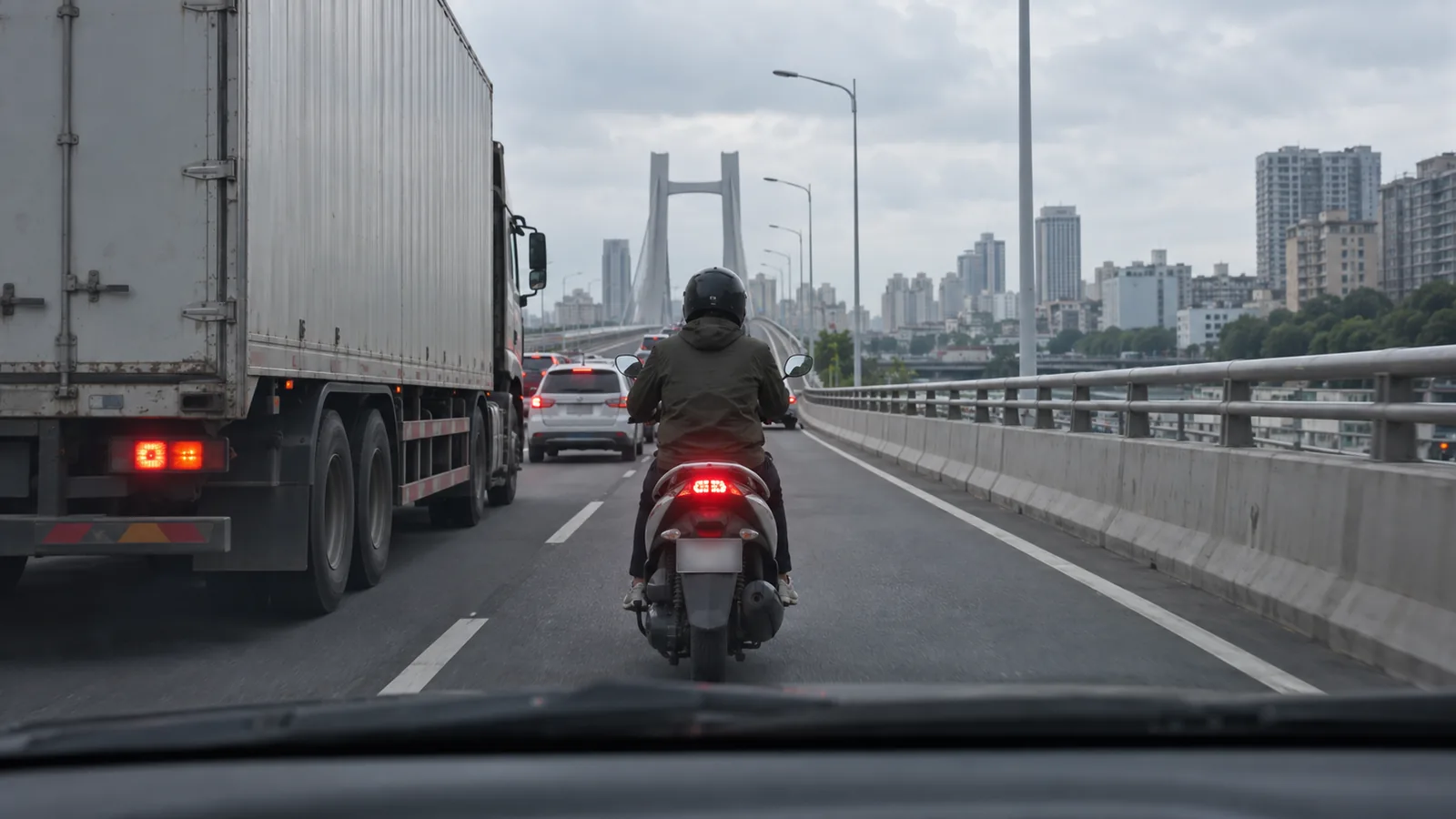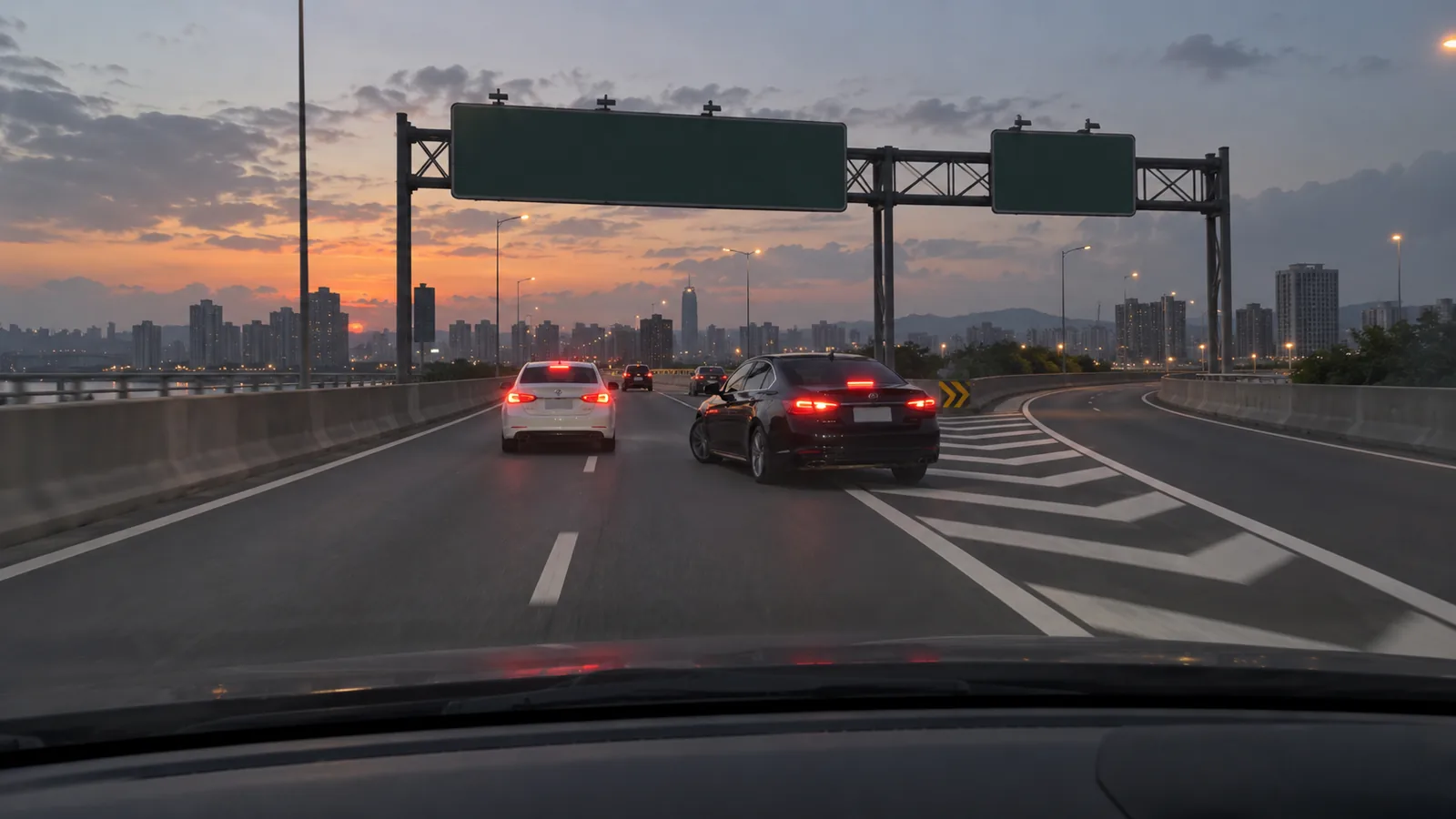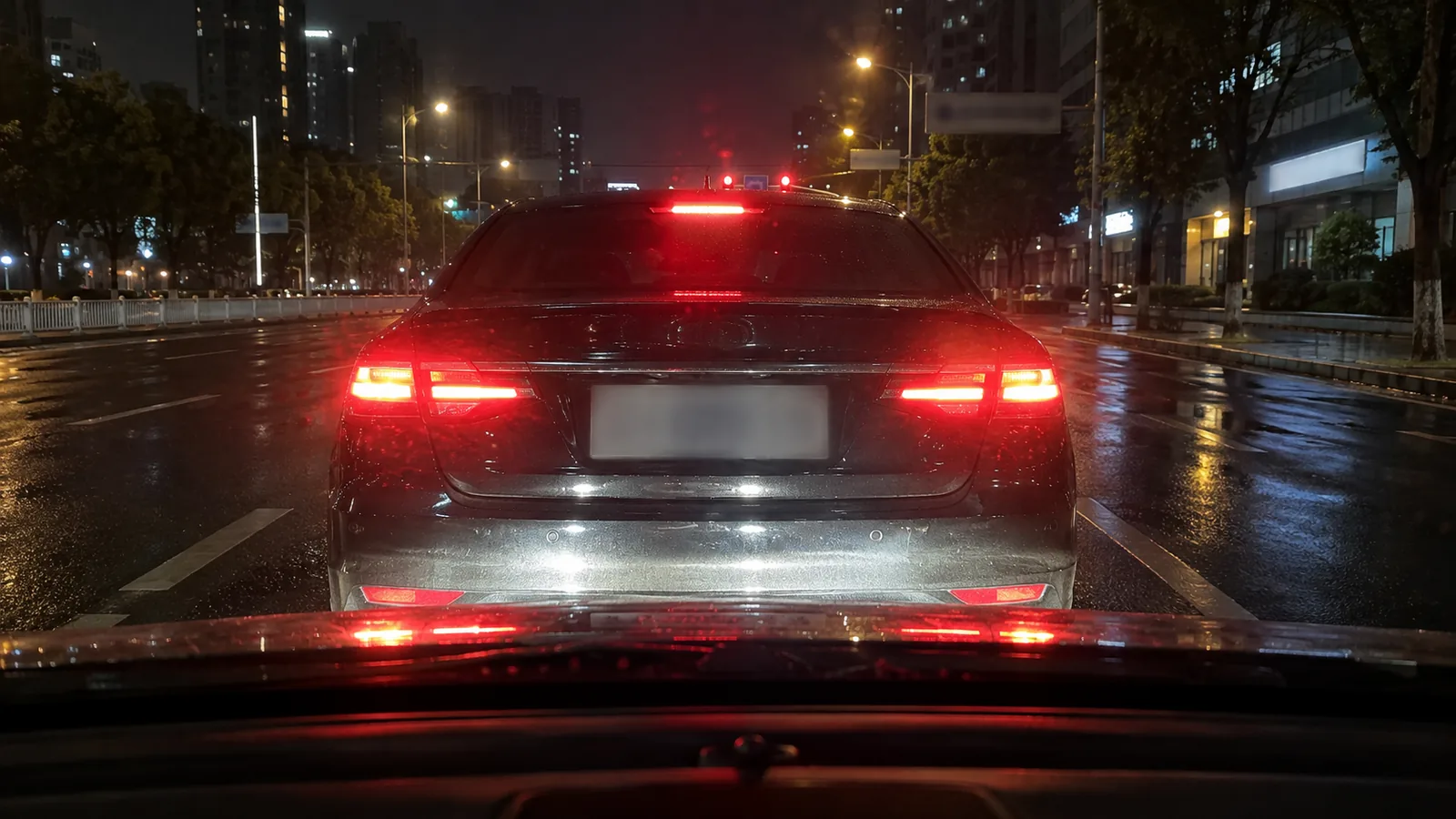
Just after 10:14 pm on 21 January 2023, two private cars were crossing Xinbei Bridge (新北大橋) on New Taipei's Huanhe Expressway (新北環河快速道路), heading toward Sanchong. The courts call them car A and car B. Car A changed lanes to the right, and car B, behind it, sounded its horn for about two seconds. Fifteen seconds later car A slowed abruptly. For more than three minutes after that, it slowed, stopped in the lane and reversed into car B, again and again (Taiwan High Court, 114年度上訴字第3183號, 12 November 2025).
This happened on the one-way approach roads of Xinbei Bridge and Zhongxing Bridge (中興橋), on a route that included a ramp with only one lane. It was night, but other vehicles were still on the expressway. The first-instance court found that car A's driver acted out of annoyance at being honked and flashed at, and that car B's bumper, bonnet and bodywork ended up scratched and damaged to the point of being unusable (New Taipei District Court, 113年度訴字第513號, 25 March 2025).
The driver of car A did not dispute the slowdowns, the stops or the reversing. The argument was about why: the car behind had been chasing car A, the driver said, and everything that followed was self-defence. Neither court accepted that.
What car B's camera recorded
The New Taipei District Court played car B's dashcam file in court on 7 November 2024. That inspection (勘驗, the court's own formal viewing of the evidence) is the backbone of both judgments, and the High Court set out its results by the dashcam clock (Taiwan High Court, 114年度上訴字第3183號, 12 November 2025).
The recording starts at 22:13:12. At 22:14:02 car A changes lane to the right and car B sounds its horn for about two seconds. At 22:14:17 car A slows abruptly. At 22:14:22–23 car B flashes its high beams for about two seconds and sounds the horn once. At 22:15:08 car A moves right again, into the lane in front of car B.
From there the pattern repeats. Car A slows abruptly at 22:15:15 and stops at 22:15:34. At 22:15:44–45 it reverses into car B. It moves off at 22:15:49, stops at 22:15:52, moves off at 22:15:56, stops at 22:16:09, moves off at 22:16:18 and stops again at 22:16:59. From 22:17:02 to 22:17:05 it reverses into car B a second time, keeps reversing and pushing car B at 22:17:06, and stops reversing at 22:17:08. It moves off at 22:17:14, stops a fifth time at 22:17:34–35, and from 22:17:37 to 22:17:45 reverses into car B a third time. At 22:17:50 it stops reversing and gets ready to move forward.
Car A disappears from view at 22:18:19 and reappears at 22:20:06. At 22:21:03 it turns right while car B carries straight on, and car A does not appear again before the recording ends.
The first-instance judgment tallies it in a schedule: two abrupt slowdowns, five abrupt stops, three reversing collisions. The High Court counted more than three minutes of dangerous driving, from 22:14:17 to 22:17:45, and stressed that car A was the car in front and car B the car behind (Taiwan High Court, 114年度上訴字第3183號, 12 November 2025).
The courts did not rely on that file alone. The evidence also included car A's own dashcam footage and car B's, each with a prosecutors' inspection record, photographs of the damage to car B, a repair estimate from a service centre in Xinzhuang, vehicle photographs and records from the Sanchong police precinct (New Taipei District Court, 113年度訴字第513號, 25 March 2025).
"Lightly touched"
Car A's driver admitted there had been a traffic dispute with car B at that time and place, and did not dispute the damage to car B. What the driver denied was any crime. At first instance the account was that car B had started crowding car A (逼車, the everyday Taiwanese word for pressing or forcing another vehicle), that this was frightening, and that the stops and reversing were self-protection. The reversing, the driver added, was a slow push meant to warn car B to stop crowding, too slow to damage anything (New Taipei District Court, 113年度訴字第513號, 25 March 2025).
On appeal, the High Court summarised the grounds this way (Taiwan High Court, 114年度上訴字第3183號, 12 November 2025):
我是正當防衛,從影像資料可知,我只是想脫離告訴人車輛。告訴人對我按喇叭、閃燈,我不理會繼續高速行駛,告訴人開始追我、用燈照我,造成心理恐懼,我擺脫不了告訴人,就減速停車,輕輕碰告訴人車輛,意思是請他不要追了,如果繼續追,我會用車去撞,沒想到告訴人一直追到萬華
(It was self-defence. The footage shows I was only trying to get away from the complainant's car. The complainant honked and flashed the lights at me; I ignored it and kept driving fast. The complainant started chasing me and shining the lights on me, which frightened me. I couldn't shake the complainant off, so I slowed down, stopped and lightly touched the complainant's car, meaning: please stop chasing me, and if you keep chasing, I will ram you with my car. I never imagined the complainant would follow me all the way to Wanhua.)
That is the defendant's version, not a finding. Neither judgment makes any finding about a chase to Wanhua (萬華); in the footage the court inspected, the cars part at 22:21:03 and car A does not reappear. The High Court did not comment separately on the sentence about ramming. It answered the appeal by going back to the footage.
Car B's driver gave police and prosecutors a different account. Car A had changed lanes and nearly caused a collision, so car B's driver flashed the high beams. Car A then got in front, repeatedly stopped suddenly, crowded car B and reversed into it, and blocked car B on a ramp with only one lane, damaging the bumper and the bonnet. Car B's driver also said they had called the police straight away when the crowding began (New Taipei District Court, 113年度訴字第513號, 25 March 2025).
Car A's driver had filed a criminal complaint of their own, accusing car B's driver of obstructing traffic safety, coercion and making threats. New Taipei prosecutors decided not to prosecute, finding the evidence insufficient (New Taipei District Court, 113年度訴字第513號, 25 March 2025). So the car behind honked and flashed, and the driver in front says they felt chased.
A warning, not an attack
Under Article 23 of the Criminal Code, an act done to defend one's own or another's rights against a "現在不法之侵害" (present unlawful infringement) is not punishable. The New Taipei court added that the infringement must be objectively unlawful before anyone may repel it by their own force, and that where an act is not simply the counter-action needed to repel such an infringement, there is no room to claim the right of defence.
It then found no infringement at all. Car A was in front and car B behind, so car B could not have obstructed car A's freedom to drive. The footage showed car A's dangerous driving starting immediately after car B's warning honk, not as a response to crowding. A honk was at most a warning to the car in front, clearly different from a present unlawful infringement. Car B's driver's statement about calling the police at once was backed by a transcript of audio in the prosecutors' inspection record. The court concluded that no evidence showed any present unlawful infringement by car B's driver (New Taipei District Court, 113年度訴字第513號, 25 March 2025).
The High Court put it in one line that also covers the high beams:
告訴人所為鳴按喇叭、閃大燈之行為至多僅為向前車示警,核與刑法上正當防衛所稱「現在不法侵害行為」有間
(The complainant's honking and flashing of the high beams were at most a warning to the car in front, and are different from the "present unlawful infringement" that self-defence under the Criminal Code requires.)
It called the self-defence plea "臨訟卸責之詞", words offered for the litigation to shed responsibility (Taiwan High Court, 114年度上訴字第3183號, 12 November 2025). The timeline holds a detail neither court remarked on: the flash of high beams at 22:14:22 came five seconds after car A's first abrupt slowdown at 22:14:17.
Stopping on an expressway as "other means"
Article 185(1) punishes damaging or blocking roads, waterways, bridges or other public traffic facilities "或以他法致生往來之危險" (or causing danger to traffic by other means), with up to five years' imprisonment, detention, or a fine of up to NT$15,000.
The New Taipei court read it as requiring a concrete danger but no actual harm. It is enough that, objectively, people and vehicles cannot pass or can pass only with difficulty, and would be exposed to possible danger if they tried. "Other means" covers any method beyond damage or blockage that is enough to obstruct public traffic. Citing two Supreme Court judgments (101年度台上字第2375號 and 104年度台上字第1101號), the court said sustained dangerous driving, which sharply raises the risk of crashes and casualties, falls within it.
It measured car A's driving against Article 94 of the Road Traffic Safety Rules. Paragraph 2 forbids slowing suddenly, braking or stopping in the lane without cause unless an emergency requires slowing, and says a car in front that must slow or stop must signal the car behind in advance by lights or hand. Paragraph 3 forbids weaving or other dangerous driving. Car A broke both, on an expressway where traffic moves fast, and screenshots showed other vehicles on the road even at night. That was enough for an objective danger to public traffic.
On intent, the court said an adult of normal intelligence with years of driving experience could hardly claim not to know that this driving might leave car B unable to avoid a collision, or make other drivers panic, swerve or fail to stop in time even if the two cars never touched. Yet the driver did it "僅因不滿告訴人對其按鳴喇叭" (only out of displeasure at being honked at).
The same conduct was coercion under Article 304(1): force need not be applied to the person directly, and the stops and reversing put psychological pressure on car B's driver and obstructed their right to drive on the road. It was also criminal damage under Article 354. The slow-push argument failed because the collisions did happen, the damage at the front of car B matched the point of impact confirmed in the inspection, and three reversals into the same spot showed the driver knew what they would do. The court treated the ten moves as one continuing offence and, because one act broke three provisions, punished it under the heaviest, Article 185(1) (New Taipei District Court, 113年度訴字第513號, 25 March 2025).
Five months, and an appeal that changed nothing
In sentencing, the first-instance court weighed that a traffic dispute alone had led to dangerous driving that seriously endangered other vehicles on the expressway, obstructed car B's driver and damaged car B. It also weighed the defendant's record, the failure to admit the offence after the fact, motive, means, purpose and harm, the defendant's personal circumstances, the lack of any settlement, compensation or forgiveness, and the views of the prosecutor, the defendant and the complainant. It imposed five months' imprisonment, convertible to a fine (易科罰金) at NT$1,000 a day (New Taipei District Court, 113年度訴字第513號, 25 March 2025).
Under Article 41, where an offence carries a maximum of five years or less and the sentence is no more than six months' imprisonment or detention, it may be converted to a fine at NT$1,000, NT$2,000 or NT$3,000 a day, unless conversion would fail to correct the offender or maintain legal order. The court chose the lowest rate.
The defendant appealed, asking to be acquitted. The Taiwan High Court adopted the first court's facts, evidence and reasons, added its own on the footage and self-defence, and found the sentence properly grounded in the factors of Article 57, within the statutory range and proportionate. The appeal was dismissed (Taiwan High Court, 114年度上訴字第3183號, 12 November 2025).
| Court | Case number | Date | Result |
|---|---|---|---|
| New Taipei District Court | 113年度訴字第513號 | 25 March 2025 | Convicted of obstructing public traffic safety (coercion and criminal damage also made out, punished under the heaviest offence); five months' imprisonment, convertible at NT$1,000 a day |
| Taiwan High Court | 114年度上訴字第3183號 | 12 November 2025 | Defendant's appeal dismissed; first-instance judgment upheld |
Where the ruling stops
The courts found no evidence of a present unlawful infringement on this record. Car A was in front, and what the footage shows car B doing is a horn of about two seconds, then a flash of the high beams of about two seconds and one more honk. Neither court held that honking or flashing is always lawful, or that the driver in front can never rely on self-defence. A case with different footage would be judged on that footage.
These are criminal judgments. They award no damages for car B, and the amount on the repair estimate is not stated. Administrative penalties run on a separate track. As background only, Article 43(1)(iv) of the Road Traffic Management and Penalty Act covers sudden slowing, braking or stopping in the lane without an emergency, with a current fine (in force since 30 June 2023) of NT$6,000 to NT$36,000 and an on-the-spot driving ban, and paragraph 4 adds a six-month plate suspension. Neither judgment mentions it, and the texts do not say whether any such penalty was imposed. At the time of this incident in January 2023, the maximum was NT$24,000.
The High Court judgment ends with a notice that an appeal may be filed within 20 days of service. The texts do not show whether anyone appealed or whether the judgment is final.
When the horn comes from behind
Both courts read a horn or a flash from behind as a warning to the car in front, not an attack that justified hitting back. Article 94(2) already tells the driver in front not to slow suddenly or stop in the lane without an emergency, and to signal before slowing or stopping. Calling a stop or a nudge a "warning", or describing the contact as light or slow, moved neither court. The contact itself, and its repetition, did.
The case was also decided by evidence that existed before anyone reached a courtroom. Car B's dashcam showed, to the second, who did what and in what order, and car B's driver's call to the police was backed by recorded audio. The driver who stopped in the lane to deliver a warning ended up with a conviction and a counter-complaint that prosecutors declined to pursue. The driver who called the police when the trouble began was the one whose account the courts believed.
Sources
Judgments
- 臺灣新北地方法院113年度訴字第513號刑事判決 (New Taipei District Court, 25 March 2025)
- 臺灣高等法院114年度上訴字第3183號刑事判決 (Taiwan High Court, 12 November 2025)
Statutes
- 中華民國刑法 第23條 (Criminal Code, Article 23)
- 中華民國刑法 第185條 (Criminal Code, Article 185)
- 中華民國刑法 第304條 (Criminal Code, Article 304)
- 中華民國刑法 第354條 (Criminal Code, Article 354)
- 中華民國刑法 第41條 (Criminal Code, Article 41)
- 中華民國刑法 第57條 (Criminal Code, Article 57)
- 道路交通安全規則 第94條 (Road Traffic Safety Rules, Article 94)
- 道路交通管理處罰條例 第43條 (Road Traffic Management and Penalty Act, Article 43) (background only; not applied in either judgment)
- 道路交通管理處罰條例 第43條 (Article 43, text promulgated 20 January 2021 and in force from 1 June 2021, the version in force at the time of the incident)
This column was written from public court judgments and statutes. Sources checked on 3 October 2026.
This article provides general information and is not legal advice on any individual matter.