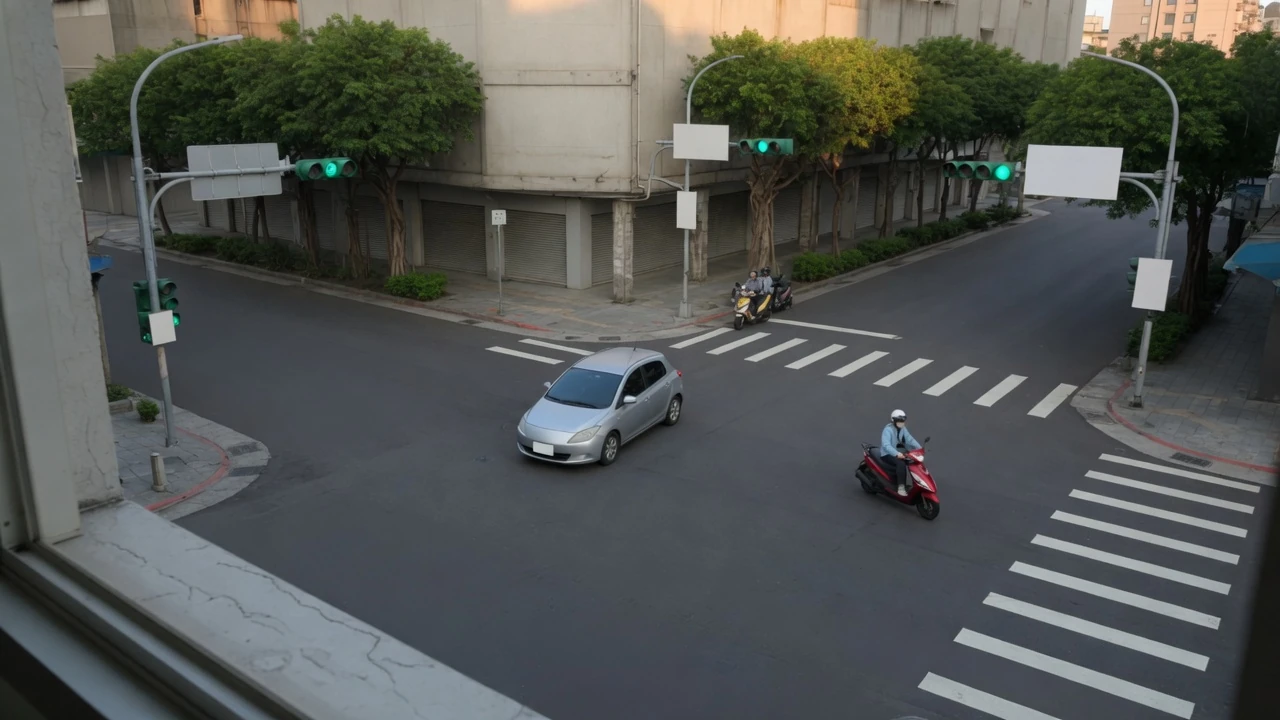
A driver turning left at a Taiwan intersection must let an oncoming scooter going straight pass first. That rule identifies who should yield; a civil court can still examine whether the rider's speed or attention contributed to the loss. In three published civil cases, courts assigned the turning car driver 70%, 60% and 50% of the fault. Those are findings on three sets of evidence, not standard percentages for other crashes.
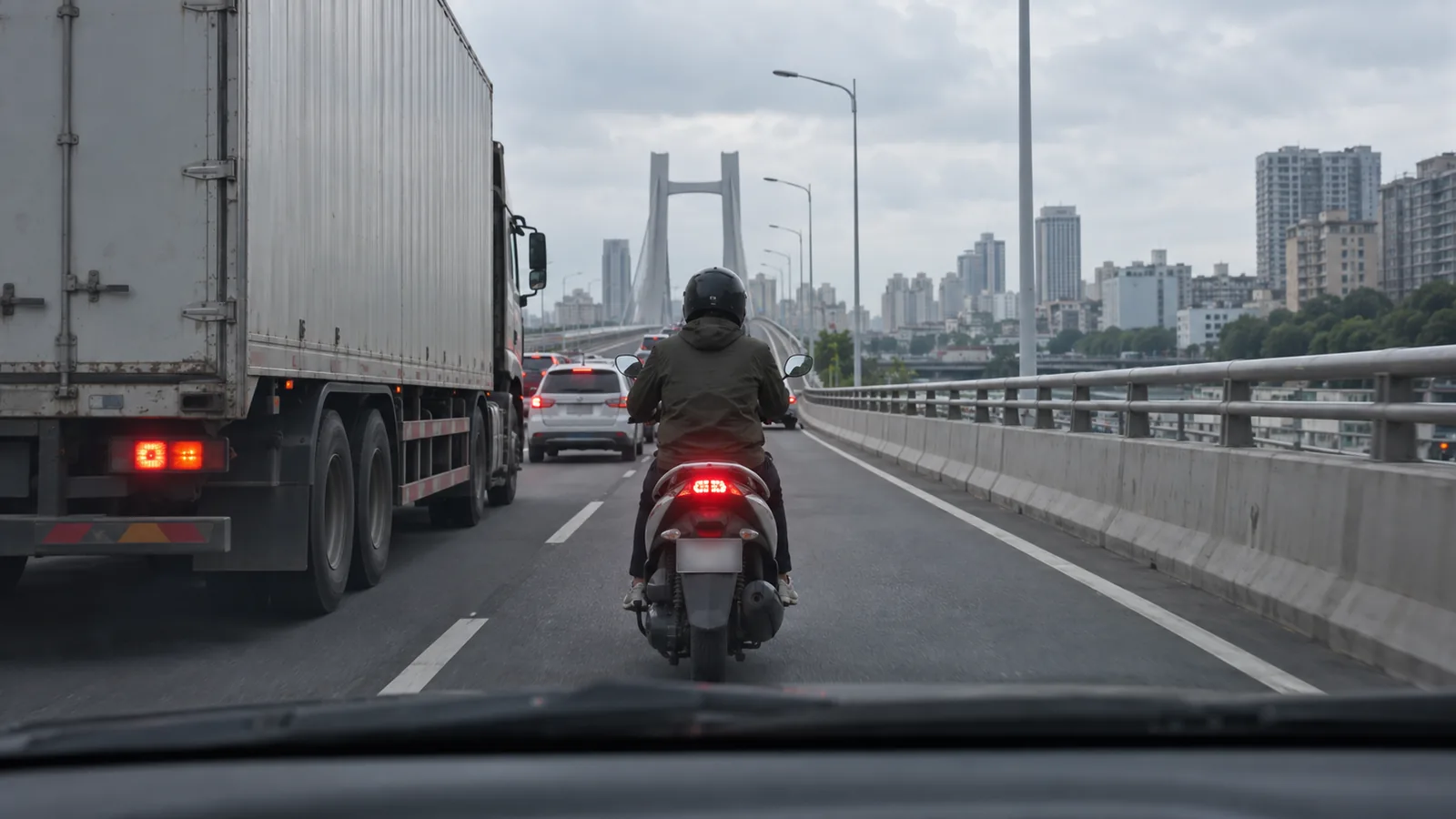
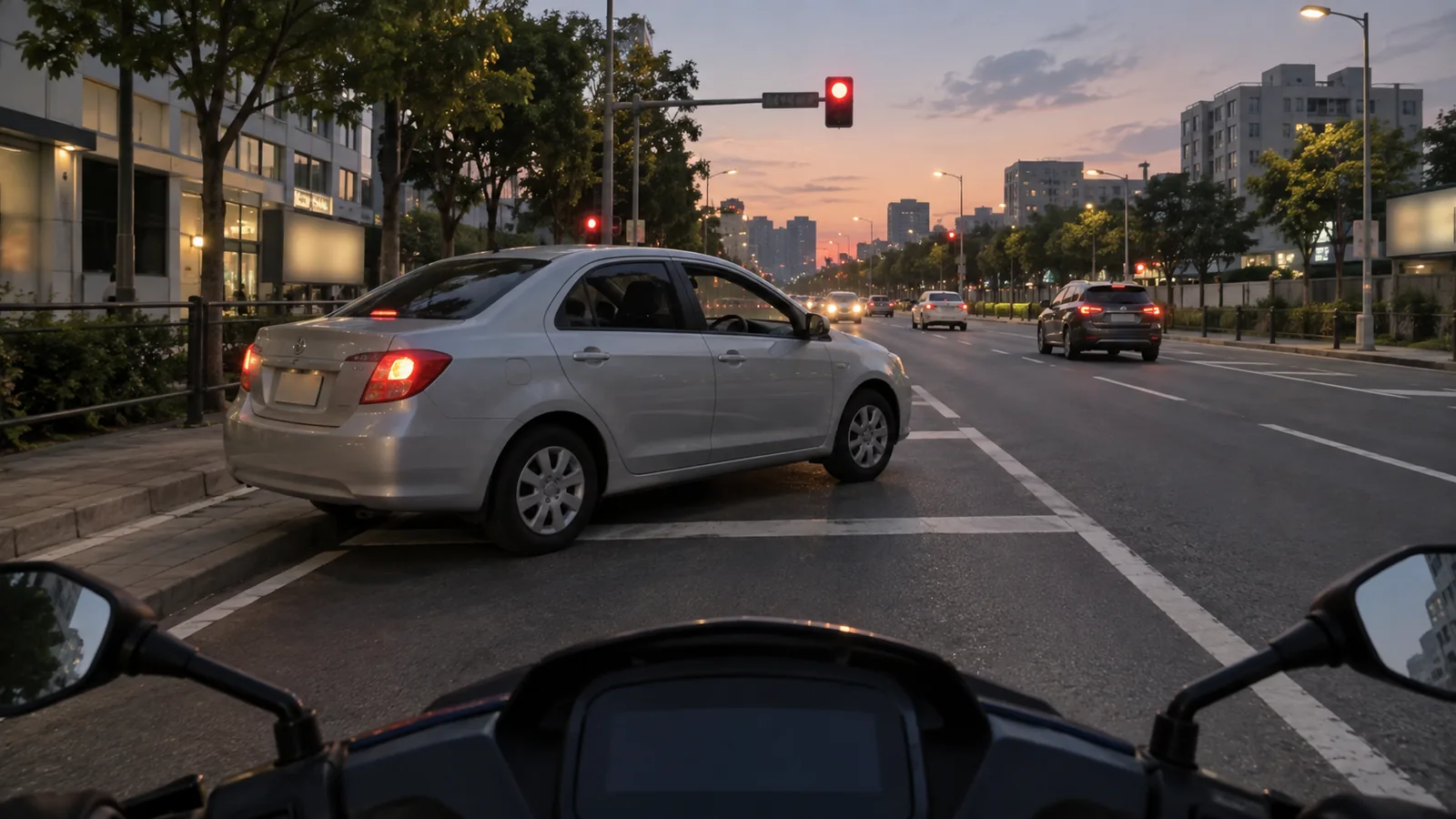
The cover image was generated by AI and does not show an actual accident.
The left-turning vehicle must yield
Article 102(1)(7) of the Road Traffic Safety Regulations (道路交通安全規則) says a turning vehicle must yield to one going straight. Article 102(1)(5) also requires a driver turning left to signal 30 metres before the intersection, move into the inner or left-turn lane, turn at the intersection's centre, and refrain from cutting into the oncoming lane to turn first. Road Traffic Safety Regulations, Article 102

Scooters have their own turning rules. Where an intersection has no applicable signs or road markings, Article 99(2) directs a scooter rider who is turning to follow Article 102 and the additional scooter rules. Signs and markings take priority where they exist. Road Traffic Safety Regulations, Article 99
Under Article 48(1)(6) of the Road Traffic Management and Penalty Act (道路交通管理處罰條例), a driver who turns without yielding to a vehicle going straight faces an administrative fine of NT$600–1,800. Road Traffic Management and Penalty Act, Article 48
Three civil cases, three divisions of fault
Each case involved a car turning left across the path of an oncoming motorcycle. Each court found a failure to yield and also considered the rider's conduct. The percentages below are the courts' civil fault findings, stated as car driver first, rider second.
New Taipei: a fall without contact, 70:30
In New Taipei, the rider braked sharply on seeing a car turn left and fell. The car driver argued that the vehicles had never touched and that the rider had simply fallen while speeding. The Sanchong Summary Court of the Taiwan New Taipei District Court (臺灣新北地方法院三重簡易庭) rejected that defence. It noted that the driver had admitted negligent injury in a related criminal case, then found an adequate causal link between the left turn, emergency braking and the fall. Contact between vehicles was not required for that finding.
The police preliminary analysis sheet (道路交通事故初步分析研判表) also recorded speeding by the rider. The court assigned 70% of the fault to the car driver and 30% to the rider. Case 114 Chong Jian 1080, November 28, 2025
Yunlin: an unproved speeding claim, 60:40
At a signal-controlled junction in Yunlin, a left-turning car collided with an oncoming motorcycle. The accident appraisal committee (行車事故鑑定會) identified the car's failure to yield as the primary cause (肇事主因) and the rider's failure to watch the road ahead as a secondary cause (肇事次因).
The car driver used CCTV timing and distance to argue that the rider had run a red light and exceeded the speed limit. The Taiwan Yunlin District Court (臺灣雲林地方法院) described that claim as 「僅係其個人片面臆測之詞」—the driver's unproved, one-sided speculation. The committee had compared the signal-control record with the footage and found that both vehicles entered on green. The court assigned 60% of the fault to the car driver and 40% to the rider. Case 114 Jian 80, January 29, 2026
Taichung: measured speed changed the appeal, 50:50
The Taichung suit was brought by the left-turning car's insurer, not by the motorcycle rider. After paying for the car's damage, the insurer sought recovery from the rider of a large motorcycle under Article 53 of the Insurance Act (保險法), which governs an insurer's right of subrogation after payment. The Taichung Summary Court of the Taiwan Taichung District Court (臺灣臺中地方法院臺中簡易庭) assigned 70% of the fault to the car driver and 30% to the rider. First-instance case 114 Zhong Jian 3178, January 5, 2026; Insurance Act, Article 53
On the insurer's appeal, the Taiwan Taichung District Court (臺灣臺中地方法院) still found that the car had failed to yield. But an appraisal review (覆議) had measured the motorcycle travelling 31.6 metres in the 1.3 seconds before the collision, an average of about 87.5 km/h. The court compared this with the 50 km/h urban limit in that case. It reasoned that the speed reduced the rider's response time, increased stopping time and could affect the turning driver's estimate of when the motorcycle would reach the junction. It changed the division to 50:50. Appeal case 115 Jian Shang 93, July 31, 2026
These are district court decisions. Their ratios do not set a rule for other accidents. The Taichung appeal also shows why an appraisal's description of causes and a court's numerical allocation should be kept distinct: the insurer cited appraisal and review findings that both drivers were causes of the crash, while the two courts assigned different percentages.
A rider's fault can reduce civil damages
Article 217(1) of the Civil Code (民法) allows a court to reduce damages, or relieve the liable party of them, if the injured person's fault contributed to causing or increasing the damage. This is the basis for taking a rider's conduct into account in a civil claim. Civil Code, Article 217
The New Taipei and Taichung courts considered speeding; the Yunlin court considered the rider's failure to watch ahead. Article 93 of the Road Traffic Safety Regulations generally sets a 50 km/h limit where no speed sign or marking applies, with lower limits on specified kinds of road or lane. Article 94 requires drivers to watch the road ahead and take necessary safety measures. Article 93; Article 94
An allegation still needs proof. In Yunlin, the driver's estimate drawn from CCTV did not establish the alleged red-light violation or speeding.
Rider fault did not cancel separate sanctions
In a Hsinchu criminal case at an intersection without traffic lights, the judgment described the oncoming rider entering quickly without slowing or paying attention ahead. The Taiwan Hsinchu District Court (臺灣新竹地方法院) nevertheless convicted the left-turning car driver of negligent injury (過失傷害罪), imposing two months' imprisonment, convertible to a fine at NT$1,000 per day. Case 112 Jiao Yi 338, September 15, 2023
In a Taipei administrative case, a motorcycle hit the right rear side of a left-turning car. The car driver said the turn was already complete. The scene diagram placed both the impact and the motorcycle's fall inside the intersection. The Taipei High Administrative Court, Local Administrative Litigation Division (臺北高等行政法院地方行政訴訟庭) found that the driver had failed to yield and upheld a NT$900 traffic fine. Any rider fault, the court said, belonged to the apportionment of civil damages; it did not remove the driver's administrative liability. Case 114 Jiao 2071, October 28, 2025
Accident appraisal has its own deadlines
The Regulations on Vehicle Accident Appraisal and Review (車輛行車事故鑑定及覆議作業辦法) allow an appraisal of a police-handled road accident on application by a party, heir, legal representative or vehicle owner, or through referral by the agency that handled the scene or a judicial commission. A case already under investigation or trial requires a judicial commission. Applications or referrals by the police or military police made more than six months after the accident are generally not accepted; a delay caused by a natural disaster or another circumstance beyond the applicant's control is an exception. Accidents outside the statutory road scope and accidents already appraised are also excluded. Article 3
Where both drivers were at fault, an appraisal describes the greater contributor as the primary cause and the lesser as the secondary cause. If their degrees of fault are equal, it describes both as causes (同為肇事原因). Article 8
A party disputing the appraisal may give reasons and seek one review within 30 days starting the day after receiving the opinion. A case already in judicial proceedings must be submitted through the relevant judicial authority. Article 10 The courts in these cases considered appraisal material but set the civil fault percentages themselves.
Police records become available in stages
After a crash causing injury or death, the driver must provide immediate aid, take the required measures, notify the police and refrain from arbitrarily moving the vehicles or scene evidence. Breaching those duties carries a fine of NT$3,000–9,000. In an injury case, if all parties agree, they must mark the vehicle positions and move the vehicles somewhere that does not obstruct traffic. Road Traffic Management and Penalty Act, Article 62(3)
The National Police Agency (內政部警政署) says parties can request the accident party registration sheet (道路交通事故當事人登記聯單) at the scene. The scene diagram and photographs can be requested after seven days; the preliminary analysis sheet can be requested after thirty days. These are application times, not promised delivery dates. NPA FAQ The guide to police records after a crash explains the request routes and their conditions.
The records mattered in the cases above: the New Taipei court cited the preliminary analysis on speed, and the Taipei administrative court checked the collision location against the scene diagram. If fault, appraisal or a proposed settlement is disputed, the account of the crash and the original records are useful to have together.
For advice on a Taiwan traffic accident, contact attorney Wei Tseng (曾雋崴) at Hovering International Law Firm (昊鼎國際法律事務所): wei@hoveringlaw.com.tw. The office is at 7F-2, No. 35, Sec. 1, Chengde Rd., Datong Dist., Taipei City 103, Taiwan.
This article presents general information from Taiwan statutes and published judgments. It is not legal advice on an individual case.
Back to traffic accident guidance
Sources
- Road Traffic Safety Regulations (道路交通安全規則), Article 102
- Road Traffic Safety Regulations, Article 99
- Road Traffic Safety Regulations, Article 93
- Road Traffic Safety Regulations, Article 94
- Road Traffic Management and Penalty Act (道路交通管理處罰條例), Article 48
- Road Traffic Management and Penalty Act, Article 62
- Civil Code (民法), Article 217
- Insurance Act (保險法), Article 53
- Regulations on Vehicle Accident Appraisal and Review (車輛行車事故鑑定及覆議作業辦法), Article 3
- Regulations on Vehicle Accident Appraisal and Review, Article 8
- Regulations on Vehicle Accident Appraisal and Review, Article 10
- National Police Agency FAQ on accident records
- New Taipei District Court, Sanchong Summary Court, 114 Chong Jian 1080
- Yunlin District Court, 114 Jian 80
- Taichung District Court, Taichung Summary Court, 114 Zhong Jian 3178
- Taichung District Court, 115 Jian Shang 93
- Hsinchu District Court, 112 Jiao Yi 338
- Taipei High Administrative Court, Local Administrative Litigation Division, 114 Jiao 2071
This article provides general information and is not legal advice on any individual matter.