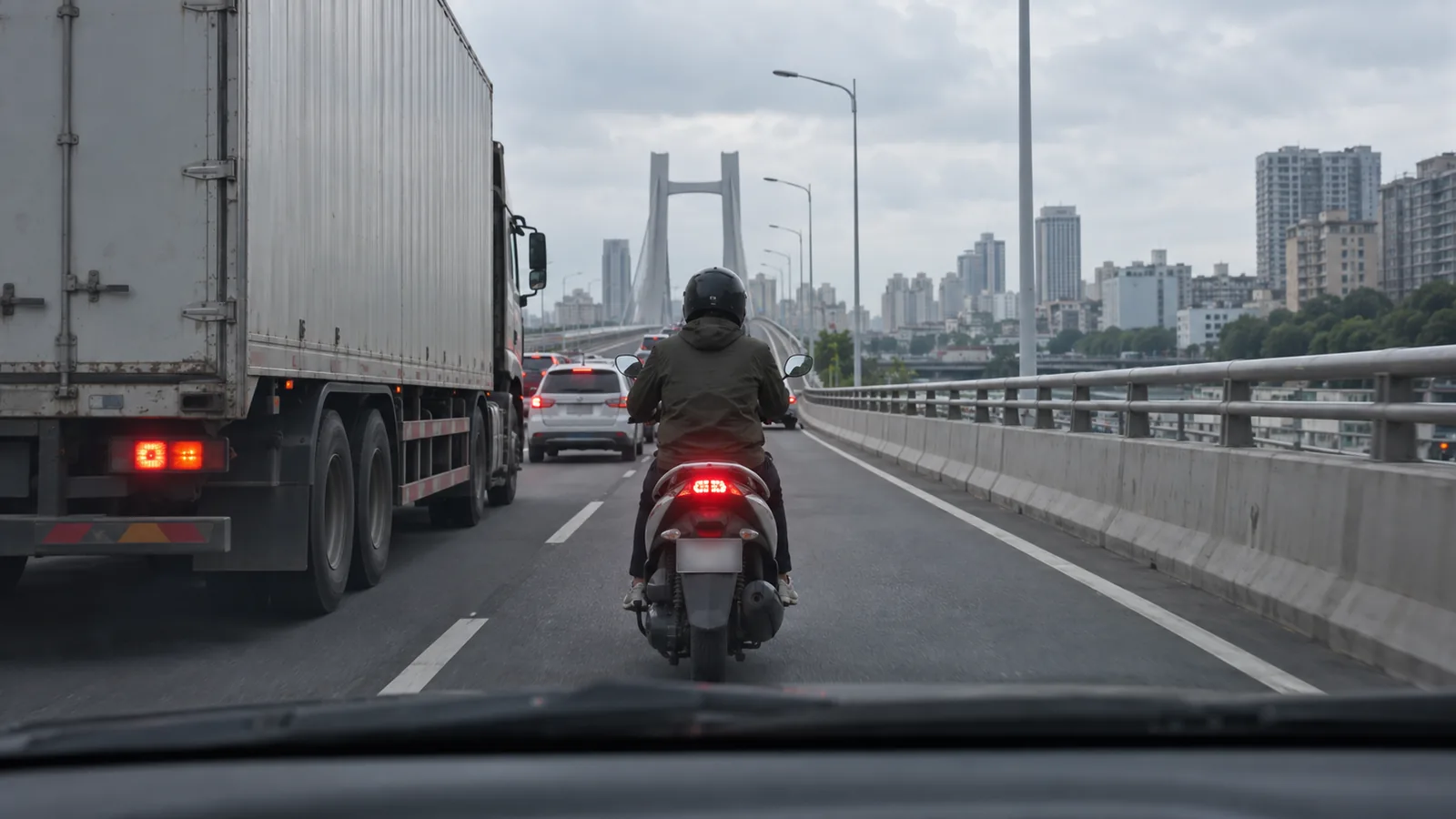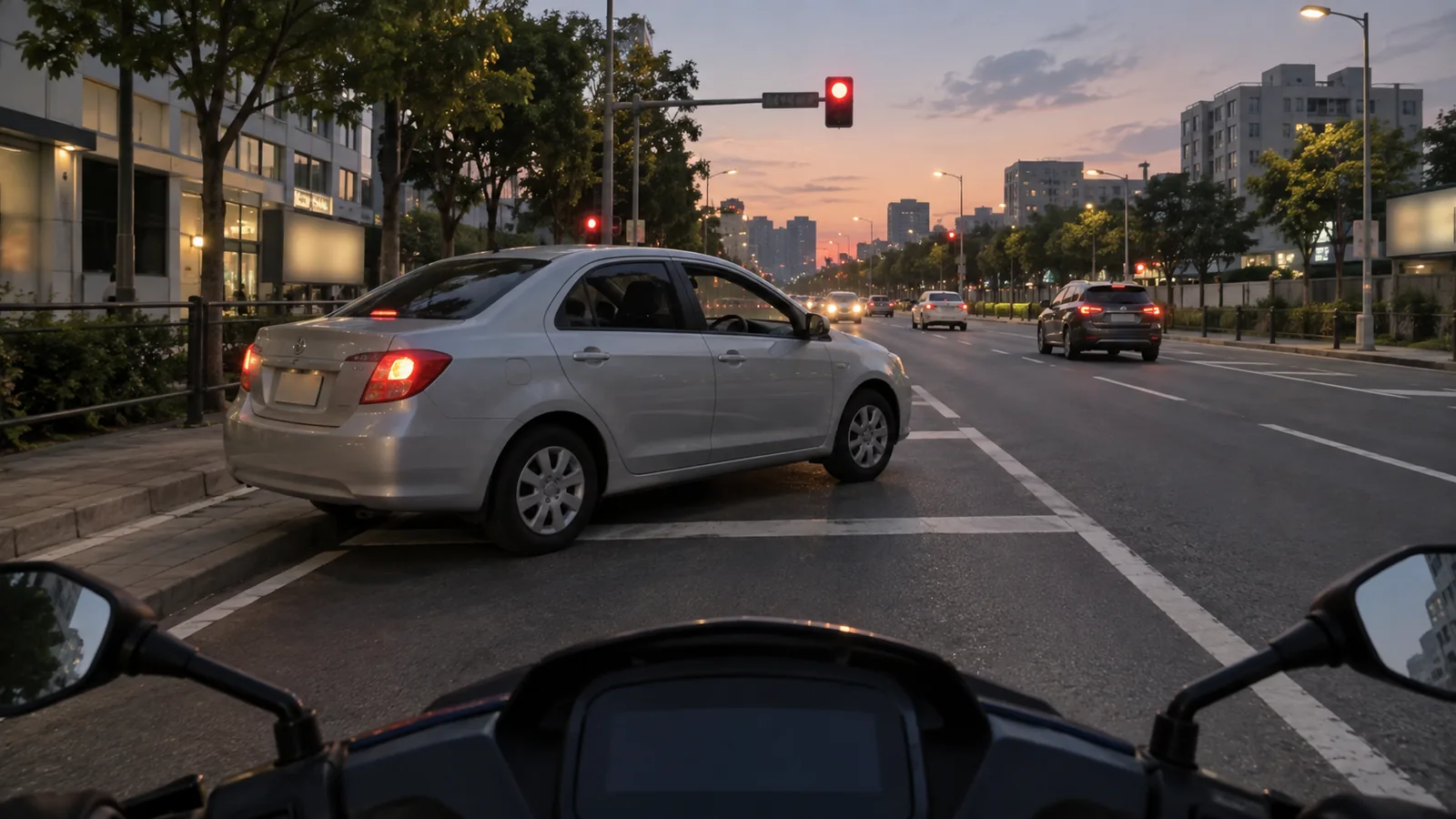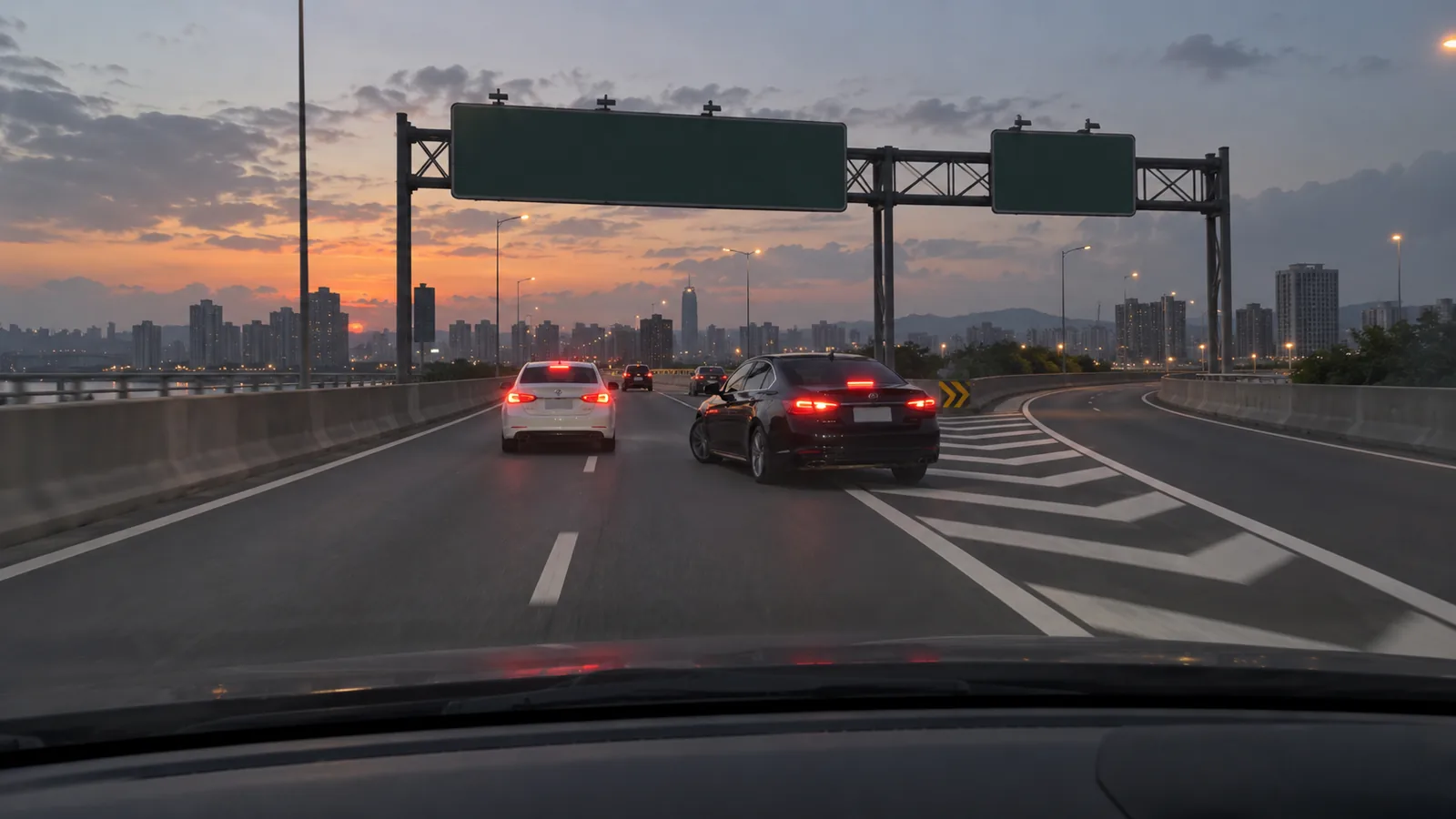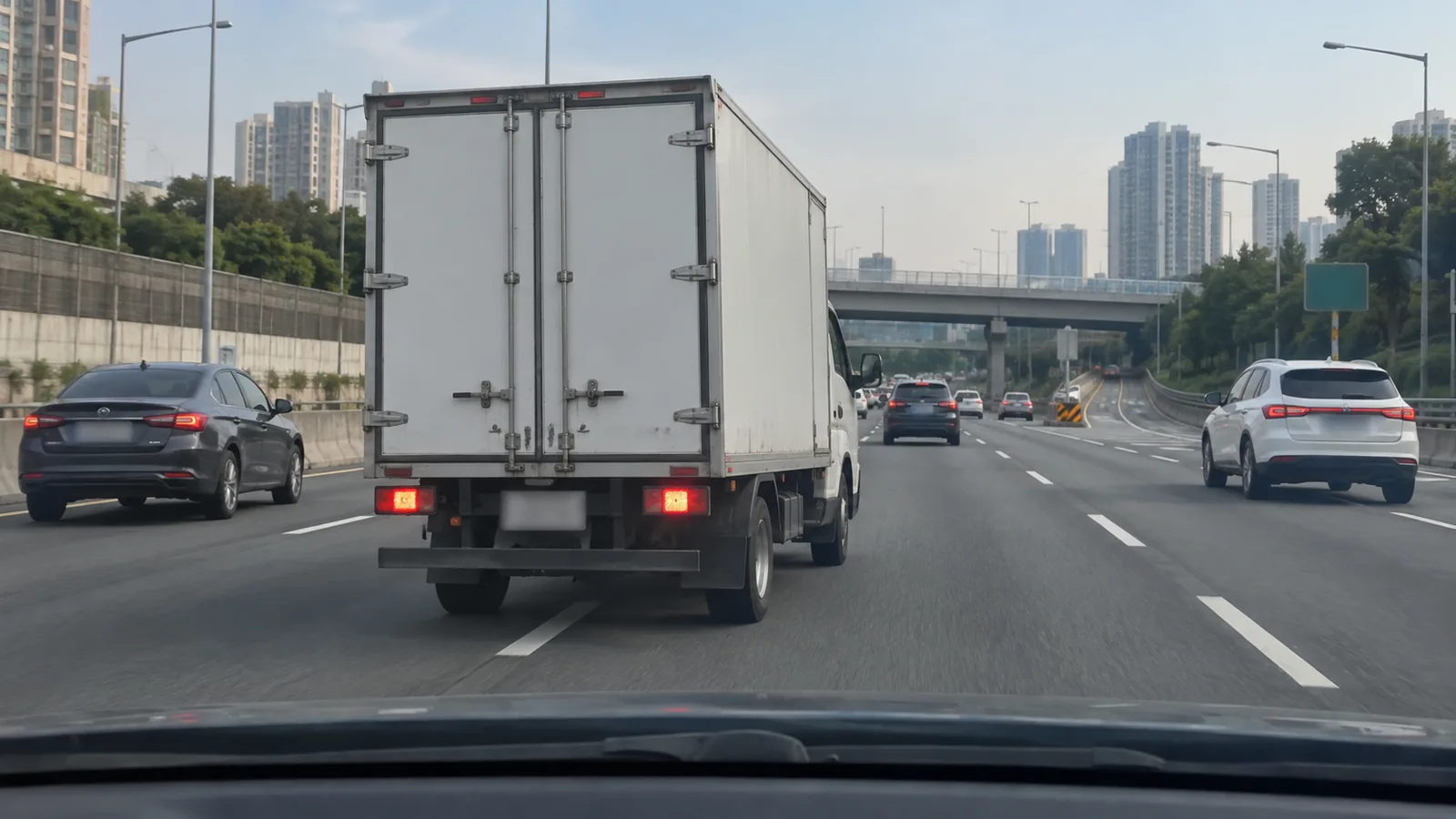
At about 3:10 pm on 22 February 2024, a rented light truck and a taxi were on Wenhua 1st Road (文化一路) in Linkou District, New Taipei, the truck heading toward Linkou and the taxi toward Guishan. At the Bade Road (八德路) junction the truck turned left and the taxi turned right, both into the entrance of the northbound Linkou interchange. A sign there asked left-turning vehicles to keep to the inner side of the ramp. The courts accepted that the truck driver knew about the sign, ignored it for no reason and cut in front of the taxi in the outer lane (New Taipei District Court, 113年度審訴字第716號, 6 March 2025; Taiwan High Court, 114年度上訴字第5567號, 14 January 2026).
Once both vehicles were on the freeway section from the Linkou interchange toward Wugu, the truck forced its way into the taxi's lane four times, braked hard in front of it three times and drove alongside it, forcing the taxi to give way "任意以迫近、驟然變換車道方式" (by closing in and abruptly changing lanes). The taxi sensed the vehicle closing in, and its automatic braking activated (first-instance and High Court judgments).
The truck driver was sentenced to four months' imprisonment. The High Court later replaced that with 40 days' detention. Both judgments record that he had not settled with the taxi driver. What changed the outcome was evidence that the taxi had been fighting for the lane too.
Twelve seconds in the case file
The facts were never contested at trial. The first-instance judgment adopted the indictment's facts and evidence, adding only the truck driver's admission in court. That evidence included his statements to police and prosecutors, the taxi driver's statements, copies of two traffic violation notices, the taxi driver's dashcam footage with criminal-case evidence photos, and the prosecutors' office's inspection record (勘驗筆錄, the record of an official inspection). The National Highway Police Bureau had referred the case.
The High Court went back to the screenshots attached to the inspection record in the investigation file. For roughly twelve seconds on the day, from 3:07:56 to about 3:08:08 pm (the charge's "about 3:10" is approximate), they showed:
被告與被害人車輛為了爭道而有互不禮讓及貼近車身等情形
(the defendant's and the victim's vehicles contesting the lane, neither giving way to the other, and drawing close to each other's bodywork, among other things)
That description comes from the High Court's account of the screenshots (Taiwan High Court, 114年度上訴字第5567號, 14 January 2026).
The court set this beside the truck driver's statement to police. He said that after he turned left into the northbound interchange at about 3:07, a black Mercedes taxi came up from the shoulder on his right rear and stayed pressed alongside him for about 30 seconds. Unable to get past, it dropped behind, moved to his left and stayed tight against that side for one to two minutes, then sped in front to block him when a large truck ahead changed lanes. After that, he said, the two kept overtaking each other, three to five times (High Court judgment).
The detailed sequence above is the truck driver's account to police. The High Court left the first-instance findings on the offence unchanged. For sentencing, however, it accepted that both drivers had competed for the lane and driven close to stop the other from overtaking. It described his account as consistent ("相符") with the screenshots and his claim of mutual crowding as having a basis ("尚屬有據"), without expressly adopting every detail of his account.
The judgments do not say whose camera produced the screenshots, or how the taxi's automatic braking was established. No braking log, vehicle data or expert report is mentioned; the activation appears only in the statement of facts.
Denied to police, admitted in court
Prosecutors indicted him on 2 September 2024. Article 185(1) of the Criminal Code punishes endangering public traffic by damaging or blocking roads "或以他法" (or by other means), with up to five years' imprisonment, detention, or a fine of up to NT$15,000. Article 304(1) punishes coercion, here obstructing the taxi driver's right to drive safely. Because one act committed both offences, he was to be punished under the heavier Article 185(1), and the repeated moves, close together in time and driven by the same intent, were charged as a single offence (first-instance judgment).
He denied the allegations to police and prosecutors. In the New Taipei District Court he admitted them at the preparatory stage, and the court heard the case under the simplified trial procedure (簡式審判程序). On 6 March 2025 it convicted him of obstructing public traffic safety (妨害公眾往來安全罪) and sentenced him to four months' imprisonment, convertible to a fine at NT$1,000 per day (易科罰金). The court said his driving endangered the taxi driver and other road users, and it weighed his record and personal circumstances, his motive, purpose and means, his eventual admission, and the fact that he had not settled with the taxi driver.
An appeal about the sentence alone
He appealed and expressly limited the appeal to the sentence, which Article 348(3) of the Code of Criminal Procedure allows. The High Court therefore reviewed only the penalty and relied on the facts, evidence and offence found at first instance. His case was that he had admitted the offence, and that the dispute was one of "雙方為了超車而有相互逼車的情形" (both sides pressing each other in order to overtake). 逼車 is the everyday Taiwanese word for crowding or forcing another vehicle on the road.
The cut-ins and the hard braking were his (High Court judgment). If the other driver also refused to give way and crowded him, should that lighten his sentence?
The factor the first court left out
The High Court started from the general standard: a sentence rests on the offender's culpability and must weigh all the circumstances, in particular the factors in Article 57 of the Criminal Code. The court's discretion is bounded by proportionality, equality and the principle that the punishment must fit the offence.
The court accepted that the truck driver had forced his way into the lane, braked hard and closed in to make the taxi give way. But the dispute had arisen because both drivers were contesting the lane and refusing to yield, each closing in to stop the other from overtaking. From that it drew a conclusion about the taxi driver:
被害人就本件行車糾紛之發生亦應負部分責任
(the victim should also bear some responsibility for how this traffic dispute arose)
Those are the High Court's words (Taiwan High Court, 114年度上訴字第5567號, 14 January 2026).
So in weighing the truck driver's motive, the provocation he received and the degree to which he breached his duties (items 1, 2 and 8 of Article 57), the sentencing court had to take into account that the taxi driver had also contested the lane and refused to give way. The first court had not: "原審漏未審酌及此,容有未當" (the court below failed to consider this, which was improper). The High Court found the appeal well founded and set the sentence aside.
Its own sentence was 40 days' detention, again convertible at NT$1,000 a day. It did not excuse the driving: cutting in, braking hard and closing in to force the taxi to give way had endangered the taxi driver and other road users, and the court called it "誠屬不該,殊值非難" (plainly wrong and deserving of censure). The rest of what it weighed largely mirrors the first court's list, including his admission and the absence of a settlement. The one error it identified was the missing account of the taxi's part in the dispute.
The kind of penalty changed too. As statutory background (neither judgment cites it expressly), under Article 33, fixed-term imprisonment (有期徒刑) ordinarily runs from two months, and detention (拘役) from one day to less than 60 days. Article 41 allows conversion to a fine at NT$1,000, NT$2,000 or NT$3,000 a day where the offence carries a maximum of five years or less and the sentence is no more than six months' imprisonment or detention, unless conversion would fail to correct the offender or maintain legal order. Both courts chose the lowest rate. Converted in full, 40 days comes to NT$40,000.
| Stage | Authority and case number | Date | Result |
|---|---|---|---|
| Indictment | New Taipei District Prosecutors Office, 113年度偵字第38619號 (indictment attached to New Taipei District Court, 113年度審訴字第716號, 6 March 2025) | 2 September 2024 | Charged under Criminal Code Art. 185(1) and Art. 304(1), one act committing both |
| First instance | New Taipei District Court, 113年度審訴字第716號, 6 March 2025 | 6 March 2025 | Convicted of obstructing public traffic safety; 4 months' imprisonment, convertible at NT$1,000 a day |
| Appeal on sentence only | Taiwan High Court, 114年度上訴字第5567號, 14 January 2026 | 14 January 2026 | Sentence set aside; 40 days' detention, convertible at NT$1,000 a day |
What the judgment does not decide
The High Court did not revisit guilt. The taxi driver's conduct reduced the sentence and left the conviction and the offence untouched. "Partly responsible" is the court's assessment for sentencing, not a finding that the taxi driver committed an offence. Neither judgment mentions any investigation of the taxi driver, any apportionment of fault, or any civil claim for damages.
The administrative side cannot be read from these texts: the evidence included two traffic violation notices, but the judgments do not say who received them or under which provision. As background only, the judgments' wording closely tracks Article 43(1)(iii) of the Road Traffic Management and Penalty Act, on forcing another vehicle to give way by closing in or abrupt lane changes. That item, like item (iv) on sudden slowing or braking without an emergency, carries a fine of NT$6,000 to NT$36,000 and an on-the-spot driving ban, and paragraph 4 adds a six-month plate suspension. Neither court applied it.
The High Court's judgment ends with a notice that an appeal may be filed within 20 days of service, and the texts do not show whether anyone appealed. Sentencing also weighs everything in a particular case, so this judgment does not mean a sentence will always come down whenever the other driver contested the lane too.
For anyone driving in Taiwan
The investigation file that supported the charge also showed the taxi. Twelve seconds of screenshots, read with the truck driver's own account to police, were enough for the High Court to call the taxi driver partly responsible for the dispute. If you are the driver being cut off, what you do next is on the record as well: fighting for the lane, refusing to give way and closing in on the other vehicle is exactly what the court counted as the taxi driver's share.
The criminal facts also start before the freeway, at the ramp entrance, with a lane sign for left-turning vehicles that the truck driver knew about and ignored (first-instance and High Court judgments).
Sources
Judgments
- 臺灣高等法院114年度上訴字第5567號刑事判決 (Taiwan High Court, 14 January 2026)
- 臺灣新北地方法院113年度審訴字第716號刑事判決 (New Taipei District Court, 6 March 2025)
Statutes
- 中華民國刑法 第185條 (Criminal Code, Article 185)
- 中華民國刑法 第304條 (Criminal Code, Article 304)
- 中華民國刑法 第57條 (Criminal Code, Article 57)
- 中華民國刑法 第33條 (Criminal Code, Article 33) (background explanation of penalty types; not expressly cited in either judgment)
- 中華民國刑法 第41條 (Criminal Code, Article 41)
- 刑事訴訟法 第348條 (Code of Criminal Procedure, Article 348)
- 道路交通管理處罰條例 第43條 (Road Traffic Management and Penalty Act, Article 43) (background only; not applied in either judgment)
This column draws on public court judgments and statutes. Sources checked on 3 October 2026.
This article provides general information and is not legal advice on any individual matter.