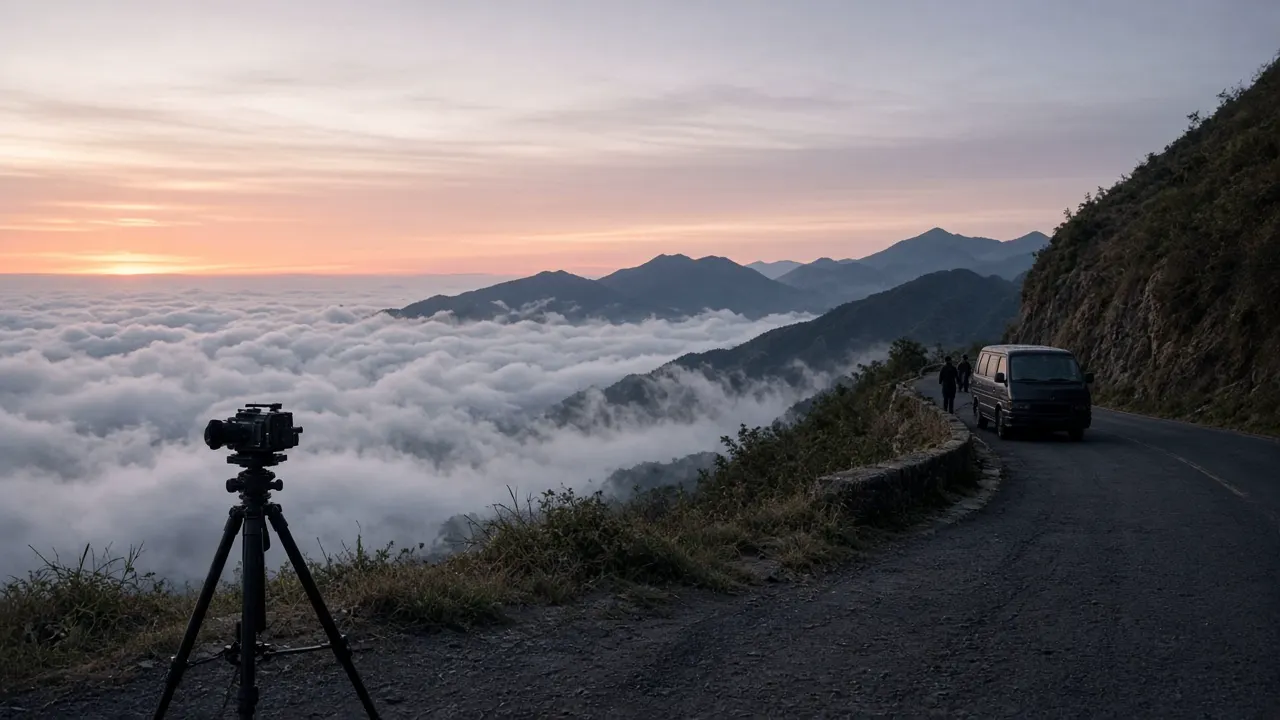
Cooking inside a parked vehicle at Wuling, the high pass on Hehuanshan, breaks Taroko National Park's rules even with a flameless electric appliance. The park headquarters said so on October 25, according to the Central News Agency: the parking lot is not a designated camping and cooking area, so cooking or staying overnight there does not comply, inside a vehicle or not.
The occasion was a complaint about a car-camping video that a production company shot at Wuling featuring a Korean cheerleader. After reviewing the footage, the headquarters said rock climbing shown in the video violated the National Park Act and would be penalized. Police on patrol had already asked the crew to stop cooking on October 4, and the crew complied. The report does not say whether the performer or the company will receive the decision.
For anyone shooting vanlife or travel content in Taiwan's mountains, the episode raises practical questions. How large can the fine be? Is there a permit to get? And what happens if the notice arrives after you've flown home?
What the Act forbids, and the NT$3,000 ceiling
Article 13 of the National Park Act lists eight prohibited acts inside a park, from burning vegetation, hunting and polluting water or air to dumping refuse and driving outside permitted areas. Item 8 is a catch-all: other conduct prohibited by the national park authority, which is the Ministry of the Interior (Article 3). For people who leave open trails to get a shot, the headquarters said rangers and police first ask them to stop; repeated refusal, or actual pollution, leads straight to a citation under that item.
The fine sounds odd on paper. Article 26 sets "not more than 1,000 yuan" for violations of items 4 through 8, an amount stated in an old currency unit. Article 2 of the statute converting those units multiplies it by three. So the cap is NT$3,000. Damage also has to be repaired, or paid for if repair is impossible or extremely difficult (Article 27).
No filming clause, but permits still matter
Search the Act and its Enforcement Rules and you will not find the word for filming. The working rules sit in the Ministry's park-by-park prohibitions under Article 13(8). Point 6 of Taroko's list bars rock climbing, camping, cooking and operating remote-controlled devices outside designated areas without approval, so both scenes the headquarters objected to are on it. Rock climbing, camping and remote-controlled devices appear both in the June 2019 text reproduced in the headquarters' drone application notes and in the current text, amended by the Ministry of the Interior on September 5, 2025 and in force from that day. Cooking has a history of its own. The 2019 text said 野炊, cooking over an open fire on the ground, and an amendment of June 28, 2022 changed it to 炊煮, which the 2025 text keeps. The explanatory note for that amendment says 炊煮 covers any heat source, from firewood to camping stoves.
Drones have their own procedure. Taroko National Park Headquarters takes advance applications for aerial filming, and the government service page asks for them at least 7 days before the shoot, with 7 days to process. The same page gives the earliest filing date both as 60 days and as three months ahead. Approval from the headquarters does not replace aviation rules: point 4 of the application notes says drone operators must also comply with the Civil Aviation Act (民用航空法) and other applicable law, and point 7 requires a separate park entry permit for controlled areas such as ecological protection areas, plus a mountain entry permit inside mountain restricted zones. Entering an ecological protection area requires the headquarters' approval under Article 19, and Article 14(10) leaves room for other matters that need the authority's permission.
Contesting a fine from overseas
Before imposing a fine, the agency should give the person a chance to state their side (Administrative Penalty Act, Article 42). It may skip that step when the facts are objectively clear. Footage of the act itself may be argued to meet that test.
A decision sent abroad is served through the foreign country's authorities or a Taiwan mission or similar body; failing that, by registered mail (Administrative Procedure Act, Article 86). The decision itself must state how to challenge it, the deadline and the receiving authority (Article 96).
You then have 30 days from the day after service to file an administrative appeal (Administrative Appeal Act, Article 14). Living in the United States counts as not residing where the appeal authority sits, so travel time is deducted (Article 16). For residents of the Americas, the Executive Yuan's deduction rules set it at 44 days. Appointing an appeal representative who lives there and can act within the period removes the deduction. The appeal goes through the agency that issued the fine, which, if it finds the appeal well founded, may cancel or change its own decision at that stage (Article 58).
After an unsuccessful appeal, a suit to set the decision aside goes to the administrative courts (Administrative Litigation Act, Article 4). Fines of NT$500,000 or less follow the summary procedure, with a district administrative court as the first instance (Article 229).
Brand, agency or creator: who pays
Foreign nationals who breach an administrative duty inside Taiwan are subject to Taiwan's administrative penalties (Administrative Penalty Act, Article 6), and a penalty requires intent or negligence (Article 7(1)). Where the company itself is the violator, Article 7(2) presumes that the fault of its representative or of the staff who actually acted is the company's own. Article 14 penalizes each person who intentionally takes part in a joint violation, according to their role.
Who bears the cost is a contract question for the brand, the agency and the creator. A clause can say the production company reimburses the fine and any restoration cost. It cannot change whose name appears on the decision. The amount itself reflects blameworthiness, impact and any gain from the violation (Article 18(1)); where the gain exceeds the statutory maximum, the fine may go above it up to that gain (Article 18(2)). Whether sponsorship or ad revenue from a video counts as gain from the violation is open to argument. Whether a visa-exempt visitor may do paid shoots at all is a separate issue, discussed in our column on commercial activity by visitors.
A Taiwan lawyer can draft the pre-decision statement, check the legal basis and findings in the decision, file the administrative appeal and any lawsuit as your representative, and review cost-sharing terms among the brand, agency and talent. Consultations with an English-speaking lawyer in Taipei are available through Hovering International Law Firm at wei@hoveringlaw.com.tw; see our dispute services. Taipei office: 7F-2, No. 35, Sec. 1, Chengde Rd., Datong Dist., Taipei City 103 (臺北市大同區承德路一段35號7樓之2).
For a crew that has already flown home, the 30-day count starts the day after the decision arrives, not on the day of the shoot.
Sources
Checked October 26, 2026.
- Central News Agency, October 25, 2026 (Chinese)
- National Park Act, Article 13
- National Park Act, Article 26
- Statute converting currency units in current laws to New Taiwan Dollars (現行法規所定貨幣單位折算新臺幣條例), Article 2
- National Park Act, Article 27
- Enforcement Rules of the National Park Act
- National Park Act, Article 3
- Taroko National Park aerial filming application (gov.tw service page, updated July 21, 2026)
- Taroko National Park Headquarters, notes on applying for aerial filming (with the June 20, 2019 prohibitions)
- Prohibitions in the Taroko National Park area, current text in force since September 5, 2025 (太魯閣國家公園區域內禁止事項)
- Ministry of the Interior Order 台內園字第11412804051號 of September 5, 2025, amending the Taroko prohibitions with immediate effect (Public Policy Participation Platform)
- National Park Service, explanatory note on the 2025 amendment of the Taroko prohibitions (修正總說明)
- National Park Service, explanatory note on the 2022 amendment of point 6 of the Taroko prohibitions (第六點修正總說明)
- National Park Act, Article 19
- National Park Act, Article 14
- Administrative Penalty Act, Article 42
- Administrative Procedure Act, Article 86
- Administrative Procedure Act, Article 96
- Administrative Appeal Act, Article 14
- Administrative Appeal Act, Article 16
- Rules on Deducting Travel Time in Administrative Appeals (訴願扣除在途期間辦法), Article 5
- Administrative Appeal Act, Article 58
- Administrative Litigation Act, Article 4
- Administrative Litigation Act, Article 229
- Administrative Penalty Act, Article 6
- Administrative Penalty Act, Article 7
- Administrative Penalty Act, Article 14
- Administrative Penalty Act, Article 18
Frequently Asked Questions
- Our contract says the brand pays any fine. Will the decision be issued to the brand?
- Not because of the contract. The agency names whoever breached the duty: Article 7(2) of the Administrative Penalty Act presumes the fault of a company's representative or acting staff to be the company's own when the company is the violator, and Article 14 penalizes each person who intentionally takes part in a joint violation. The contract decides who reimburses whom afterward.
- Can sponsorship income push the fine above NT$3,000?
- Possibly. Article 18(1) of the Administrative Penalty Act weighs blameworthiness, impact and any gain from the violation, and Article 18(2) allows a fine above the statutory maximum, up to the amount of the gain, where the gain exceeds that maximum. Whether revenue from a sponsored video counts as gain from the violation is open to argument.
- I'm back in the US. Do I get extra time to appeal?
- The 30 days run from the day after service (Administrative Appeal Act, Article 14). Someone who does not live where the appeal authority sits has travel time deducted (Article 16), and the Executive Yuan's rules set that at 44 days for residents of the Americas. The deduction does not apply if you have an appeal representative living there who can act within the period.
This article provides general information and is not legal advice on any individual matter.