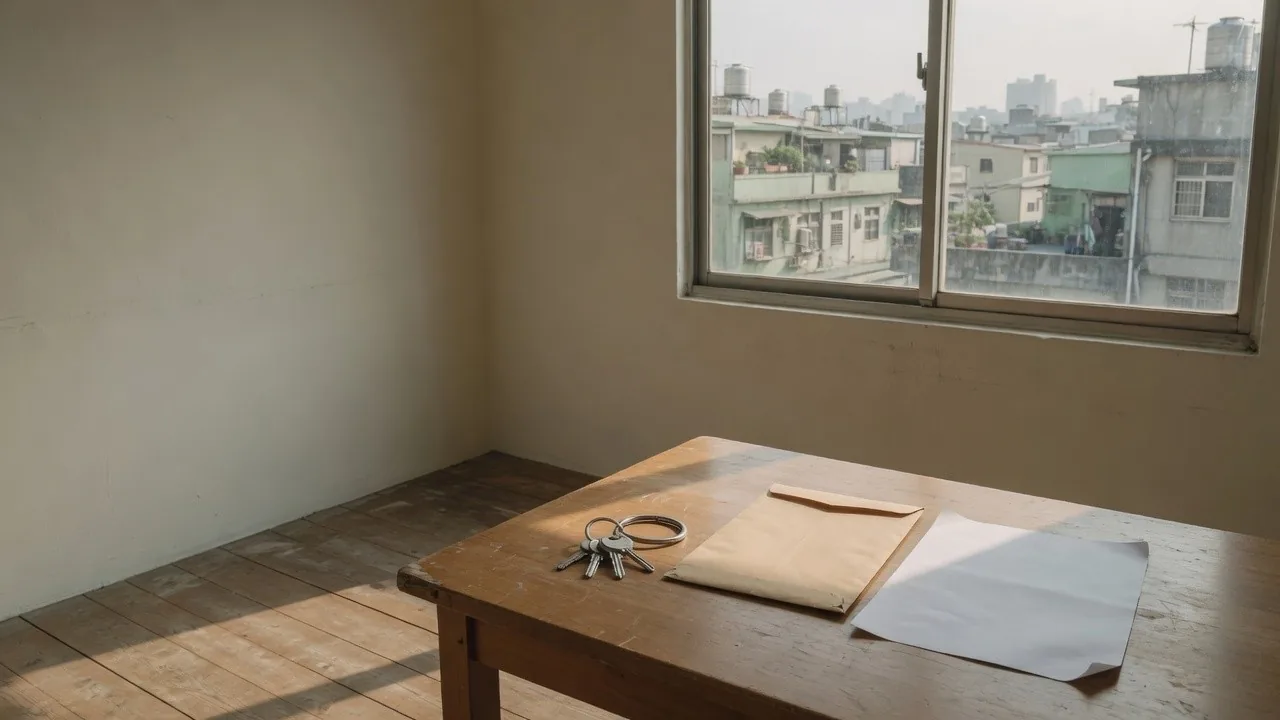
On December 12, 2022, the landlord's wife sent a short message: a family member was going to use the unit, so it could not be rented out, and the money would be returned (judgment). By then the prospective tenant's side had paid one month's rent as a holding deposit (定金) on a ground-floor unit in Taipei. The landlord's wife had handed over the keys, and a contractor had painted walls and started on the woodwork. The lease was not yet signed or notarized.
That money, NT$88,000, was refunded. It did not end the matter. In judgment 113 Jian-Shang No. 219 (113年度簡上字第219號), an appeal panel of the Taipei District Court left in place a simplified-procedure order to pay another NT$88,000, dismissing the landlord's appeal on January 21, 2026. The judgment states that no further appeal is allowed.
When a deal collapses before signing, a 定金 paid to hold a place can come back as it was, stay with the landlord, or come back doubled. The courts in Taipei and Keelung applied Article 249 of the Civil Code by analogy to such money, and the outcome turned on whether the collapse was attributable to the landlord, to the side that paid, or to neither. A different agreement between the parties comes first.
The agreed notarization in the Taipei case
Article 248 of the Civil Code presumes a contract formed once one party has received a 定金 from the other. That is only a presumption. Article 166 points the other way where the parties agreed on a required form: until that form is completed, the contract is presumed not formed.
In Taipei, the tenant's side cited Article 248, among other provisions. Because the notarization both sides had agreed on never happened, the court could not find that a lease had been formed. They had agreed on the essentials, though (the unit, rent of NT$88,000 a month, a security deposit of two months' rent), so there was a preliminary agreement (預約) to sign one (judgment).
To the landlord, the payment was an advance on the security deposit. The court classified it by when it was paid: money handed over before notarization and signing was a 立約定金, a deposit securing the conclusion of the lease (judgment). Recovering a security deposit (押金) at move-out and leaving a signed lease early are separate questions.
Returned, lost or doubled
Where the parties have not agreed otherwise, Article 249 sorts a 定金 into four outcomes.
| What happened to the contract | The 定金 |
|---|---|
| Contract performed (item 1) | Must be returned or counted as part of performance |
| Performance impossible for a reason attributable to the payer (item 2) | The payer may not demand it back |
| Performance impossible for a reason attributable to the recipient (item 3) | The recipient must return double |
| Performance impossible for a reason attributable to neither side (item 4) | Must be returned |
But what if the lease was never signed at all? Citing Supreme Court judgment 93 Tai-Shang No. 441, the Taipei court held that Article 249 applies by analogy to a 立約定金 even when the main contract was never formed (Taipei judgment). The Keelung judgment, citing Supreme Court judgment 96 Tai-Shang No. 2565, puts it more bluntly: unless otherwise agreed, a payer who refuses to enter the main contract cannot demand the deposit back, and a recipient who refuses must return double.
An invented example puts numbers on it: an American graduate student pays NT$10,000 to hold a NT$15,000-a-month studio, and the landlord gives it to a relative and refunds the NT$10,000. If nothing else was agreed and the reason is attributable to the landlord, double is NT$20,000, leaving NT$10,000 more to claim under Article 249, item 3. Had the reason been attributable to the student, the deposit could not be demanded back (item 2); had neither side been responsible, the NT$10,000 would have to be returned (item 4).
Taipei: one message settled responsibility
Taking the December 12 message at its word, the court found that the lease went unsigned for a reason attributable to the landlord: a family member was going to use the unit. Applying Article 249, item 3, by analogy, the landlord owed double, NT$176,000. After the NT$88,000 already refunded, NT$88,000 remained (judgment).
Two defenses failed. One was a side agreement, said to date from the payment, that only the amount paid would be refunded if no lease was signed before a notary in time, whichever side was responsible. The tenant's side denied it. There was no proof. The other was that the tenant's side had gone in to paint on December 11 without consent. Relying on the contractor's testimony, the court found that, up to the return of the keys, the landlord's side knew of the work and raised no objection. The messages asking to hold off until the lease was signed and notarized came on December 8, after the keys had gone back, and no later entry was proven (judgment).
Keelung: a lease that stalled on a guarantor
A small-claims judgment from the Keelung District Court's summary division (基隆簡易庭), 114 Ji-Xiao No. 407 of April 29, 2025, went the other way. The lease was to be in the name of the plaintiff's father. It was the plaintiff who viewed the property with an agent, transferred NT$6,000 as a 定金 the next morning, and asked to see a draft lease about two hours after paying. The court treated money paid before the terms were even known as a 立約定金.
Next came the guarantor. Through the agent, the landlord asked for a guarantor, or a guarantor's letter if the guarantor could not attend; the agent told the landlord that any changes could be settled on the signing day. By the landlord's account, only the father came to sign, and the plaintiff refused by phone to sign in the box for a joint and several guarantor (連帶保證人). The landlord went on to describe two substitutes, and the plaintiff did not contest that part. The father agreed to prepay a year's rent instead of providing a guarantor, then backed out after withdrawing the money. The plaintiff agreed to provide a business card, ID number and household-registration address instead, sent the card, and still refused to sign. The plaintiff sued for double, NT$12,000, saying the landlord had changed the terms at the last minute (judgment).
Both readings led to the same place. If a substitute had been agreed that day, the deal failed because the plaintiff in the end did not want to sign. If not, the plaintiff and the landlord never agreed before signing on whether a joint and several guarantor was needed. Either way, the reason was not attributable to the landlord. The claim was dismissed, and the plaintiff was ordered to bear the NT$1,000 court costs (judgment).
That judgment decided only the claim for double under Article 249, item 3. It did not address whether the NT$6,000 itself had to be returned (item 4) or could be kept (item 2). The judgment states that an appeal is allowed only on the ground that the judgment is contrary to law. It must be filed with the same court within 20 days of service, and that court's collegiate panel hears it. For a foreigner with no one in Taiwan to act as guarantor, the time to ask whether one is required is before any money moves.
Fit-out costs already spent
Under Article 245-1, paragraph 1, item 3, where no contract is formed, a party who, in preparing or negotiating it, acted in a way clearly contrary to good faith is liable to the other party who, without negligence, believed the contract would be formed and suffered loss. The claim lapses if not exercised within two years (paragraph 2). On that basis the Taipei court awarded NT$7,500 for the contractor's labor. The landlord now owed NT$95,500 in all, plus 5% annual interest for late payment (judgment).
When a visa or a job falls through
Visa refusals and changed job offers are less clear. Unless the parties agreed otherwise, a dispute under Article 249 can turn on whether such a setback is attributable to the payer (item 2) or to neither side (item 4). Neither judgment decided it. If both sides agree in messages on what happens to the deposit in that situation, their agreement takes priority over the four rules if it can be proven. The Taipei court, too, settled responsibility on the strength of one message sent on December 12.
What a Taiwan lawyer can do in this situation
A lawyer can read the transfer record, any receipt and the chat history to work out what the payment was (定金, advance rent or security deposit) and whether anyone agreed to a refund-only term. From the messages the lawyer can rebuild who ended the negotiation and when, then send a formal demand by 存證信函 for return or double return under Article 249 and for reliance costs such as fit-out labor under Article 245-1. The lawyer can also negotiate with the landlord or agent, and draft the filing and appear for you in a small-claims or simplified case. How it ends depends on the evidence and on the court.
Hovering International Law Firm is at 7F-2, No. 35, Sec. 1, Chengde Rd., Datong Dist., Taipei City 103, Taiwan. For a consultation with an English-speaking lawyer in Taipei, email wei@hoveringlaw.com.tw with the transfer record and message screenshots showing why the lease was not signed.
Official sources
- Civil Code (Taiwan), Art. 166, Art. 245-1, Art. 248, Art. 249 (Laws & Regulations Database of the Republic of China; current text, whole law last amended August 17, 2026)
- Taiwan Taipei District Court, civil judgment 113 Jian-Shang No. 219 (113年度簡上字第219號), January 21, 2026, Judicial Yuan judgment database
- Taiwan Keelung District Court, Keelung summary division, small-claims civil judgment 114 Ji-Xiao No. 407 (114年度基小字第407號), April 29, 2025, Judicial Yuan judgment database
Checked: October 19, 2026
Frequently Asked Questions
- My landlord pulled out because a relative needs the place and refunded my deposit. Can I claim more?
- If nothing different was agreed and the lease failed for a reason attributable to the landlord, you can claim double the deposit. In judgment 113 Jian-Shang No. 219, the Taipei District Court applied Article 249, item 3, of the Civil Code by analogy to a deposit paid before signing and ordered the landlord to pay NT$88,000 more after the NT$88,000 already refunded. The landlord's claimed refund-only side agreement was not proven.
- The landlord demanded a joint and several guarantor and I refused to sign. Do I get double back?
- The Keelung District Court's summary division dismissed the claim for double in small-claims judgment 114 Ji-Xiao No. 407. It held that the failure to conclude the lease was not attributable to the landlord under either reading: no agreement on a guarantor, or agreement on substitute terms followed by the plaintiff's refusal to sign. The plaintiff had paid the deposit for a lease that was to be in the plaintiff's father's name. It ruled only on that claim, not on whether the NT$6,000 deposit itself had to be returned. What the parties agreed and the facts of each case can change the result.
- Can I recover fit-out costs I spent before the lease was signed?
- Article 245-1, paragraph 1, item 3, makes a party who acted in a way clearly contrary to good faith while preparing or negotiating a contract that was never formed liable to the other party, who without negligence believed the contract would be formed and suffered loss. The claim lapses if not exercised for two years under paragraph 2. Where the lease failed for a reason attributable to the landlord, the Taipei court awarded NT$7,500 in fit-out labor on that basis.
This article provides general information and is not legal advice on any individual matter.