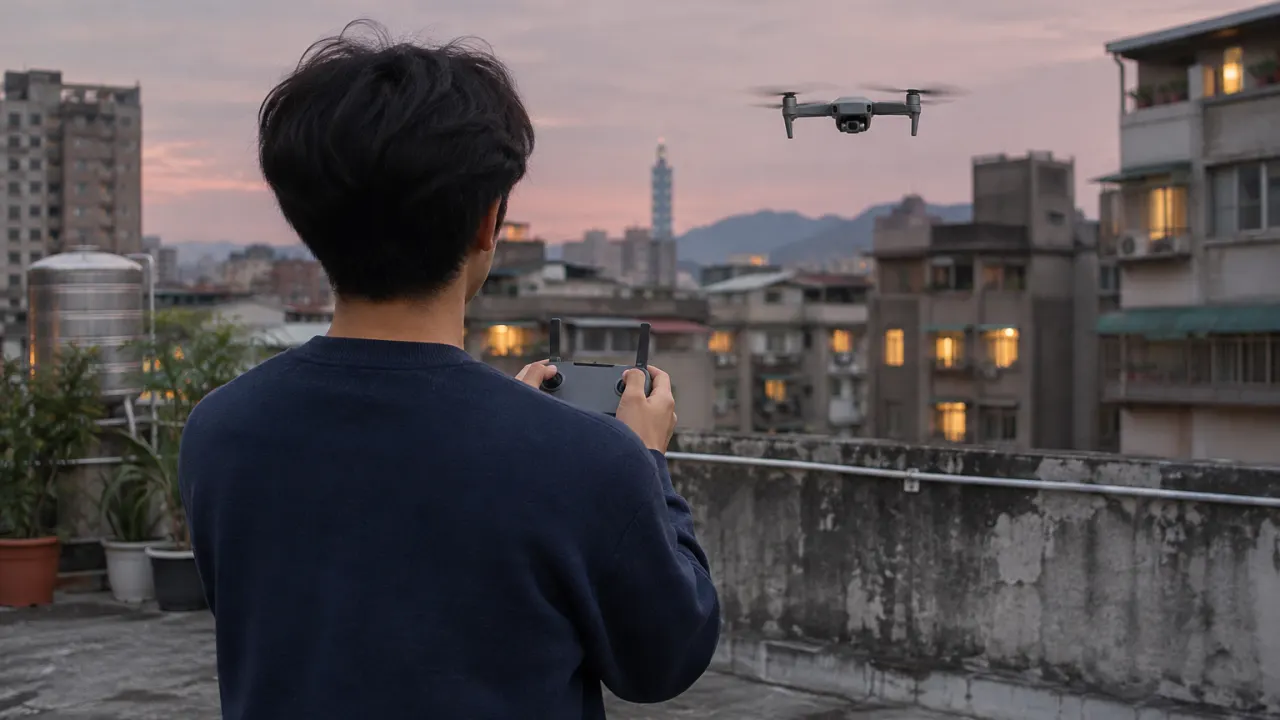
Two hundred and fifty grams. At or above that maximum take-off weight, a privately owned drone in Taiwan must be registered. Article 99-10(1) of the Civil Aviation Act requires registration of drones owned by individuals at 250 g or more, and of every drone owned by a government agency, school or legal entity, with the registration number marked visibly on the aircraft. Above a CAA-announced weight, remote identification is also required. Maximum take-off weight includes airframe, fuel, battery and payload (Regulations of Drone, art. 2(iii)).
Lighter drones are not rule-free. The Act's drone chapter covers all outdoor flights (art. 99-9(1)), and most rules ignore weight.
Registration and licenses by weight
Owners register with the Civil Aeronautics Administration (CAA), including online (Regulations art. 39). Under article 6, individuals file a form with a copy of a national ID or overseas Chinese residence certificate and may fly only once the number is marked. Owners must be at least 14; under-18s need a guardian's consent. Changes of name, address or phone require amended registration (6(3)). The number must stay readable with the naked eye (art. 8), which also lets neighbors identify the owner. Registration lasts two years; renewal may be sought in the last 30 days (art. 10). A sale or loss must be deregistered within 15 days (art. 7).
Licenses turn on weight and navigation equipment (art. 19):
| Max take-off weight (individual owner) | Register | Operator license |
|---|---|---|
| Under 250 g | No | No |
| 250 g to under 2 kg | Yes | No |
| 2 kg to under 15 kg, with navigation equipment | Yes | Basic (普通操作證) |
| 15 kg and over | Yes | Professional (專業操作證) |
A 2–15 kg drone without navigation equipment is not on the article 19 list. Drones owned by government agencies, schools or legal entities need a professional license at any weight (art. 20(2)(iii)). A basic license requires age 18 and a written test; a professional one adds experience, a medical and a practical test. From 14, a learner's license allows practice on drones under 25 kg, with a basic or professional license holder alongside and within that holder's aircraft category (20(2)(i)). Licenses last three years (art. 23(1)).
Borrowing a drone? Article 99-10(2) puts the license duty on whoever operates it, so the borrower of a 3 kg navigating drone needs a basic license.
Flight rules for every drone
Article 99-14(1) sets ten rules. No flying above 400 feet (about 122 m) over ground or water. No dropping or spraying objects. No flying over gatherings of people or outdoor assemblies and parades. No flying between sunset and sunrise. Operate within visual line of sight, with no aid beyond corrective lenses; extended visual line of sight uses a licensed observer within 300 m of the drone, capped at 900 m from the operator and 400 feet (Regulations arts. 2(v)–(vi), 28(1)(iv)). One operator, one drone at a time. Keep watching the drone and its surroundings, and avoid approaching or hitting aircraft, buildings or obstacles.
What about night shots? The sunset rule has no time exception. Only approved agencies, schools and legal entities can be exempted (99-14(2)), and they still need a CAA permit before the approved activity, plus local and central consent for flights over crowds (99-14(3)).
The Regulations add distance. Operators must stay at least 30 m from motorways, expressways, railways, MRT lines, buildings and obstacles (art. 28(1)(i)). Government agencies, schools or legal entities holding a CAA permit under article 32(1) are exempt from all of article 28(1), including the moving-vehicle ban (28(2)). No operating from moving aircraft, vehicles or boats. No flying above 0.02% blood alcohol or 0.1 mg per litre of breath, or while impaired by psychoactive substances (art. 27). Operators must stay alert to aircraft, ultralight vehicles, other drones and obstacles (art. 29).
Two layers of no-fly zones
Restricted and prohibited areas and set distances around airports and airfields are closed to drones; the CAA announces those distances (art. 99-13(1)). Outside them, below 400 feet, city and county governments announce areas and times for drone activity (99-13(2)).
For its 2025 New Year's Eve party, the Taipei City Government closed a 2 km radius around City Hall to drones from 00:00 on December 31, 2024 to 24:00 on January 1, 2025, unless its tourism department consented. That notice has expired; check current notices before flying.
Intruding drones can be stopped by area managers, airport and airfield operators with the aviation police, or local governments (99-13(5)–(7)). Organizations flying there for work need prior consent (99-13(3)–(4)). National parks have separate filming permits, covered in our piece on a national park filming fine.
What the fines are
| Violation | Fine (NT$) | Other measures | Basis |
|---|---|---|---|
| Flying in restricted or prohibited areas or near airports and airfields; above 400 ft | 300,000–1.5 million | License revoked; drone may be confiscated | art. 118-1 |
| Flying without a required license; an organization's missing or insufficient liability insurance | 60,000–300,000 | Activity stopped; confiscation if serious | art. 118-2(1) |
| Required registration or number missing; breaching a local notice; breaching 99-14(1)(ii)–(x) | 30,000–150,000 | Activity stopped; confiscation if serious | art. 118-2(2) |
Night and crowd flights fall in the third row, as does the 30 m rule via 99-14(1)(iv). Local governments impose these fines, except that the CAA does when a no-fly zone or the 400-foot ceiling was also breached (118-2(3)).
Civil liability is separate. The owner pays for death, injury or property damage caused by the drone, or by objects falling from it, regardless of fault and even for force majeure (art. 99-15(1)). Lend it out and owner and operator are jointly liable (99-15(2)). Organizations must insure for the prescribed amount before approved flights (99-15(3)). Safety incidents must be reported to the CAA (99-9(3)).
Visitors' drones
A foreigner with foreign government registration, inspection and operator documents may fly after CAA recognition (art. 99-12). Regulations article 38 requires a form, a passport copy and the certificates, with a Chinese translation for documents not in English; recognition lasts up to six months. Foreigners, and nationals without household registration, with permission to stay six months or more may sit Taiwan's license tests; residents of mainland China, Hong Kong or Macau need one year (38(3)).
No foreign certificates? Article 38(1) sets out no other route; ask the CAA before travelling.
The drone at the neighbor's window
Can a drone merely crossing your yard be stopped? Civil Code article 773 extends land ownership above and below the surface as far as its exercise is useful, but interference that does not obstruct that exercise cannot be excluded. A high pass may fall within that proviso. Low hovering by a house differs and breaches the 30 m rule.
What it films is another matter. Criminal Code article 315-1 punishes, without lawful reason, using equipment to peep at another's non-public activities or private body parts, or secretly recording them, with up to three years' imprisonment, short-term detention or a fine of NT$300,000. A drone hovering at a living-room window and recording (an invented example) puts "non-public" and "lawful reason" in issue. Prosecution requires a complaint (art. 319), filed within six months of learning who the offender is (Code of Criminal Procedure art. 237(1)). Recording to distribute, or distributing, carries up to five years or NT$500,000 (art. 315-2(2)–(3)), and media holding the recording are confiscated whoever owns them (art. 315-3).
Civilly, Civil Code article 18(1) supports removing or preventing an infringement of personality rights, and article 195(1) supports compensation for emotional harm from an unlawful privacy invasion. As a listed interest, privacy needs no showing of seriousness; that threshold applies only to unlisted interests. The Personal Data Protection Act does not apply to purely personal or household activities, or to footage from public places or public events not combined with other personal data (art. 51(1)). Takedowns are covered in our piece on photos posted without consent.
What a Taiwan lawyer can handle
Taiwan lawyers can test a fine's basis and the notice area, then file an administrative appeal and suit. The appeal is due within 30 days from the day after the decision arrives, judged by when the authority receives it (Administrative Appeal Act art. 14(1), (3)). They also handle crash and privacy claims. Consultations on civil matters are available at wei@hoveringlaw.com.tw. Hovering International Law Firm (昊鼎國際法律事務所), Taipei: 7F-2, No. 35, Sec. 1, Chengde Rd., Datong Dist., Taipei City 103. Taichung: 6F-1, No. 19, Guanqian Rd., North Dist., Taichung City 40453.
Near an airport or in a restricted area, the fine starts at NT$300,000, and a licensed operator loses the license (art. 118-1).
Sources
Checked November 3, 2026; Chinese originals quoted.
- Civil Aviation Act, arts. 99-9, 99-10, 99-12, 99-13, 99-14, 99-15, 118-1, 118-2
- Regulations of Drone (遙控無人機管理規則), arts. 2, 6, 7, 8, 10, 19, 20, 23, 27, 28, 29, 32, 38, 39
- Taipei City Government, 2025 New Year's Eve drone no-fly notice (Dec. 31, 2024–Jan. 1, 2025)
- Civil Code, arts. 18, 195, 773
- Criminal Code, arts. 315-1, 315-2, 315-3, 319; Code of Criminal Procedure, art. 237
- Personal Data Protection Act, art. 51; Administrative Appeal Act, art. 14
Frequently Asked Questions
- Can I fly the drone I brought on holiday to Taiwan?
- A foreigner holding foreign government documents for drone registration, inspection and operation may apply to the Civil Aeronautics Administration for recognition and fly once it is granted (Civil Aviation Act art. 99-12). The application includes a form, a passport copy and the foreign certificates, with a Chinese translation if they are in a language other than English. Recognition lasts at most six months from issue (Regulations of Drone art. 38(1)–(2)).
- My drone weighs 200 grams. Do the rules apply?
- Registration does not, because it applies to drones owned by individuals with a maximum take-off weight of 250 grams or more (Civil Aviation Act art. 99-10(1)). The flight rules in article 99-14(1), such as the 400-foot ceiling, the night ban, the ban over crowds and visual line of sight, and the no-fly zones under article 99-13, have no weight exception.
- A gust knocked my drone into someone's car. Do I pay even though I made no mistake?
- Yes. Under Civil Aviation Act article 99-15(1), the owner is liable for death, injury or property damage caused by operating a drone regardless of intent or negligence, including damage from force majeure. If the owner lent the drone to someone else, owner and operator are jointly liable (art. 99-15(2)).
This article provides general information and is not legal advice on any individual matter.