
Taiwan's Criminal Code art. 315-1 punishes anyone who, without lawful reason, secretly records another person's "non-public" activities, speech, conversations or private body parts, or uses tools or equipment to spy on them. The penalty is up to three years' imprisonment, short-term detention or a fine of up to NT$300,000. With a neighbor's camera, the first word that matters is "non-public."
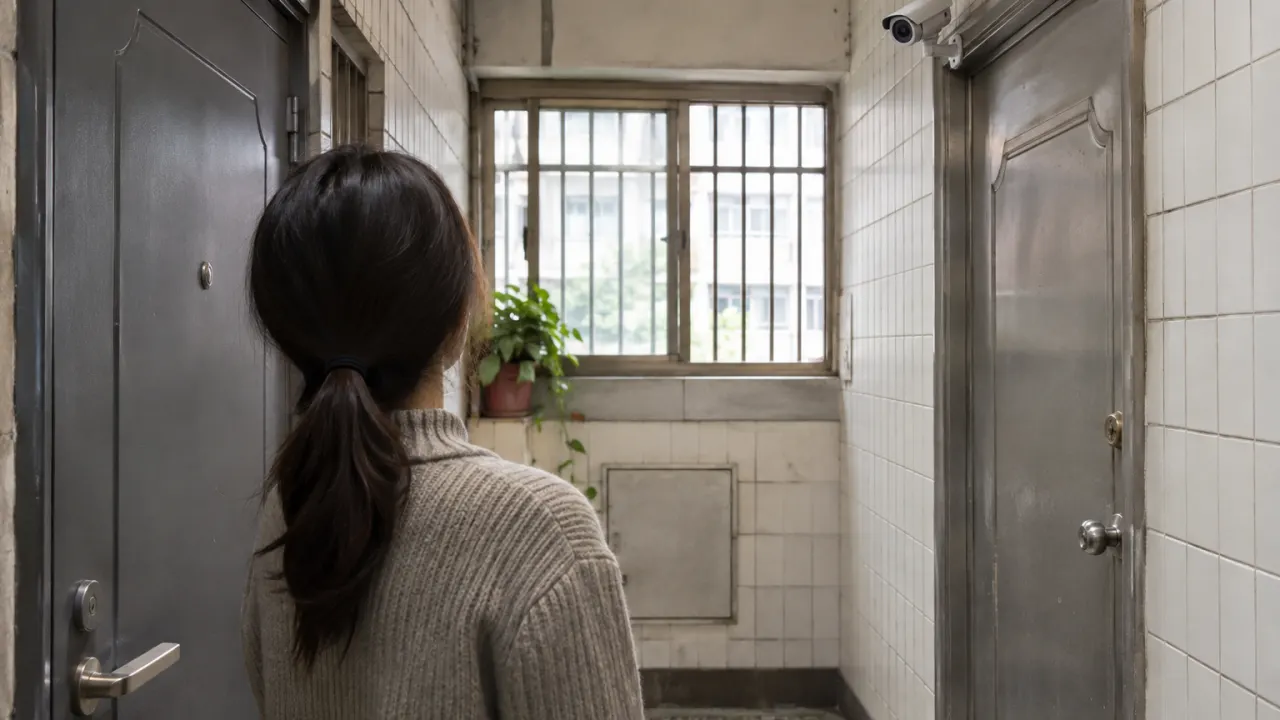
In a Taipei apartment block, the unit opposite mounts a dome camera above its door (an invented example). The lens looks across the corridor at your door and living-room window, recording all day. Is walking down a shared corridor the same as living behind your own window? The article does not define "non-public."
It lists what is protected instead: activities, speech, conversations and private body parts, not places. Where a living room seen through a window fits is a question of fact. Recording is not required: item 1 covers spying with tools or equipment, so a live feed is not excluded.
Balconies are harder: laundry is visible from opposite, yet being glimpsed differs from daily recording. Angle, duration and zoom will matter.
Why a camera that never stops is different
A posted photo is one event; a running camera logs arrivals, visitors and routines every day. Three bodies of law respond: the Civil Code, which allows an order against a threatened intrusion; the Personal Data Protection Act (PDPA), whose reach depends on who collects and why; and the Condominium Administration Act. Posting and removing photos is covered in our article on photos posted without consent.
| Route | Basis | What you seek | Sticking point |
|---|---|---|---|
| Civil injunction | Civil Code 18(1) | Removal or re-angling | Intrusion or threat of intrusion |
| Civil damages | Civil Code 184, 195 | Solatium | Unlawful infringement, fault |
| Personal data | PDPA 19, 29 | Stop collection, damages | Art. 51 exclusion |
| Apartment rules | Condominium Act 9, 36 | Committee intervention | Common area, bylaws |
| Criminal complaint | Criminal Code 315-1, 319 | Prosecution | "Without lawful reason," "non-public" |
Before you know what it records
Civil Code art. 18(1) lets a person ask the court to remove an infringement of personality rights and, where one is threatened, to prevent it. You need not have seen the footage; where the lens points is visible from outside. The claim should name the remedy: removal, re-angling or a privacy shield.
Money is separate. Art. 18(2) allows damages or solatium only where a statute provides, and for privacy that is art. 184, on intentional or negligent unlawful infringement, and art. 195(1). It lists body, health, reputation, liberty, credit, privacy and chastity, adds other personality interests "where the circumstances are serious," and allows a "reasonable amount" for non-pecuniary loss, which the court sets.
If the camera or its wiring is fixed to your own wall or unit, art. 767(1) also applies: an owner may demand removal of interference and prevention of threatened interference. Ownership is the basis, so what the camera sees is beside the point.
The neighbor's security against your privacy
The neighbor has a case too: none of these articles bans cameras as such. Art. 148(1) bars exercising rights mainly to harm others, which home security hardly is.
Disputes can narrow to angle and range. Does it reach across into your door and windows? Does it record sound? Is footage shared? Those facts decide infringement under art. 18 and the "necessary scope" under PDPA art. 5. A few degrees of rotation may end it.
Ask first. A neighbor who ignores a specific written request supplies evidence of a continuing intrusion; one who adjusts the lens saves court fees.
Does the Personal Data Protection Act reach a neighbor?
PDPA art. 2 defines personal data as information identifying a person directly or indirectly, including features, and treats non-government persons and groups as "non-government agencies." Video of faces and comings and goings can qualify. Such an agency needs a specific purpose and one of the grounds in art. 19(1), such as a statutory basis, consent, or no harm to the data subject's rights.
Collection must stay within what the purpose needs and bear a proper, reasonable link to it (art. 5); use generally stays within that purpose (art. 20). A non-government agency that breaches the Act is liable for damages unless it proves no intent or negligence (art. 29), and via art. 28(3) a victim who cannot prove actual loss may ask the court for NT$500 to NT$20,000 per person per incident. Data collected in breach of the Act must be deleted, or its collection, processing and use stopped, at the data subject's request (art. 11(4)).
The obstacle is art. 51(1). The Act does not apply to data handled by a natural person "purely for personal or household activities" (item 1), or to audio-visual data collected in public places or public activities and not combined with other personal data (item 2). Whether a home camera that records into a neighbor's window every day is "purely" household activity is not settled by the text, and no published judgment on the point was found as of November 3, 2026.
Item 1 speaks of natural persons. It does not fit a management committee or a company-run shop. Item 2 turns on undefined "public places"; a key-card corridor may differ from a street arcade. Footage tagged with names or unit numbers is no longer "not combined."
Even if art. 51 applies, only the PDPA drops out. Civil Code arts. 18, 184 and 195 and Criminal Code art. 315-1 remain.
Cameras in an apartment's common areas
Under the Condominium Administration Act art. 3(4), parts outside the private units that are shared are common areas, typically corridors, stairwells and outer walls. Residents must use them according to their purpose and normal use; if not, the management committee (or, without one, the manager in charge) must stop it and may ask the authorities to act or sue (art. 9(2), (4)). "Residents" include tenants (art. 3(8)), whether they installed the camera or are filmed by it.
Special arrangements on common-area use bind only if written into the bylaws (art. 23(2)(2)), and stopping residents' violations is a committee duty (art. 36(5)). Outer-wall installations such as signs or window frames "or similar acts" are subject to filed bylaws or owners' resolutions (art. 8(1)); whether a camera counts, the text does not say. See our articles on management committees and bylaws and neighbor noise.
What if the committee installed the camera? Its duties include safety around the building (art. 36(3)), but as a non-natural person it does not fit PDPA art. 51(1)(1), so placement and range must meet arts. 5 and 19. Can you see the footage? PDPA art. 10 requires answering inquiries, allowing review or providing copies on request, unless major interests of the collector or a third party would be harmed; art. 3 bars waiving these rights in advance.
Six months to file a complaint
Art. 315-1 offences are prosecuted only on complaint (Criminal Code art. 319), filed within six months of learning who the offender is (Code of Criminal Procedure art. 237(1)). That date can be later than the day you first noticed the camera. Complaints go in writing or orally to a prosecutor or judicial police officer, and an oral complaint is recorded in a transcript (art. 242(1)). Spreading secretly recorded content is separately punishable (art. 315-2(3)), and items holding it are confiscated regardless of ownership (art. 315-3).
Keep the evidence on your side
Photograph the lens direction and note when the recording light is on and when you first noticed it. Check for a microphone: recorded talk can meet art. 315-1's "conversations" element, though "without lawful reason" and "non-public" must still be shown. Make requests by dated message or certified letter (存證信函), ask the committee in writing and keep its reply. These records later show the threatened intrusion and the date you learned who the offender was.
Do not remove the camera yourself. Destroying or disabling another's property in a way that may harm them is criminal damage under art. 354, punishable by up to two years, also prosecuted on complaint (art. 357). Removal should go through the committee or a court order.
What a Taiwan lawyer can do
A lawyer can document the camera's range, bring art. 18 and 195 claims, answer an art. 51 defense, write to the committee and file a criminal complaint. Consultations on civil disputes are available at wei@hoveringlaw.com.tw. Hovering International Law Firm (昊鼎國際法律事務所), Taipei: 7F-2, No. 35, Sec. 1, Chengde Rd., Datong Dist., Taipei City 103. Taichung: 6F-1, No. 19, Guanqian Rd., North Dist., Taichung City 40453.
Start with the photo and date from the day you first saw the dome camera. The six months for a complaint run from the day you learn who installed it.
Sources
Checked November 3, 2026. Taiwan laws are cited from the Chinese originals.
Frequently Asked Questions
- The camera faces my home, but I don't know what it actually records. Can I still go to court?
- Yes. Civil Code art. 18(1) lets a person ask the court to remove an infringement of personality rights and, where an infringement is threatened, to prevent it. Money damages or solatium, however, require a specific statutory basis under art. 18(2); for privacy that basis is arts. 184 and 195.
- Does Taiwan's Personal Data Protection Act apply to a camera a private neighbor installed?
- Art. 2 counts natural persons as non-government agencies, but art. 51(1)(1) excludes collection, processing or use by a natural person purely for personal or household activities. Whether a home security camera that keeps recording a neighbor's door or windows falls within that exclusion is not settled by the text. The wording of item 1 does not fit cameras installed by a management committee or other non-natural persons.
- Can I ask the building's management committee to show me its CCTV footage?
- Art. 10 of the Personal Data Protection Act requires a non-government agency, at the data subject's request, to answer inquiries about, allow review of, or copy the personal data it collected, unless doing so would harm national interests, official duties, or major interests of the collector or a third party. Under art. 3 these rights cannot be waived in advance or limited by contract.
This article provides general information and is not legal advice on any individual matter.


