"Since the victim had no licence either, the damages should be reduced." On May 16, 2017, the Taiwan High Court rejected that defence (Taiwan High Court civil judgment 103 Shang No. 1311). Riding without a licence is a finable violation. This crash, the court found, came purely from the other rider's fault and had nothing to do with the licence.
For a foreigner riding in Taiwan on a home licence, or none, the next question is whether that holds every time. The facts behind the ruling give a narrower answer.
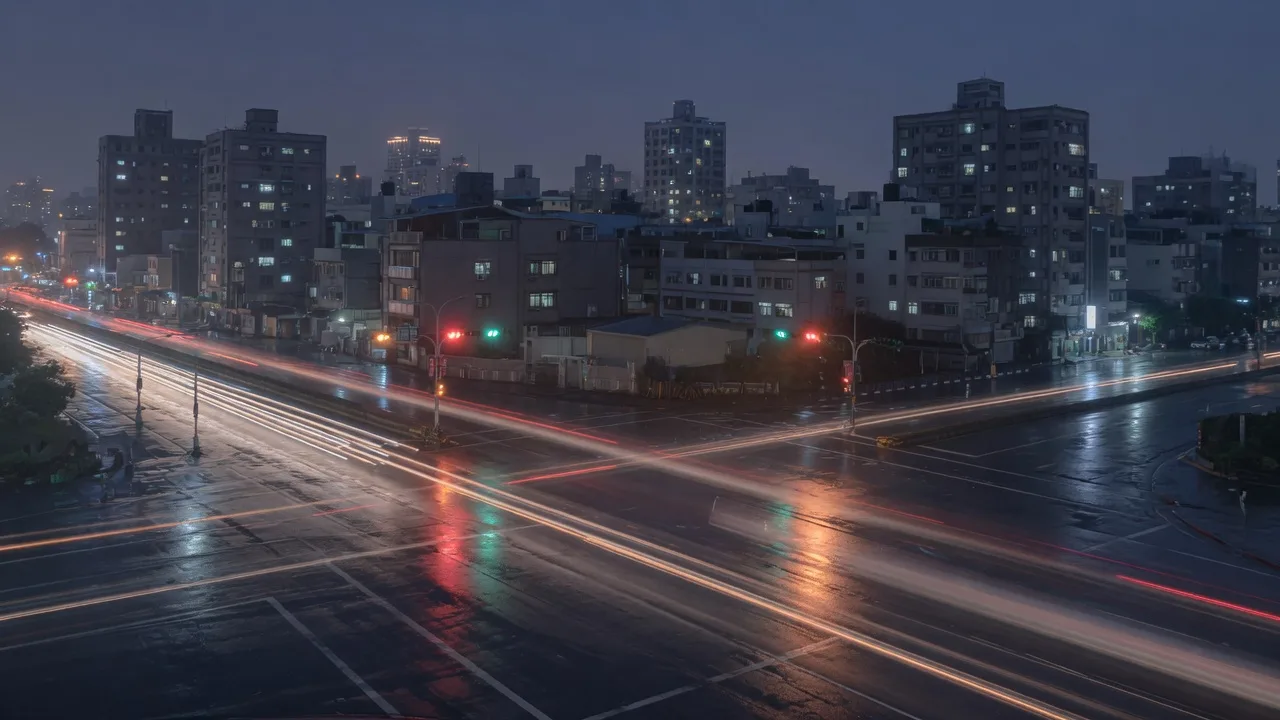
An intersection in Hsinchu, November 2012
At about 7:25 p.m. on November 13, 2012, at the junction of Nanda Road and Dongnan Street in Hsinchu, one rider heading north crossed the double yellow centre line before reaching the stop line and cut into the oncoming lane to turn left early. A rider coming straight the other way could not stop in time. That rider suffered lung contusions and bleeding in the skull and died at 10:05 p.m. the same night.
In defence, the rider who turned argued that the victim had actually run a red light out of Dongnan Street. The court relied on intersection video, the direction of scrape marks on the road, the damage on both scooters and an analysis of the forces involved, and rejected the story. The defendant had also told the first-instance court that the victim came from the opposite direction. An expert report put the time from the centre line to the point of impact at roughly 0.7 to 1.06 seconds. Typical driver perception-reaction time is 1 to 1.6 seconds. There was no time to react.
Criminally, the defendant was convicted of negligent homicide: one year's imprisonment, suspended for three years, on condition of paying NT$1.5 million to the victim's parents.
Does a missing licence count as contributory fault?
Article 217(1) of the Civil Code lets a court reduce or cancel damages where the injured person's own fault contributed to the occurrence or extent of the harm. The question is contribution.
On the licence itself, the High Court accepted that riding a motorcycle without a licence breaches Article 50(1) of the Road Traffic Safety Rules and attracts a traffic penalty. It found, however, that this crash was caused purely by the defendant's fault and was unrelated to whether the victim held a licence. Even if the victim was unlicensed, that did not make the victim contributorily negligent.
That conclusion rests on the evidence. The expert timing showed the victim had no chance to react. And if an unlicensed rider's inexperience had helped cause the crash or made the harm worse? Then the result could be different.
Why the victim's own insurance did not matter
It was the defendant's scooter whose compulsory insurance had lapsed. The victim's parents therefore claimed from the Special Compensation Fund under Article 40(1)(ii) of the Compulsory Automobile Liability Insurance Act. The Fund paid the parents NT$1,001,118 and NT$1,001,117, NT$2,002,235 in all, and then sued the defendant under its subrogation right (Article 42(2)).
Next, the defendant argued that the victim's own scooter was insured, so the parents could have claimed from that insurer and the Fund had no need to pay. The court disagreed. Compulsory insurance covers the liability of the insured vehicle to third parties after an accident (Article 25(1)). Whether the victim's vehicle, which bore no liability, was insured is irrelevant to a claim against the Fund when the liable vehicle is uninsured.
What the parents could claim
When a crash is fatal, the parents are claimants in their own right. Article 192(2) of the Civil Code covers loss of support where the deceased owed a statutory duty to support a third person, and Article 194 allows parents, children and spouses to claim for non-financial harm. In the parents' separate civil case (Taiwan High Court 104 Shang No. 693), after deducting the Fund's payments and NT$50,000 already received, the two parents were still awarded about NT$1.24 million and NT$2.19 million respectively. For the Fund's claim, the court treated NT$1 million of each parent's compensation as damages for non-financial harm and the rest as loss of support.
At first instance, the Hsinchu District Court (102 Su No. 608) found for the Fund, and the High Court dismissed the appeal: NT$2,002,235 plus interest from August 10, 2013. The judgment notes that a further appeal could be filed within 20 days of service. Whether one was filed cannot be confirmed from the public copy.
For foreigners who ride in Taiwan
This ruling rejected the licence-based defence. It did not approve riding without a licence, and the court said in terms that a penalty applies. Holders of a foreign licence may be able to use Article 50(5) of the same Rules: with a valid official foreign licence and proof of permission to stay or reside for six months or more, a licence can be converted without a test on the basis of reciprocity.
Roughly 0.7 to 1.06 seconds, on the expert estimate: that was all the rider coming through the junction had. In weighing fault, the court looked at that window and the paths of the two scooters, not at a licence card.
Sources
- Taiwan High Court civil judgment 103 Shang No. 1311 (May 16, 2017; copy of the Judicial Yuan law database text published by the Special Compensation Fund)
- Civil Code, Articles 192, 194 and 217
- Road Traffic Safety Rules, Article 50
- Compulsory Automobile Liability Insurance Act, Articles 25, 40 and 42 (current text as amended June 15, 2022; checked November 3, 2026)
Frequently Asked Questions
- I was riding a scooter in Taiwan without a Taiwanese licence when another vehicle hit me. Can I still claim?
- In the judgment below, yes. The Taiwan High Court held that where the crash was caused solely by the other rider's fault, the victim's lack of a licence was not contributory negligence. Riding without a licence is still a traffic violation that can be fined, and a different set of facts could lead to a different result.
- The victim's own scooter was insured. Should the family claim from that insurer instead?
- The court rejected that argument. Compulsory insurance covers the insured vehicle's liability to third parties. A vehicle that bears no liability does not change the victim's right to claim from the Special Compensation Fund when the liable vehicle is uninsured (Compulsory Automobile Liability Insurance Act, Articles 25(1) and 40(1)(ii)).
- Can a foreign licence be converted in Taiwan?
- Article 50(5) of the Road Traffic Safety Rules lets a holder of a valid official foreign licence who has permission to stay or reside in Taiwan for six months or more convert it, without a test, to an ordinary Taiwanese licence of the same class from the day after entry, on the basis of reciprocity. Whether this covers your country and vehicle class is a question for the motor vehicles office.
This article provides general information and is not legal advice on any individual matter.