
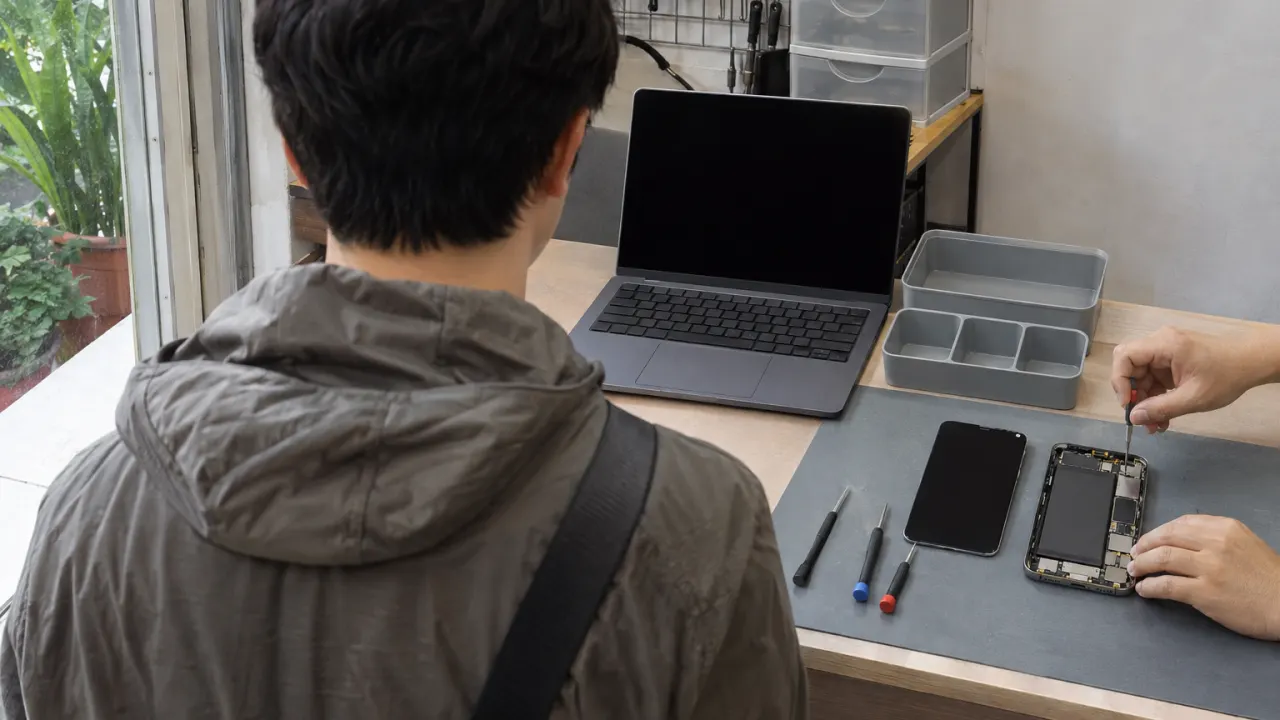
The phone went in for a new screen and returned three days later. The screen works. The photo library is empty, the front camera is dead, and the bill reads NT$7,800 against a NT$3,500 quote, the extra blamed on "board cleaning" (an invented example).
No standard terms for device repair
Consumer Protection Act Article 17 lets the central authority announce terms a trade's standard-form contracts must or must not contain; announced mandatory terms bind even if omitted (paragraph 5). As of November 3, 2026, the Executive Yuan lists 88 such announcements and 96 model contracts. Only car repair has "repair" (維修) in its title; phones and laptops have none.
So the ticket's fine print governs. Terms a business pre-drafts for many consumers are standard terms, posted notices included (Article 2, item 7). Doubtful terms favor the consumer (Article 11(2)); terms breaching good faith and obviously unfair to the consumer are void (Article 12(1)). Without the reasonable review period of up to 30 days that Article 11-1 requires, a term is not part of the contract unless the consumer claims it (paragraph 3).
Repair is a contract for work; storage is less clear
Civil Code Article 490 defines a contract for work (承攬): one party completes a piece of work, the other pays on completion. A paid repair fits. Materials the repairer supplies are presumed part of the fee (paragraph 2). Payment is due on delivery, or on completion if nothing is delivered (Article 505(1)); check agreed prepayments.
Safekeeping is not addressed. A paid depositary (寄託, Article 589(1)) owes a good administrator's care (Article 590) and may not use the item, or let others use it, without consent (Article 591(1)). Whether that covers storage during repair is unstated.
And the technician's own slip? A debtor answers for its agents' or employees' intent or negligence in performing as for its own, unless otherwise agreed (Article 224).
When photos are wiped
No Civil Code article addresses data lost in a repair; the job was the device, not the photos stored on it. In contract, further loss caused by incomplete performance attributable to the debtor is claimable (Article 227(2)). In tort, whoever intentionally or negligently and unlawfully infringes another's right must compensate (Article 184(1), first sentence). Both need fault and loss.
What if the ticket disclaims all responsibility for data loss? Liability for intent or gross negligence cannot be waived in advance (Article 222). A pre-written term freeing or lightening the drafter's liability is void to that extent if obviously unfair in the circumstances (Article 247-1, item 1); Consumer Protection Act Article 12 points the same way.
Fault and loss must still be proved. If the customer signed consent to a reset the shop said was needed, the first fight is over that consent's reach. Keep the form.
Fixed badly, or broken elsewhere
A flickering new screen is a defect: the work must have the agreed quality, without defects reducing value or ordinary or agreed fitness (Article 492). After a reasonable deadline for a fix (Article 493(1)), the customer may have it fixed and recover necessary costs (paragraph 2), unless the repairer refuses an excessively costly fix (paragraph 3). An unfixed, refused or unfixable defect allows rescission or a lower fee, but no rescission for an unimportant defect (Article 494); the repairer's fault adds damages (Article 495(1)).
The defect must surface within one year of delivery (Article 498(1)), and the rights lapse one year after discovery (Article 514(1)). Deliberate concealment stretches the one-year window to five (Article 500) and voids any clause excluding or limiting defect liability (Article 501-1).
Damage outside the job, like a camera cable torn during the swap, falls under Articles 227(2) and 184, and damaged property is compensated by its loss in value (Article 196). Tort claims lapse two years after learning of the damage and liable party, or ten years after the act (Article 197(1)). Article 227 sets no period of its own.
Sometimes the device itself is the cause. Article 508(1) puts the risk of damage before acceptance on the repairer, or on a customer who delays acceptance; under paragraph 2, the repairer is not liable for customer-supplied materials destroyed by force majeure. Under Article 509, if defective customer materials or improper instructions ruin the work, a repairer who warned in time may claim pay for labor and outlays, plus damages for the customer's negligence. Is a handed-in device "materials"? The Code is silent.
Finishing past the agreed or a reasonable time through the repairer's fault allows a lower fee or delay damages (Article 502(1)). Where on-time completion is essential, the customer may rescind and claim damages (paragraph 2), and if the repairer's delay makes a missed deadline clearly foreseeable, may do so before completion (Article 503).
A bill above the quote
With no agreed fee, the price list applies, or custom (Article 491(2)). If only an approximate fee was estimated and it is exceeded by a very large amount for reasons not attributable to the customer, the customer may rescind during or after the work (Article 506(1)) but owes the repairer reasonable compensation (paragraph 3). No figure defines "very large" (甚鉅).
For unrequested work like the board cleaning, first ask whether it was inside the job ordered; the ticket's repair items and any approving message answer that.
No payment, no phone? A creditor holding another's movable may retain it while a connected, due claim is unpaid (Article 928(1)). Retention needs a claim. Whether the extra is owed decides it.
A technician browsing the album
The Personal Data Protection Act covers data identifying a person directly or indirectly (Article 2, item 1); non-government agencies are natural or legal persons or groups outside government (item 8). They may collect or process personal data only with a specific purpose and a ground in Article 19(1), item 2 being a contractual or quasi-contractual relationship plus appropriate security measures, and never beyond what that purpose requires (Article 5). Testing a touchscreen and copying an album differ on that point.
If a non-government agency's violation leads to unlawful collection, processing or use, or other infringement of rights, it pays damages unless it proves no intent or negligence (Article 29(1)). Non-pecuniary loss counts; if actual loss is hard to prove, the court may be asked to set NT$500 to NT$20,000 per person per incident (Article 29(2), applying Article 28(2)-(3)). The claim lapses two years after learning of the damage and liable party, or five years after the damage (Article 30). Article 51(1), item 1, exempts natural persons acting for purely personal or family purposes, which commercial repair is not.
Disclosing without cause another's secret learned or held through computers or related equipment falls under Criminal Code Article 318-1; obtaining, deleting or altering another's electromagnetic records without cause, causing damage, under Article 359. Both need a complaint (Articles 319, 363) within six months of knowing the offender (Code of Criminal Procedure Article 237(1)). Photos already online: see photos posted without consent.
Manufacturer warranty and the repair shop
A business guaranteeing quality must issue a written warranty stating, among other items, its content, period and start, and the manufacturer's name and address (Consumer Protection Act Article 25). That document governs warranty repairs; an independent shop answers under its own contract.
For sales, point 5 of the Ministry of Economic Affairs' mandatory terms for electrical appliance sales (March 3, 1999) makes the seller responsible for warranty repair per its ads and warranty. The seller repairs in-warranty failures not attributable to the buyer; after three failed repairs the buyer may demand a refund or same-kind replacement, which the seller may not refuse. Whether phones and laptops are "appliances" there is undefined.
Complaint, mediation, small claims
Consumers may complain to the business, a consumer group or a consumer service center; the business must handle it properly within 15 days (Consumer Protection Act Article 43(1)-(2)). Next come the local consumer protection officer (paragraph 3) and the consumer dispute mediation committee (Article 44). Official guidance says suing needs neither step first.
Money claims up to NT$100,000 use small claims (Code of Civil Procedure Article 436-8(1)); see small claims, and renovation contracts for more on contracts for work.
What a Taiwan lawyer can do
Defect rights lapse a year after discovery; criminal complaints have six months. Within them a Taiwan lawyer can review the paperwork, assess Article 506 rescission and the waiver clause, write to the shop, and handle mediation, data claims or litigation. Consultations on civil disputes are available at wei@hoveringlaw.com.tw. Hovering International Law Firm (昊鼎國際法律事務所), Taipei: 7F-2, No. 35, Sec. 1, Chengde Rd., Datong Dist., Taipei City 103. Taichung: 6F-1, No. 19, Guanqian Rd., North Dist., Taichung City 40453.
Back to the phone: the board-cleaning charge turns on consent to extra work, the dead camera on proof it worked before the swap, the empty album on the ticket's backup wording and any reset consent.
Sources
Checked November 3, 2026. Taiwan laws and notices are cited from the Chinese originals.
- Executive Yuan, list of mandatory and prohibited terms for standard-form contracts (88 entries)
- Executive Yuan, list of model standard-form contracts (96 entries)
- Ministry of Economic Affairs, 電器買賣定型化契約應記載及不得記載事項 (announced March 3, 1999, Jing (88) Shang No. 88002193)
- Consumer Protection Committee, Executive Yuan, 消費爭議處理程序
- Consumer Protection Act, Article 2
- Consumer Protection Act, Article 11
- Consumer Protection Act, Article 11-1
- Consumer Protection Act, Article 12
- Consumer Protection Act, Article 17
- Consumer Protection Act, Article 25
- Consumer Protection Act, Article 43
- Consumer Protection Act, Article 44
- Civil Code, Article 184
- Civil Code, Article 196
- Civil Code, Article 197
- Civil Code, Article 222
- Civil Code, Article 224
- Civil Code, Article 227
- Civil Code, Article 247-1
- Civil Code, Article 490
- Civil Code, Article 491
- Civil Code, Article 492
- Civil Code, Article 493
- Civil Code, Article 494
- Civil Code, Article 495
- Civil Code, Article 498
- Civil Code, Article 500
- Civil Code, Article 501-1
- Civil Code, Article 502
- Civil Code, Article 503
- Civil Code, Article 505
- Civil Code, Article 506
- Civil Code, Article 508
- Civil Code, Article 509
- Civil Code, Article 514
- Civil Code, Article 589
- Civil Code, Article 590
- Civil Code, Article 591
- Civil Code, Article 928
- Personal Data Protection Act, Article 2
- Personal Data Protection Act, Article 5
- Personal Data Protection Act, Article 19
- Personal Data Protection Act, Article 28
- Personal Data Protection Act, Article 29
- Personal Data Protection Act, Article 30
- Personal Data Protection Act, Article 51
- Criminal Code, Article 318-1
- Criminal Code, Article 319
- Criminal Code, Article 359
- Criminal Code, Article 363
- Code of Criminal Procedure, Article 237
- Code of Civil Procedure, Article 436-8
Frequently Asked Questions
- The repair ticket says the shop is not responsible for data loss. Can I still claim?
- Liability for intent or gross negligence cannot be waived in advance (Civil Code Article 222). A pre-written term that frees or lightens the shop's liability is void to that extent where it is obviously unfair in the circumstances (Civil Code Article 247-1, item 1), and Consumer Protection Act Article 12 voids standard terms that breach good faith and are obviously unfair to the consumer. Even then, compensation still requires fault on the shop's side and actual loss (Civil Code Articles 227(2) and 184(1)).
- The shop will not return my phone until I pay the extra charge.
- A creditor holding another's movable may retain it when a claim connected with it is due and unpaid (Civil Code Article 928(1)), and the fee is due when the work is delivered (Article 505(1)). Retention needs a valid claim, so the question is whether the extra amount is owed. If the quote was only an estimate and was exceeded by a very large amount for reasons not attributable to you, rescission under Article 506(1) is also worth examining.
- My laptop failed again two months after the repair, with the same symptom.
- For a defect in the repaired part you may set a reasonable deadline and demand a fix (Civil Code Article 493(1)). The defect must be found within one year of delivery (Article 498(1)), and the rights to a fix, a lower fee, damages or rescission lapse if not exercised within one year of discovering it (Article 514(1)).
This article provides general information and is not legal advice on any individual matter.


