
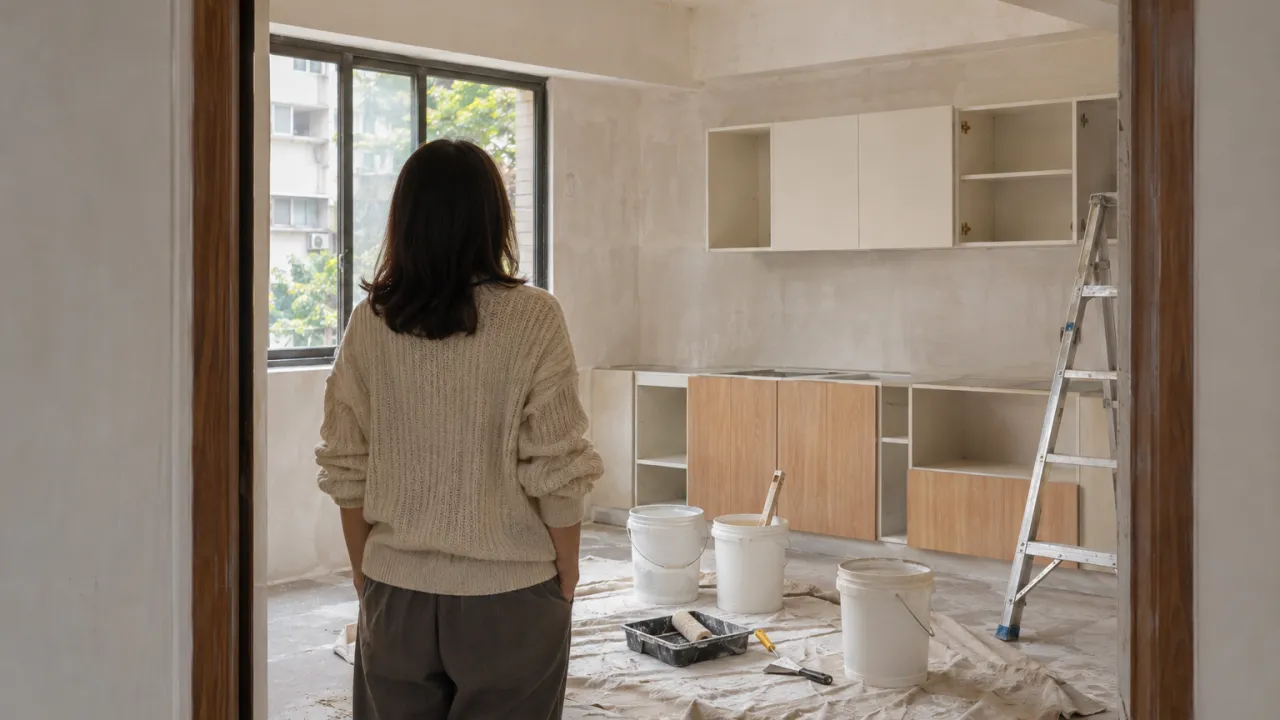
NT$310,000. That was a renovation firm's extras invoice in the last week of a Taipei apartment job, against a signed quote (報價單) of NT$820,000 (an invented example). Whether the owner owes it turns on three questions: was the quote a fixed price or an estimate; who ordered the extra work; and when?
A contract for work
The Civil Code treats renovation as chenglan (承攬), a contract for work: one side completes defined work, the other pays on completion (Civil Code art. 490(1)). Where the contractor supplies materials, their cost is presumed to be part of the price (art. 490(2)).
A Ministry of the Interior model renovation contract (建築物室內裝修—工程承攬契約書範本) dates from 2012 and was revised on December 9, 2014 (Tai-Nei-Ying No. 1030813951). Where a signed contract follows its wording, the clauses cited below are its terms.
Estimate or fixed price?
For an estimate, art. 506 governs. If the price runs "far beyond" the estimate for reasons not attributable to the owner, the owner may rescind, during the work or after it (para. 1). For a building or other structure on land, or major repairs to one, only a reasonable reduction is available, though unfinished work can be stopped by notice and rescinded (para. 2). Either way, a rescinding owner pays the contractor reasonable compensation (para. 3).
How far is "far beyond"? The Code gives no percentage. A 38% overrun is arguable either way.
With a fixed-price quote, the question is scope. Article 11 of the model contract allows changes only by agreement. Scheduled items keep their unit rates; new items are priced by negotiation and signed by the owner, in writing, before work starts.
What about extras requested only by word of mouth? A contract forms when the parties agree, expressly or by conduct (art. 153(1)). Work plainly done only for pay is deemed paid work, priced by a price list or, failing one, custom (art. 491). Oral orders still create a duty to pay where agreement is shown or art. 491 applies. They just make the agreed scope and amount harder to prove.
Late completion
If the contractor's fault makes the work late, past the agreed date or a reasonable time, the owner may claim a price reduction or delay damages (art. 502(1)). Rescission needs more: completion or delivery by a specific date must have been an essential term (art. 502(2)).
If the contractor's delay makes a missed deadline clearly foreseeable, and would justify rescission after completion, the owner may rescind early and claim damages (art. 503).
Under art. 504, an owner who accepts late work without a reservation releases the contractor from liability for the delay's consequences. A written reservation at handover avoids that.
Model article 16(1) sets a late penalty of 0.1% of the total price a day, capped at 10% and deductible from payments, except for delay caused by the owner or not attributable to the contractor. On an NT$820,000 job that is NT$820 a day, to a maximum of NT$82,000. Late owner-supplied materials or other trades extend the schedule; past 30 days, the owner covers the contractor's losses (art. 9(2)). Courts may cut an excessive penalty (art. 252); see our piece on penalty reductions.
Owners can cause delay too. When the work needs an owner's act that never comes, the contractor may set a reasonable deadline and, if it passes, rescind and claim damages caused by the rescission (art. 507).
Defects, step by step
Work must have the agreed quality, free of defects that cut its value or fitness for ordinary or agreed use (art. 492). Remedies come in sequence.
First, the owner sets a reasonable deadline for repair (art. 493(1)). If it passes, the owner may repair and recover the necessary cost (para. 2), unless repair would be excessively expensive and the contractor refuses on that ground (para. 3).
Next come rescission or a price reduction, once the deadline is missed, repair is refused, or the defect cannot be fixed (art. 494). Rescission is barred for minor defects and for buildings or other structures on land. Contractor fault adds damages, and a building defect so serious that the work cannot serve its purpose allows rescission (art. 495). Owner-supplied materials or owner instructions that cause defects carry no such rights, unless the contractor knew and kept quiet (art. 496). During the work, defects clearly foreseeable from the contractor's negligence can be ordered corrected by a deadline, then handed to a third party at the contractor's risk and cost (art. 497).
Under model article 13, the owner inspects within 10 days starting the day after a written completion notice is served. Staying away without good reason after two written reminders, each setting a reasonable deadline, means presumed acceptance. Defects not repaired by the agreed deadline, and still unfinished after the owner's demand, may go to a third party, paid from unpaid instalments.
The clocks
| Situation | Period | Source |
|---|---|---|
| Ordinary work | Defect must be discovered within 1 year of delivery | art. 498 |
| Building or structure on land, or major repairs | 5 years | art. 499 |
| Contractor deliberately concealed the defect | 1 year becomes 5; 5 becomes 10 | art. 500 |
| After discovery | Rights lapse if not exercised within 1 year | art. 514(1) |
Contracts may lengthen the art. 498 and 499 periods but not shorten them (art. 501). A clause excluding defect liability is void if the contractor deliberately hid the defect (art. 501-1). The model contract adds a one-year warranty from acceptance that leaves Civil Code liability intact (art. 22), and bars defect claims five years after acceptance (art. 13(4)). Whether interior work is "major repairs" is undefined; a contractual period avoids that fight. The contractor's own claim for the price lapses after two years (art. 127(7)).
Holding back the final payment
Payment is due on delivery, or part by part if parts are delivered and priced separately (art. 505). The model contract caps stage payments at 5%, 25%, 30% and 30%, and the balance falls due only after full acceptance, an interior renovation compliance certificate, and a warranty deposit of at least 5% (art. 6).
Can an owner simply withhold everything? Art. 264 lets a party refuse performance until the other side performs, unless it must perform first, and not where refusal after partial performance breaches good faith (para. 2). Withholding a large balance over a small defect invites that argument. Late payment costs money: contract interest of up to 5% a year (art. 6), statutory interest if none is agreed (art. 233), and the model's 0.1% daily penalty, capped at 10%, after a written demand setting a reasonable period (art. 16(2)).
Apartment rules and permits
Using common areas for work on your unit needs the management committee's or manager's consent (Condominium Administration Act art. 6(1)(4)). Main structural elements may not be altered without building-authority approval (art. 16(3)). See our guide to management committees.
Interior renovation of buildings used by the public needs a permit (Building Act art. 77-2). So do buildings the Ministry designates; licensed renovators must do the work. Covered work means fixed ceilings, interior walls, fixed partitions over 1.2 metres, cabinet partitions included, and moved dividing walls, not wallpaper or furniture (Regulations art. 3). Work normally waits for the permit (art. 22). Article 33 is the exception. It covers residential use, or up to 300 m² per storey on floors one to ten and basements, 100 m² from the eleventh up (an area spanning two or more storeys is added up and may not exceed the smallest of those storeys' limits), where one-hour fire-rated walls, doors and windows enclose the area and escape routes, fire equipment, fire compartments and main structure stay unchanged. Signed drawings are filed (申報), work starts once the authority sets a period, and permit review and the compliance certificate follow completion.
Housing blocks of six or more storeys count as buildings used by the public under a Ministry order of March 3, 2010 (No. 0990801045), quoted in a Taipei City appeal decision of August 10, 2026. Permit delays fall on whoever the contract made responsible for applying.
Mediation and court
Township and city offices mediate civil disputes, free apart from inspection costs (Township and County-Administered City Mediation Act arts. 1, 23); a court-approved settlement has the effect of a final judgment (art. 27). Consumer complaints go to the business (15 days to respond), then a consumer protection officer and a consumer dispute mediation committee (Consumer Protection Act arts. 43, 44).
Property claims up to NT$500,000 generally go to court mediation before suit (Code of Civil Procedure art. 403(1)(11)). A court may dismiss that application if mediation already failed before another statutory body (art. 406(1)(2)). The same NT$500,000 ceiling marks the summary procedure (art. 427(1)), and money claims up to NT$100,000 use small claims (art. 436-8(1)). An NT$310,000 claim falls in the summary range. See our small-claims guide and our note on preserving evidence before suit.
Working with a Taiwan lawyer
A Taiwan lawyer can sort an extras bill into original scope, agreed additions and unsupported items, draft the repair demand, handover reservation or art. 506 notice in Chinese, and handle mediation or litigation. Consultations on civil disputes are available at wei@hoveringlaw.com.tw. Hovering International Law Firm (昊鼎國際法律事務所), Taipei: 7F-2, No. 35, Sec. 1, Chengde Rd., Datong Dist., Taipei City 103. Taichung: 6F-1, No. 19, Guanqian Rd., North Dist., Taichung City 40453.
Back to the NT$310,000 invoice: quoted items at quoted unit rates, signed change orders at their amounts, anything undocumented by price list or custom. The one-year clock for any defect starts the day it is found.
Sources
Checked November 3, 2026. Taiwan law is quoted from the Chinese originals.
- Civil Code, art. 127
- Civil Code, art. 153
- Civil Code, art. 233
- Civil Code, art. 252
- Civil Code, art. 264
- Civil Code, art. 490
- Civil Code, art. 491
- Civil Code, art. 492
- Civil Code, art. 493
- Civil Code, art. 494
- Civil Code, art. 495
- Civil Code, art. 496
- Civil Code, art. 497
- Civil Code, art. 498
- Civil Code, art. 499
- Civil Code, art. 500
- Civil Code, art. 501
- Civil Code, art. 501-1
- Civil Code, art. 502
- Civil Code, art. 503
- Civil Code, art. 504
- Civil Code, art. 505
- Civil Code, art. 506
- Civil Code, art. 507
- Civil Code, art. 514
- Code of Civil Procedure, art. 403
- Code of Civil Procedure, art. 406
- Code of Civil Procedure, art. 427
- Code of Civil Procedure, art. 436-8
- The Township and County-Administered City Mediation Act (鄉鎮市調解條例), art. 1
- The Township and County-Administered City Mediation Act, art. 23
- The Township and County-Administered City Mediation Act, art. 27
- Consumer Protection Act, art. 43
- Consumer Protection Act, art. 44
- Condominium Administration Act (公寓大廈管理條例), art. 6
- Condominium Administration Act, art. 16
- Building Act (建築法), art. 77-2
- Regulations Governing Building Interior Renovation (建築物室內裝修管理辦法), art. 3
- Regulations Governing Building Interior Renovation, art. 22
- Regulations Governing Building Interior Renovation, art. 33
- Ministry of the Interior, Building Interior Renovation Construction Contract model (建築物室內裝修—工程承攬契約書範本), announced June 25, 2012, revised Dec. 9, 2014 (Tai-Nei-Ying No. 1030813951) — Executive Yuan model contracts page
- Taipei City Government appeal decision Fu-Su-San No. 1156080925, Aug. 10, 2026, quoting Ministry of the Interior order Tai-Nei-Ying No. 0990801045 of Mar. 3, 2010 — Taipei City law database
Frequently Asked Questions
- The contractor's bill is far above the quote. Can I cancel?
- If the contract gave only an estimated price and the price exceeds it by a great deal for reasons not attributable to you, you may rescind during the work or after completion (Civil Code art. 506(1)). For a building or other structure on land, or major repairs to one, you may only ask for a reasonable reduction, though you may order work stopped and rescind while it is unfinished (art. 506(2)). Rescinding on either ground means paying the contractor reasonable compensation (art. 506(3)). With a fixed-price quote, the first question is whether the extra work was agreed.
- How long do I have to raise a defect?
- Defect rights cannot be asserted if the defect is discovered more than one year after delivery (Civil Code art. 498); for a building or other structure on land, or major repairs to one, the period is five years (art. 499). If the contractor deliberately concealed the defect, the periods become five and ten years (art. 500). Separately, each right lapses if not exercised within one year of discovering the defect (art. 514(1)). A contract may lengthen the art. 498 and 499 periods but not shorten them (art. 501).
- The work finished late. Is it safe to accept it?
- You may accept it, but if you accept late work without a reservation, the contractor is not liable for the consequences of the delay (Civil Code art. 504). For delay attributable to the contractor you may claim a price reduction or damages caused by the delay (art. 502(1)); a written reservation at handover keeps that claim alive.
This article provides general information and is not legal advice on any individual matter.


