
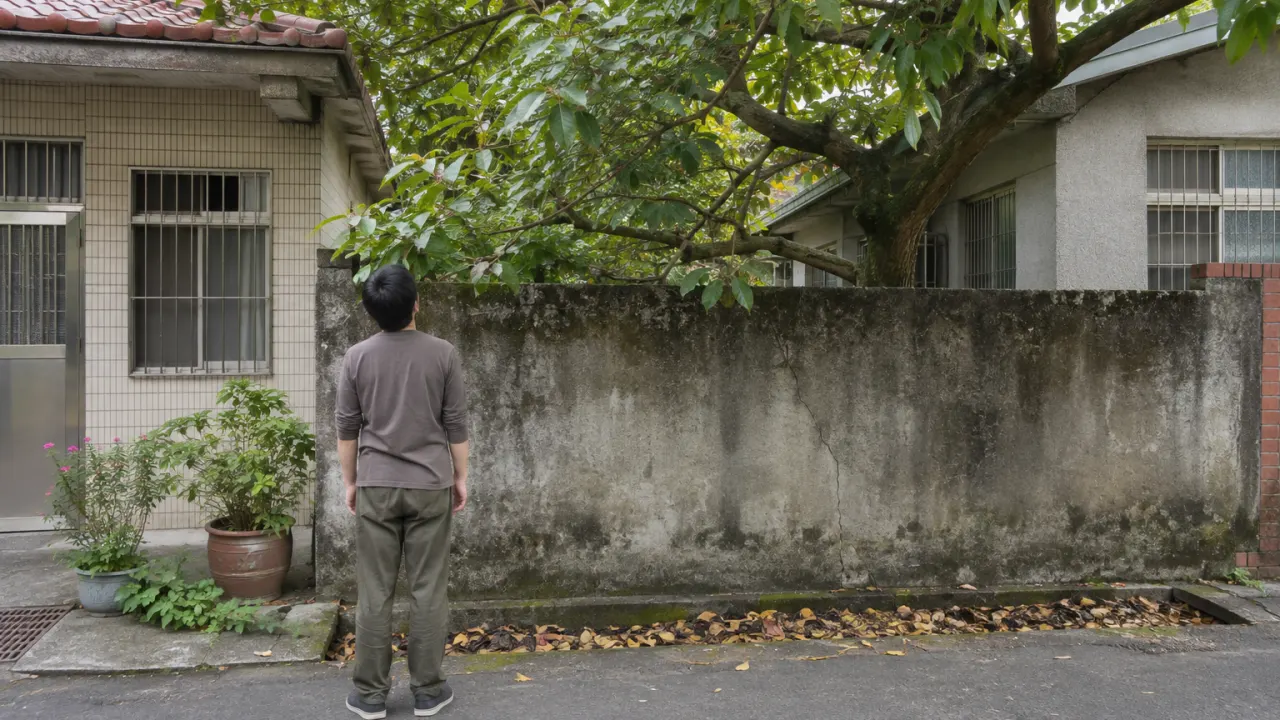
A mango that drops on its own from a neighbor's tree into your yard is yours. Article 798 of Taiwan's Civil Code deems fruit that falls naturally onto adjoining land to belong to that land's owner, unless the land is public. Fruit is the easy case. Branches, roots, roof runoff and walls built across the boundary come with steps and conditions.
These rules sit in the Civil Code's neighboring-relations provisions (相鄰關係), Articles 774 to 800. Article 774 sets the baseline: a landowner running a business or exercising ownership must take care to avoid damage to neighboring land. This piece covers detached and low-rise houses. Leaks inside apartment buildings are covered in our piece on management committees, and damage from a neighbor's construction work is outside its scope.
Overhanging branches and roots: ask first, cut later
When branches or roots of a neighbor's plant cross the boundary, the landowner may ask the plant's owner to cut them within a reasonable period (Article 797(1)). No number of days is set. A written request naming the work and a date helps if the period is later disputed.
If the period passes uncut, paragraph 2 lets the landowner cut the branches and roots that cross the line and claim the cost. Felling the tree is not part of that right.
What happens if you skip the request? Article 797 makes the request and the lapse of time the conditions for self-help. A tree owner whose tree is damaged without them may claim compensation under Article 184(1), which covers intentional or negligent unlawful injury to another's rights.
There is a threshold, too. Paragraph 3 disapplies both steps where the overhang does not interfere with use of the land.
Entering the neighbor's yard is another matter. Article 790 lets a landowner forbid entry, with narrow exceptions such as a right of way. Work you cannot reach from your side needs consent.
Rainwater: natural flow and poured water
Water flowing naturally from higher neighboring land cannot be blocked (Article 775(1)). Where the neighboring land needs that water, it may not be blocked entirely, even for the owner's own use (775(2)).
Structures are different. Article 777 forbids installing eaves, works or other equipment that make rainwater or other liquids pour directly onto adjoining property. Think of a downspout aimed at your yard, or air-conditioner drainage dripping over the wall (an invented example). "Water runs downhill anyway" describes Article 775. The test for Article 777 is whether eaves, gutters or pipes pour water directly onto your property; water that lands on the neighbor's own ground first and then flows across is still Article 775 flow.
| Source of the water | Article | What it provides |
|---|---|---|
| Natural flow from neighboring land | 775 | Cannot be blocked; water the neighboring land needs cannot be blocked entirely |
| Eaves, works or equipment pouring directly | 777 | Such installations are prohibited |
| Water works that burst or clog, causing or threatening damage | 776 | Owner of that land repairs, clears or prevents at own cost; custom on costs prevails |
| Flow blocked on neighboring land by an unforeseen event | 778 | Landowner may clear it at own cost; a benefiting neighbor contributes proportionally, unless custom differs (778(2)) |
| Draining flooded land or household water | 779 | May pass through neighboring land to a river or ditch, by the least damaging route, with compensation |
Harm need not have happened yet. A neighbor's leaf-clogged drain that overflows under the wall in every storm (an invented example) threatens damage, so that owner must clear it at their own cost under Article 776. If a neighbor objects to an Article 779 route, either side may ask the court to decide (779(4)); other laws or custom prevail (779(3)).
Is the wall over the line? Survey first
The Regulations for the Implementation of Cadastral Surveys (地籍測量實施規則), made under Land Act Article 47, list boundary identification (鑑界) as a ground for a land re-survey (Article 204, item 6). The owner or manager applies to the local registration office or online with an electronic signature, and may use an agent (Article 205). Neighboring owners are notified as interested parties. The survey proceeds without them, but an applicant who is absent or fails to bury boundary markers as required is treated as abandoning the application and loses the fee (Article 211).
One re-survey is available to a dissatisfied applicant who pays again; municipal or county staff carry it out (Article 221(1)(ii)). The applicant and attending parties confirm the points on site and sign the survey map; refusals are noted on it (221(2)). A neighbor who disputes the result may apply for a survey of their own land, with (1)(ii) and (1)(iii) applying (221(3)).
A house over the line is not automatically torn down
Under Article 796(1), if an owner built a house across the boundary without intent or gross negligence, and the neighbor knew but did not object at once, the neighbor cannot demand removal or alteration. The builder must compensate the neighbor's loss. The neighbor may also demand that the builder buy the encroached strip and any unusable remnant at a reasonable price, fixed by agreement or by the court (796(2)).
So object in writing during construction. That preserves the removal claim.
Even after a prompt objection, the court may excuse all or part of the removal, weighing public interest and the parties' interests, unless the boundary was crossed intentionally (Article 796-1). Compensation and the purchase demand then apply. Article 796-2 extends both articles to other buildings of comparable value to a house. A wall that falls short of that is handled under Article 767(1), which lets an owner demand removal of interference with ownership.
Removal and damages are separate claims
Prevention can be demanded too where interference is threatened, such as redirecting a downspout (767(1)). Losses already suffered are claimed in tort under Article 184(1). Compensation means restoring the prior state (Article 213(1)), or the victim may claim the cost of restoration instead (213(3)).
Do tenants have these rights? Article 800-1 applies Articles 774 to 800 to lessees and other users, so a foreign tenant renting a house can make the Article 797 request or the Article 777 demand. Article 767 belongs to owners and holders of other real rights (767(2)), so removing a structure is easier with the landlord involved.
Mediation comes before a lawsuit
Code of Civil Procedure Article 403(1) requires court mediation before suit in neighboring-relations disputes between owners, superficies holders or other users of real property (item 1) and over boundaries or boundary markers (item 2). The exceptions are the grounds in Article 406(1), such as no prospect of settlement or a failed mediation before another statutory body. A suit filed without one is treated as a mediation application (Article 424(1)). The application states the legal relationship and the dispute, with documents in original or copy (Article 405(2)).
Township and city offices also run mediation committees for civil matters (Township and County-Administered City Mediation Act, Article 1). They charge nothing beyond inspection costs (Article 23). The other side must consent (Article 11), and parties living in the same township use its committee (Article 13(i)). Once approved by a court, a civil mediation has the effect of a final judgment and bars a new suit on the same matter (Articles 26–27). A failure there is itself an Article 406(1) ground.
Courts may also refer such cases to a committee, pausing the suit, and get them back if no settlement comes within two months after the committee accepts the referral (Article 12). Approved settlement ends a pending suit; the plaintiff may then reclaim two-thirds of the court fee within three months of service (Article 28(1)). Once first-instance argument closes, this route is shut (Article 10(3)).
Boundary suits belong exclusively to the court where the property lies (Code of Civil Procedure Article 10(1)) and use summary procedure whatever the amount (Article 427(2)(v)).
What a Taiwan lawyer can handle
Taiwan lawyers can draft the Article 797 request and an Article 777 or 767 demand, file and attend the survey, argue for a re-survey, negotiate in mediation and bring removal, boundary or damages claims if it fails. Consultations on civil disputes are available at wei@hoveringlaw.com.tw. Hovering International Law Firm (昊鼎國際法律事務所), Taipei: 7F-2, No. 35, Sec. 1, Chengde Rd., Datong Dist., Taipei City 103. Taichung: 6F-1, No. 19, Guanqian Rd., North Dist., Taichung City 40453.
If the re-survey is still disputed, the registration office will not accept a third. The boundary is then fixed by a court or an out-of-court process (Regulations, Article 221(1)(iii)).
Sources
Checked November 3, 2026; quoted from the Chinese originals.
- Civil Code, arts. 184, 213, 767, 774, 775, 776, 777, 778, 779, 790, 796, 796-1, 796-2, 797, 798, 800-1
- Code of Civil Procedure, arts. 10, 403, 405, 406, 424, 427
- Land Act, art. 47
- Regulations for the Implementation of Cadastral Surveys (地籍測量實施規則; no official English text), arts. 204, 205, 211, 221
- Township and County-Administered City Mediation Act, arts. 1, 10, 11, 12, 13, 23, 26, 27, 28
Frequently Asked Questions
- Can I cut my neighbor's overhanging branches without asking?
- Article 797 of the Civil Code requires you first to ask the plant's owner to cut the branches and roots within a reasonable period. Only if they are not cut within that period may you cut the parts that cross the boundary yourself and claim the cost. Skipping that order and damaging the tree can expose you to a damages claim under Article 184(1). If the overhang does not interfere with use of your land, neither step applies (Article 797(3)).
- I rent a house in Taiwan. Can I ask the neighbor to trim their tree?
- Yes. Article 800-1 of the Civil Code applies the neighboring-relations rules in Articles 774 to 800 to lessees and other users of land or buildings, so a tenant may make the Article 797 request. Article 767's claim to remove interference belongs to owners and holders of other real rights (Article 767(2)).
- How many times can a boundary be re-surveyed?
- An applicant gets the original survey and one re-survey. Under Article 221(1) of the Regulations for the Implementation of Cadastral Surveys, an applicant who disputes the boundary survey may request one re-survey; if that result is still disputed, the matter goes to court or an out-of-court process, and a third survey will not be accepted.
This article provides general information and is not legal advice on any individual matter.


