
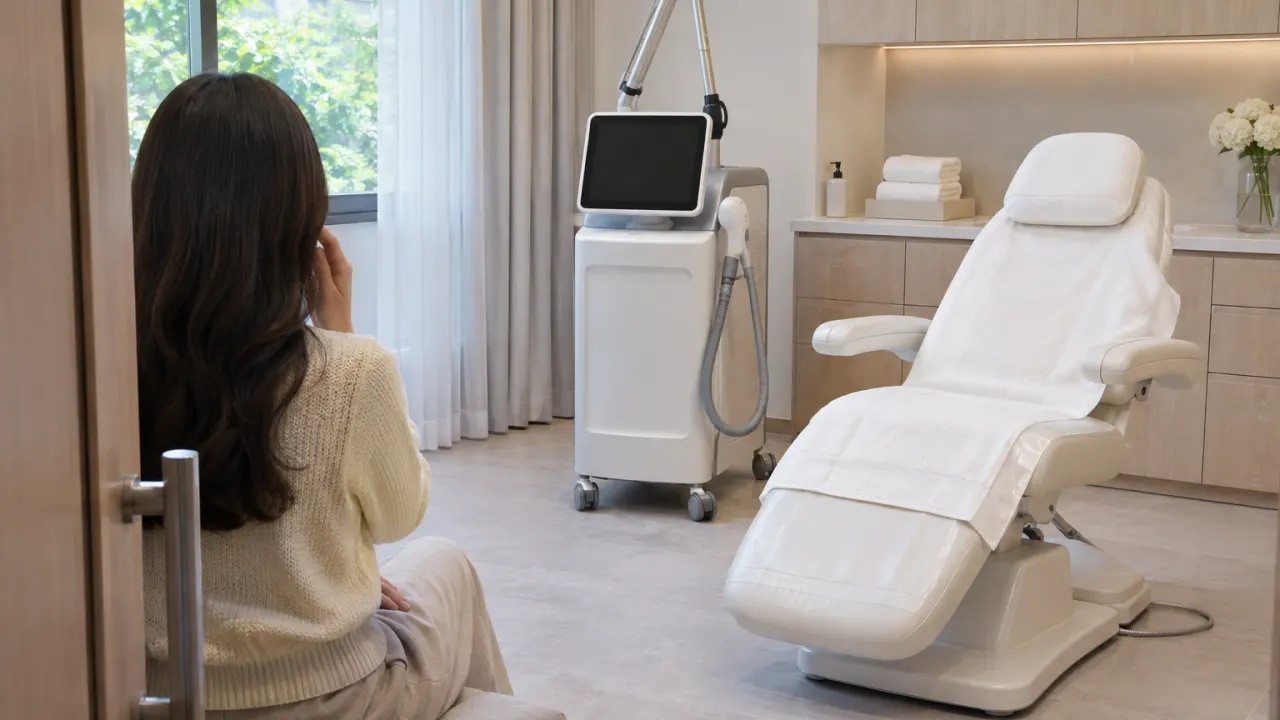
Ten laser-toning sessions at a Taipei aesthetic clinic, paid upfront: NT$60,000. The day after the third session, blisters appeared, and a brown mark lingered for weeks. The patient asked to cancel the last seven; the counsellor pointed to the contract: "Packages are non-refundable" (an invented example).
Can the patient claim compensation for the injury? And what happens to the money for seven unused sessions? Different Taiwan statutes and procedures govern each.
Cosmetic work is medical work
Taiwan's Ministry of Health and Welfare has stated that cosmetic medicine is medical practice. Lasers, botulinum toxin and filler are done under a physician's responsibility, so medical statutes govern first.
Before surgery, a medical institution must explain the reason, success rate and possible complications and risks, and obtain signed surgical and anaesthesia consent forms (Medical Care Act art. 63(1)). Invasive examinations or treatments designated by the central authority need the same explanation and written consent (art. 64(1)). Emergencies are exempt.
On August 30, 2016, the ministry announced revised model consent and information forms for 16 cosmetic procedures, including laser treatment, botulinum toxin injection and hyaluronic acid implants. The forms list each fee, including the locally approved fee, and the doctor's specialty and certificate number. A cooling-off clause has the doctor explain that the procedure is not urgent and will not be done on the day of the explanation. The ministry asked clinics to "refer to and use" the forms.
What if the treatment happened the same day as the consultation? That departs from the model clause. No statute makes that alone a basis for liability, but the signed form, and what it omits, is the first evidence on the duty to explain.
Records and copies
Clinics must keep clear, detailed and complete medical records, including physicians' notes, test reports and records by other medical staff (Medical Care Act art. 67(1)–(2)). On request, a clinic must provide copies without unjustified delay or refusal, at the patient's cost (art. 71). Once a dispute has arisen, art. 10 of the Medical Accident Prevention and Dispute Resolution Act (醫療事故預防及爭議處理法) sets a deadline: seven working days from the day after the request, for the records and the consent forms kept with them.
For the general route, see Injured at a Taiwan hospital.
A side effect is not yet a liability
Medical Care Act art. 82(1) requires the care medically necessary. Under paragraph 2, medical personnel are liable for harm only if it was intentional, or if they breached that duty and exceeded reasonable clinical discretion. The clinic itself is liable only for intent or negligence (paragraph 5). Breach is measured by that field's practice, standards, facilities, working conditions and urgency at the time and place (paragraph 4).
Compare Consumer Protection Act art. 7. A business breaching its safety duty is jointly liable, and proving no fault only lets a court reduce damages. Article 82's wording limits medical liability to fault. No provision lifts that limit for cosmetic procedures.
Once liability is shown, non-pecuniary damages are available too: breach of contract that injures body or health applies the tort rules by analogy (Civil Code art. 227-1; art. 195(1)). A tort claim lapses two years after the victim knows of the damage and the liable party, and ten years after the act (art. 197(1)).
Mediation before any lawsuit
Promulgated on June 22, 2022, the dispute act took effect on January 1, 2024. Its "medical accident" means serious injury or death, excluding results of the illness itself or unavoidable in treatment (art. 3(1)). A clinic's duty to explain and offer support within five working days from the day after the accident (art. 6(1)) applies to such accidents. Whether a pigment mark counts depends on the case.
Mandatory mediation reaches further. A "medical dispute" is any disagreement in which the patient's side holds the provider responsible for a poor outcome (art. 3(2)), and a civil suit over one must be preceded by mediation (art. 15(1)). Filing first just sends the case to mediation and suspends the suit (art. 15(2)).
Mediation normally goes to the committee where the clinic sits (art. 13(2)). It meets within 45 days of a complete application and finishes within three months, extendable once by three months and once more by agreement (art. 14(1)). It costs nothing (art. 30). If mediation fails, suing within six months from the day after the failure certificate is served counts as suing on the application date (art. 15(3)). Unless all parties agree, a mediator's advice and a party's apologies, admissions or concessions cannot be evidence or the basis of a judgment, or of a related administrative decision (art. 23).
Ending the package
As of the check date, no ministry model contract or mandatory-terms notice for cosmetic treatment contracts could be found. The refund turns on the signed contract and the Civil Code.
Services contracts that fit no other statutory type are governed by the mandate rules (Civil Code art. 529). If a treatment package falls there, art. 549(1) applies: either party may terminate at any time. Terminating at a time unfavourable to the other side, however, means paying damages, unless the termination was unavoidable for reasons not attributable to the terminating party (art. 549(2)).
When a mandate ends before the work is done for reasons not attributable to the agent, here the clinic, the clinic may claim pay for the part performed (art. 548(2)). Money for the seven unused sessions has lost its legal basis and can be reclaimed (art. 179). Divided evenly, that is NT$42,000. If the clinic re-prices the three used sessions at the full single rate, check whether the contract allows that.
And "non-refundable"? A pre-drafted standard term that makes the other side waive or restrict its rights is void to the extent it is obviously unfair (Civil Code art. 247-1(3)). A court decides that on the facts.
Approved fees and prepayment
Fee standards for medical institutions are approved by the city or county authority (Medical Care Act art. 21), and clinics may not overcharge or invent fee items (art. 22(2)). The enforcement rules define an invented item as an unapproved fee and let the authority order a refund of it (Enforcement Rules art. 11(3)–(4)). Violations carry fines of NT$50,000 to NT$250,000 (art. 103(1)(i)).
Receipts matter too. A clinic must issue receipts showing each fee item and amount (art. 22(1)), and the Taipei City health department's Q&A adds that they are issued per visit. A lump-sum "10 sessions" receipt is worth showing the health department when asking whether the package price was approved, a route separate from a civil refund claim.
Clinics also may not solicit patients by methods the central authority has banned (art. 61(1)). The same Q&A cites a March 17, 2005 Department of Health letter (衛署醫字第0940203047號) that lists advertising interest-free loans, instalments or pay-after-treatment terms.
Ads and unlicensed hands
Only medical institutions and doctors may advertise medical services (art. 84); ads implying medical services count as medical ads (art. 87(1)). Article 85(1) lists what they may contain, and art. 86 bans methods such as promotion under another's name or disguised as reporting. A clinic's own online information is exempt from the art. 85(1) list unless it falls under art. 103(2), such as false or exaggerated content (art. 85(3)). Where an ad breaches art. 85 or 86 or, without authorization, alters approved content and is false or exaggerated, it can lead to suspension of one month to one year or loss of the licence, and revocation of the responsible doctor's certificate for one year (art. 103(2)(i)).
A doctor may not treat without personally examining the patient (Physicians Act art. 11(1)). The only exception: in mountain areas, offshore islands, remote areas, or special or urgent situations, a doctor designated by the local authority may examine by telecommunication and direct nurses or midwives of a public health institution to treat. Practising medicine without a physician's qualification carries six months to five years' imprisonment and a possible fine of NT$300,000 to NT$1.5 million (art. 28); medical staff acting on a doctor's instruction in a medical institution are excepted. Work by a beautician without a doctor's examination invites a criminal complaint and a health-department report besides any civil claim.
What a Taiwan lawyer can do
Lawyers in Taiwan can obtain the records, attend mediation as the patient's agent, test the refund clause against art. 247-1, send the termination and refund demand, and sue within six months if mediation fails. Consultations on civil disputes are available at wei@hoveringlaw.com.tw. Hovering International Law Firm (昊鼎國際法律事務所), Taipei: 7F-2, No. 35, Sec. 1, Chengde Rd., Datong Dist., Taipei City 103. Taichung: 6F-1, No. 19, Guanqian Rd., North Dist., Taichung City 40453.
Three steps remain for the patient: a written termination notice, a records request (once a dispute exists, due within seven working days from the day after the request), and a mediation application where the clinic is located before suing over the injury.
Sources
Checked November 3, 2026. Taiwan law is quoted from the Chinese originals.
- Medical Care Act, art. 21
- Medical Care Act, art. 22
- Medical Care Act, art. 61
- Medical Care Act, art. 63
- Medical Care Act, art. 64
- Medical Care Act, art. 67
- Medical Care Act, art. 71
- Medical Care Act, art. 82
- Medical Care Act, art. 84
- Medical Care Act, art. 85
- Medical Care Act, art. 86
- Medical Care Act, art. 87
- Medical Care Act, art. 103
- Enforcement Rules of the Medical Care Act, art. 11
- Medical Accident Prevention and Dispute Resolution Act, full text (arts. 3, 6, 10, 13, 14, 15, 23, 30)
- Medical Accident Prevention and Dispute Resolution Act, art. 10
- Medical Accident Prevention and Dispute Resolution Act, art. 13
- Medical Accident Prevention and Dispute Resolution Act, art. 14
- Medical Accident Prevention and Dispute Resolution Act, art. 15
- Medical Accident Prevention and Dispute Resolution Act, art. 23
- Medical Accident Prevention and Dispute Resolution Act, legislative history (in force January 1, 2024)
- Physicians Act, art. 11
- Physicians Act, art. 28
- Consumer Protection Act, art. 7
- Civil Code, art. 179
- Civil Code, art. 195
- Civil Code, art. 197
- Civil Code, art. 227-1
- Civil Code, art. 247-1
- Civil Code, art. 529
- Civil Code, art. 548
- Civil Code, art. 549
- Ministry of Health and Welfare, press release on revised model consent forms for cosmetic medicine (衛福部修正美容醫學同意書範本,增列思考期、費用、醫師專科,保障民眾權益), Aug. 30, 2016
- Ministry of Health and Welfare, press release restating that cosmetic medicine is medical practice (衛生福利部重申「美容醫學」屬「醫療行為」範疇), Aug. 21, 2014
- Taipei City Department of Health, Medical Affairs Division Q&A (Q3, Q6; updated July 20, 2023)
Frequently Asked Questions
- My package contract says 'no refunds under any circumstances'. Can I still end it?
- If the treatment contract is governed by the mandate rules, Civil Code art. 549(1) lets either party terminate at any time. A pre-drafted standard term that restricts the other side's rights is void to the extent it is obviously unfair in the circumstances (art. 247-1(3)). Payment for sessions never performed can be reclaimed as a benefit whose legal basis has ceased (art. 179). A party who terminates at a time unfavourable to the other may owe damages, unless the termination was unavoidable for reasons not attributable to that party (art. 549(2)).
- Does a side effect mean the clinic must pay?
- No. Under Medical Care Act art. 82(2), medical personnel are liable only for intentional harm, or for breaching the necessary duty of care in a way that exceeds reasonable clinical discretion. Under art. 82(5), the clinic itself is liable only for intent or negligence. Breach is judged against the medical customs, standards, facilities, working conditions and urgency of that field at the time and place (art. 82(4)).
- Can I sue the clinic straight away?
- Not without mediation first. Before filing a civil suit over a medical dispute, a patient must apply for mediation to the city or county medical dispute mediation committee. If a suit is filed without it, the first-instance court sends the case to mediation and the lawsuit is suspended meanwhile (Medical Accident Prevention and Dispute Resolution Act art. 15). Mediation is free (art. 30).
This article provides general information and is not legal advice on any individual matter.


