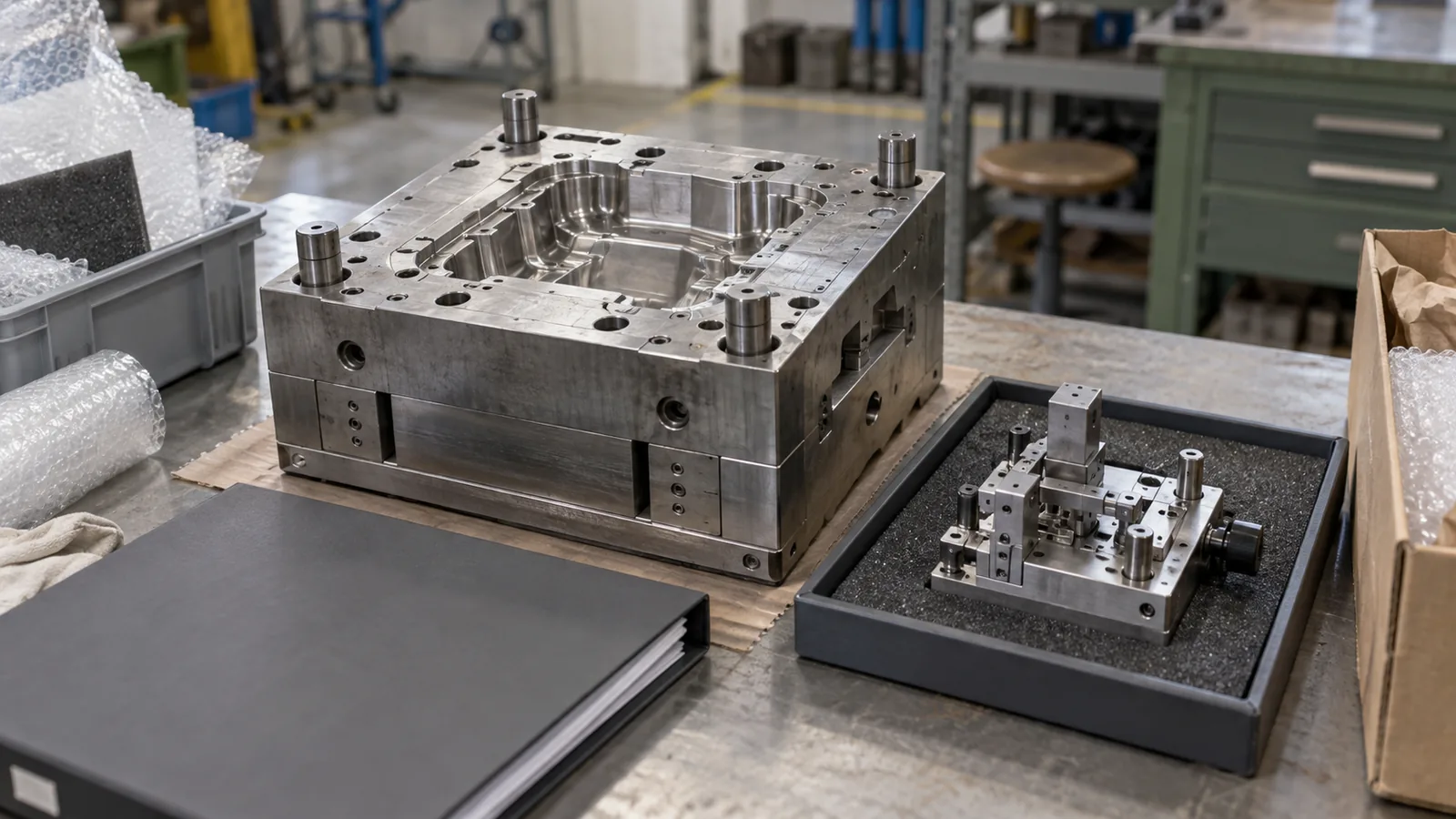
A paid tooling invoice may show that your company funded a mold. It does not, by itself, settle who owns it or when the Taiwan supplier must release it. Before arranging collection, put the tooling agreement, payment record and inventory list together. The claim needs to identify the particular equipment and the obligation to hand it over.
For a US buyer changing factories, there may be several companies in that file: the buyer that paid, the supplier that signed and a subcontractor that holds the tooling. A demand addressed to the sales team can leave the actual custodian outside the discussion.
Establish what your company acquired
Read what the tooling charge purchased. The agreement may provide for ownership of a completed mold, exclusive use during production, or reimbursement of development costs. Those arrangements do not necessarily lead to the same right at the end of the relationship.
Under Taiwan's Civil Code Article 761, a transfer of rights in movable property generally requires delivery. The law also accommodates equipment staying where it is: the transferor and buyer can agree that the transferor continues to hold it while the buyer acquires indirect possession. Where a third party holds the equipment, assignment of the claim for its return can substitute for delivery. The agreement and possession history therefore matter alongside payment.
Find the supplier's acknowledgment of the ownership arrangement, the date it took effect and the equipment it covers. A purchase order for “tooling costs” is harder to match to a specific mold than an agreed schedule with serial numbers, cavity details, photographs and storage locations. Later replacement inserts, repairs and duplicate fixtures may need their own entries. Ask which listed items still exist and who now holds them.
If the property is in Taiwan, Taiwan's choice-of-law rules direct property-right questions to the law of its location; acquisition questions can also depend on where it was when the relevant facts occurred. The law governing the supply contract is a separate inquiry. A US-law clause should not be assumed to answer both. Choice of Law Act Articles 20 and 38.
Ownership and the obligation to return it
Article 767 allows an owner to seek the return of property from someone possessing it without a right to do so. That leaves two points to establish: your ownership and the absence of a continuing basis for the holder's possession. An agreed production or storage period, for example, needs to be read before asserting that possession is already unauthorized.
A contractual handover obligation can supply another basis for the request. Identify the party that promised performance, the trigger for release, any notice period and any conditions still outstanding. Article 199 addresses a creditor's right to demand the performance owed. A promise from the supplier to procure release from its subcontractor needs to be distinguished from a direct undertaking by that subcontractor.
Keep the tooling request separate from the accounting for canceled orders. If a prepayment dispute is also open, reconcile it against the relevant orders and refund terms, as discussed in the firm's Taiwan capacity-prepayment column. Neither side should have to guess whether a proposed payment settles an invoice, buys disputed equipment or releases all claims arising from the relationship.
When the supplier says there is an unpaid balance
Taiwan law recognizes a right of retention over movable property. Under Article 928, the creditor must possess another person's movable property, have a connected claim, and generally have a debt that is due and unpaid. The article excludes possession obtained unlawfully and specified cases where the holder knew, or was grossly negligent in not knowing, that the property did not belong to the debtor.
For commercial dealings, the connection can be broader than one tooling invoice. Article 929 deems the required connection to exist between movables held through business dealings between traders and claims arising from those dealings. Paying the mold invoice may therefore leave a retention dispute over another business debt.
Ask the supplier to identify the creditor, debtor, amount, due date and contractual basis of each claimed balance. Compare that explanation with the owner and holder of each item. A bare statement that “the group account is overdue” leaves those relationships unclear.
The agreed return terms still matter. Article 930 bars retention that conflicts with the creditor's obligation or the parties' agreement, as well as retention contrary to public order or good morals. There is a qualification: Article 931 makes special provision for a debtor unable to pay, including where that inability arose or became known after delivery. A no-retention clause should be assessed against those facts before it is treated as conclusive.
Where continued withholding threatens production, counsel can also assess security for the disputed debt. Article 937 provides for the retention right to end when the debtor or owner supplies adequate security for payment. Whether a proposed guarantee or other arrangement qualifies needs to be resolved; offering security does not make an unauthorized collection safe.
Plan a handover the receiving factory can use
Once a release is agreed, the logistics terms deserve more than “available for pickup.” Record the items and condition, who disconnects and packs them, the collection location, the carrier, costs and who signs the receipt. Where a subcontractor has custody, obtain its confirmation of the arrangements. Keep the signed inventory and photographs with the handover record.
A fixture may be physically complete yet unusable at the next plant without calibration data or operating software. List those deliverables separately. For copyright-protected drawings or software, Copyright Act Article 37 makes the scope of licensed use depend on the agreement; unclear rights are presumed not to have been licensed. Check whether the receiving factory may use or modify the files. The firm's column on Taiwan-made code and designs explains that issue in more detail.
If release remains disputed, have Taiwan counsel assess the claim and any justified protective application before sending a truck or personnel to remove the equipment. Ownership documents alone are not a collection plan. Tell counsel if there is concrete evidence of an imminent move, disposal or shutdown, and preserve where that information came from.
An initial Taiwan contract-dispute inquiry can state who contracted, where the tooling is held, what the supplier says is unpaid and when production must move. Keep designs and confidential account records out of the initial message; arrange document delivery with the attorney.
Sources and review date
Official sources checked: October 10, 2026. The cited Civil Code provisions are in force. The database's notice about provisions awaiting commencement concerns other articles, not the ownership and retention rules discussed here. Chinese statutory text controls.
- Civil Code, Articles 199, 761, 767, 928–931 and 937; amendment history.
- Choice of Law Act, Articles 20 and 38.
- Copyright Act, Article 37.
This is general Taiwan legal information, not a determination of ownership or a right to enter premises or remove equipment. The full agreements, possession history and applicable law require review for a particular transfer.
This article provides general information and is not legal advice on any individual matter.