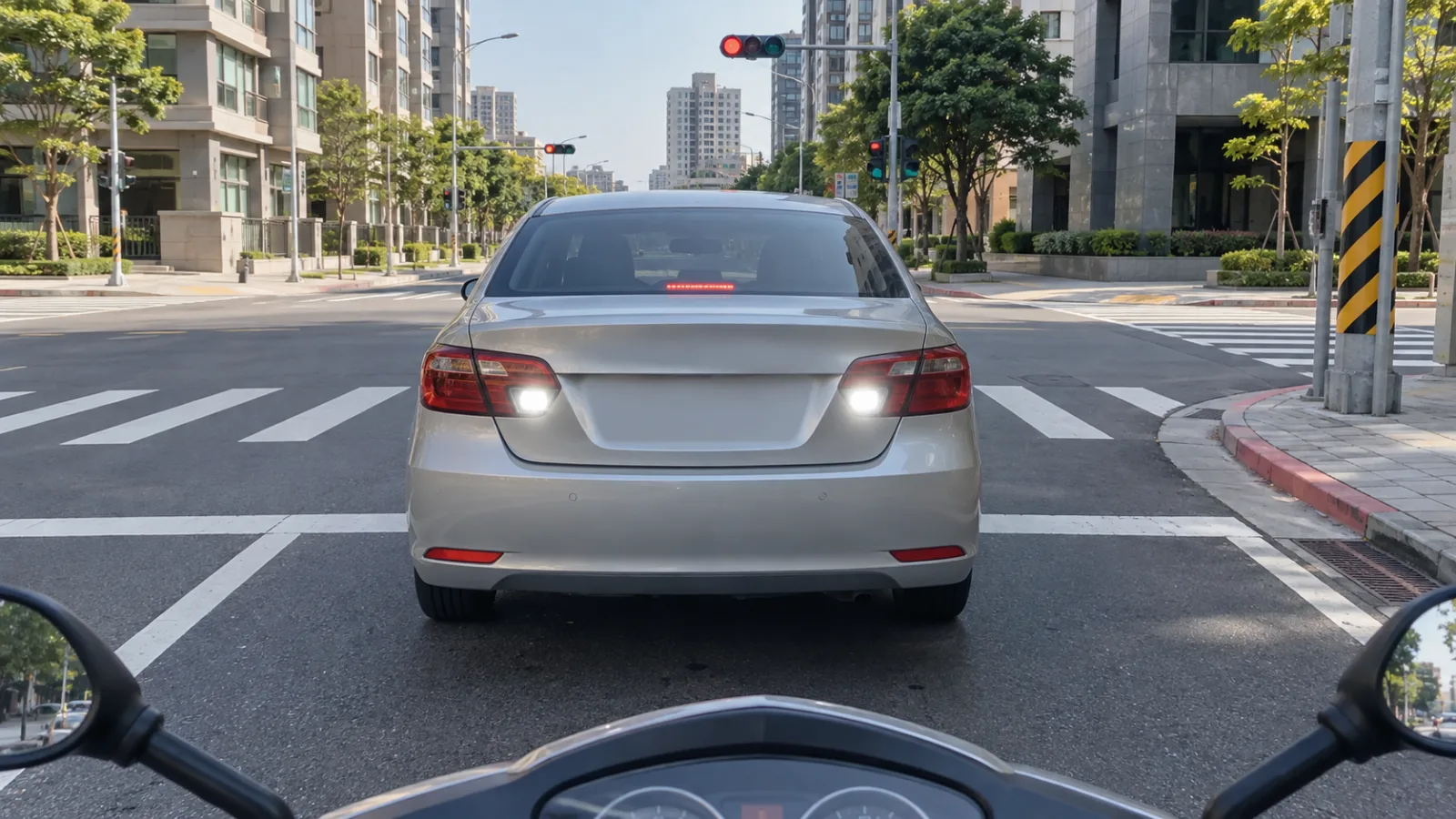
The silver car stops beyond a white stop line. Its reverse lamps come on while a scooter waits behind it. Before backing up, the driver must attend to that traffic: Article 110(2) of the Road Traffic Safety Rules requires a reverse light or hand signal, cautious and slow movement, and attention to other vehicles and pedestrians.
In this invented scene, a foreign resident is on the stationary scooter. The car's driver does not notice it and backs into the scooter's front. No personal injury is assumed. The film and cover image were made to illustrate the sequence. They are neither genuine dashcam evidence nor a reconstruction of an identifiable incident or judgment.
Crossing the line does not settle the reversing question
Overshooting explains why a driver might want to move back; it does not establish that the way behind is clear. Article 110(1) restricts reversing in listed dangerous places, including road sections bearing bend, narrow-road or roundabout signs, as well as railway crossings and fast lanes. It also states an exception when reversing is necessary to yield, park or start moving. The provision does not declare every intersection a no-reversing area. This illustration cannot establish whether its generic road meets one of the listed descriptions.
A lit reverse lamp warns of an intended movement. It does not prove the scooter has moved away. Was the scooter already stationary? Could the driver see it through the rear window or mirrors, and what remained in a blind area? Those questions belong to the moments before the car moves. A photograph taken after contact cannot answer them alone.
What the footage must show before contact
An impact-only clip can omit both vehicles' earlier positions. In an actual case, the original continuous recording can be checked for the car's approach to the line, the scooter's stop, illumination of the reverse lamps, the car's first backward movement and the first contact. Another original camera angle and scene photographs may help explain an obstructed view. This generated film supplies no measured gap, speed or timing for a real event.
Article 50(2) of the Road Traffic Management and Penalty Act provides a fine where a driver fails to display a reverse light before backing or fails to watch for vehicles and pedestrians while doing so. The lamp can be on while the driver still fails to observe the scooter. Equally, the collision alone cannot show whether the lamp was off.
From damaged fairing to a repair claim
A photograph of the scooter's front may show the contact point; an estimate identifies proposed repair work. The claimant still has to connect the damage and necessary repair to this event. Under Civil Code Article 184(1), a negligence claim concerns unlawful infringement of another's right and the resulting loss. A traffic fine does not set the amount of civil compensation.
Suppose the car's driver says the scooter stopped too close. That assertion calls for evidence of how the scooter's conduct contributed to causing or enlarging the loss. Civil Code Article 217(1) lets a court reduce or eliminate compensation if the injured party was also at fault; it supplies no preset share for reversing collisions. Actual positions, sequence and visibility must be established before that argument can be assessed. The reenactment establishes none of them.
The statutory text was checked against the official database on October 31, 2026. This fictional account provides general information. For a real stop-line collision, footage showing the car before it began to reverse can answer questions that a frame of the vehicles at rest cannot.
Sources
Frequently Asked Questions
- May a driver reverse after passing the stop line?
- Passing the line does not by itself authorize reversing, and the rules do not ban reversing at every intersection. Road Traffic Safety Rules Article 110 lists restricted locations and an exception; when reversing, a driver must signal, proceed cautiously and slowly, and watch for other vehicles and pedestrians.
- Does contact make the reversing driver wholly liable?
- There is no automatic percentage. An actual case turns on when reversing began, what was visible behind, where the scooter was and how the contact caused the claimed damage. Civil Code Article 217 permits a reduction only if the injured party's fault contributed to the damage or its enlargement.
- Can the film establish speed or following distance?
- No. This fictional reenactment has no measured data. Original continuous footage, scene photographs and vehicle damage records are needed for an actual dispute.
This article provides general information and is not legal advice on any individual matter.