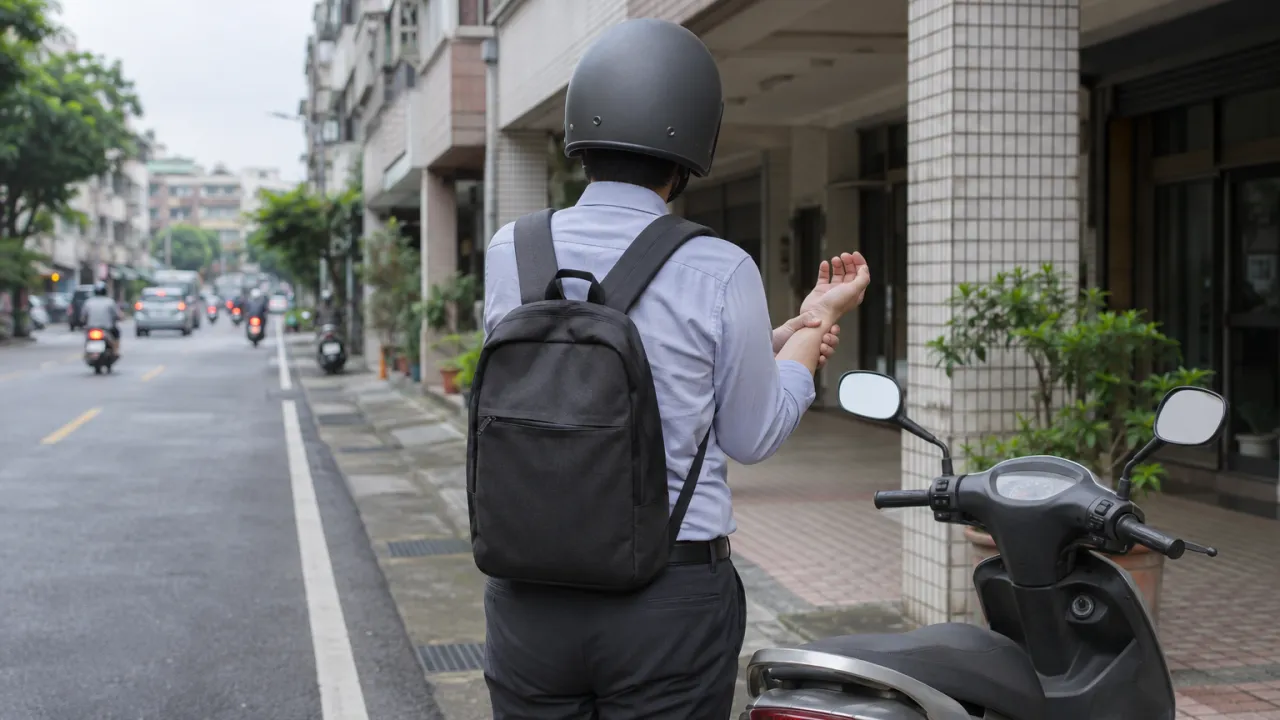
An injury on the road between home and work can count as a work injury in Taiwan. Article 4 of the Regulations for Reviewing Occupational Injuries and Diseases under Taiwan's occupational accident insurance deems such injuries to be occupational. Article 17 then lists nine circumstances that take the deeming away. Most commuting claims turn on those two provisions.
What Article 4 covers
Article 4 has four elements. The trip is for going to or leaving work. It happens at an appropriate time. It runs between your usual residence and the workplace. And the accident occurs on the route you would ordinarily have to take. Workers with two jobs are also covered on the way from one workplace to the other.
"Appropriate time" has no clock attached. Leaving home at 8:30 for a 9:00 start rarely raises a question. Heading home several hours after the shift ended invites one: what happened in between? The Bureau of Labor Insurance weighs the time, place and circumstances of the accident, its link to the job and the causal link to the injury (Article 21).
Other trips are covered too. Business travel and other off-site work, from departure until return, along a reasonable route (Article 9). The usual route out and back for a necessary meal during a workday mealtime, overtime or a duty shift, when the employer has not required staff to eat on site (Article 16). For an occupational injury, the usual route straight between workplace and treatment with the employer's consent; straight from the workplace to treatment after work and then home; or straight between home and treatment during the treatment period (Article 15).
Nine exclusions
Under Article 17, trips under Articles 4, 9, 10, 15 and 16 lose the deeming if any of the following applies:
- A private act not necessary for daily life
- Driving without a licence for that class of vehicle
- Driving while the licence is suspended, revoked or cancelled
- Running a red light at a signal-controlled intersection
- Crossing a railway level crossing unlawfully
- Driving with alcohol above the legal limit, or after using drugs, hallucinogens, narcotics or similar controlled substances
- Unlawful use of the shoulder on a freeway, expressway or other access-controlled road
- Racing, stunt driving, weaving or other dangerous driving
- Driving against the designated direction or into oncoming lanes
Every item describes the injured worker's own conduct. If the other driver ran the red light, item 4 does not stand in your way. That driver is also a separate target for a damages claim.
Foreign employees are covered from day one
Coverage under Article 6 of the Labor Occupational Accident Insurance and Protection Act is compulsory for workers aged 15 or over employed by an employer that holds a practice licence, is registered, has a tax registration, or has been granted an employment permit by the central authority. Nationality plays no part. A locally hired foreign manager and a migrant worker on a permit are both in.
Enrolment is due on the first day of work (Article 12). Missed it? Article 36(1) still has the Bureau pay the worker, then bill the employer for the corresponding amount by administrative decision.
Benefits and deadlines
Treatment is given at hospitals and clinics contracted with National Health Insurance, using the occupational-injury treatment form the employer issues. If the employer does not issue it, the worker can ask the Bureau, which issues it once the facts are confirmed (Article 39). Treated first without the form? Hand it in within ten days of the visit, not counting regular days off (例假日), or before discharge, and the hospital refunds the insurance medical fees it collected. If you miss that window for reasons not attributable to you, apply to the Bureau within six months of the outpatient visit or discharge (Article 40(1)(1); Enforcement Rules, Articles 50 and 51).
Workers who cannot work, are not receiving the usual wage and are under treatment receive an injury benefit from the fourth day off work. It is paid at the full average monthly insured salary for the first two months and at 70 percent from the third month, every half month, for up to two years (Article 42). Permanent disability after treatment leads to disability benefits (Article 43); death leads to a funeral allowance and survivors' benefits (Articles 49 and 51).
Claims lapse if not exercised within five years from the date they can be made (Article 37). Where the same accident also qualifies under labor insurance or another social insurance scheme, you choose one (Article 29(2)).
The employer's own duty is a separate question
Apart from insurance, Article 59 of the Labor Standards Act requires an employer to compensate a worker hurt in an occupational accident for medical costs, wages during treatment, disability and death. The review rules, as Article 1 states, were issued under Article 27(3) of the insurance act to govern insurance reviews. They do not say that an employer's Labor Standards Act liability follows automatically once the insurer deems a commute injury occupational. Check that point separately when negotiating with the employer. Once an employer has paid the amount due under Article 36(1) of the insurance act, the insurance benefits its worker received can be credited against its Article 59 compensation (Article 36(2)).
Any claim against another driver runs on its own track, alongside the insurance benefits. When police accident records become available is covered in Taiwan accident police records; sick-leave pay rules are in Taiwan sick leave and half pay.
Challenging the Bureau
If the Bureau decides your commute injury was not occupational, apply to the Ministry of Labor for a dispute review within 60 days from the day after the decision reaches you. An administrative appeal and an administrative lawsuit follow if needed (Article 5(1)). Where the worker's account and the employer's differ, the Bureau must ask the employer for rebuttal evidence. Without it, the Bureau reviews the case on the worker's statements and evidence together with the other facts (review rules, Article 22(3)).
Where a Taiwan lawyer fits
A Taiwan lawyer can set out how the accident and route fit Articles 4 and 17, handle the benefit claim and dispute review, and run the Labor Standards Act negotiation with the employer and the damages claim against the other driver in parallel. Consultations on employment matters are available at wei@hoveringlaw.com.tw. Hovering International Law Firm (昊鼎國際法律事務所), Taipei: 7F-2, No. 35, Sec. 1, Chengde Rd., Datong Dist., Taipei City 103. Taichung: 6F-1, No. 19, Guanqian Rd., North Dist., Taichung City 40453.
What time you left home that day, and which road you took, is where the review starts. Transit card logs, dashcam footage and attendance records can show both.
Sources
Checked November 3, 2026. Taiwan laws are cited from the Chinese originals.
- Regulations for Reviewing Occupational Injuries and Diseases under Labor Occupational Accident Insurance (勞工職業災害保險職業傷病審查準則), full text, amended May 26, 2025
- Article 1
- Article 4
- Article 9
- Article 15
- Article 16
- Article 17
- Article 21
- Article 22
- Labor Occupational Accident Insurance and Protection Act (勞工職業災害保險及保護法), full text
- Article 5
- Article 6
- Article 12
- Article 29
- Article 36
- Article 37
- Article 39
- Article 40
- Article 42
- Article 43
- Article 49
- Article 51
- Enforcement Rules of the Labor Occupational Accident Insurance and Protection Act, Article 50
- Enforcement Rules, Article 51
- Labor Standards Act (勞動基準法), Article 59
Frequently Asked Questions
- I stopped at a supermarket on the way home and was hit. Is that still a commuting injury?
- Article 17(1) of the review rules excludes accidents during private acts not necessary for daily life. Whether shopping counts as necessary for daily life, and whether the accident happened on the route you normally must take, is decided by the Bureau of Labor Insurance from the time, place and circumstances (Article 21). Records of where you stopped, when, and your route help you explain it.
- My employer never enrolled me. Can I still claim?
- Yes. Under Article 36(1) of the Labor Occupational Accident Insurance and Protection Act, the Bureau pays the benefit and then orders the employer, by administrative decision, to pay the corresponding amount within a set period.
- How do I challenge the Bureau's decision?
- Apply to the Ministry of Labor for a dispute review within 60 days from the day after the decision reaches you. If the review goes against you, you can file an administrative appeal and then an administrative lawsuit (Article 5(1) of the Act).
This article provides general information and is not legal advice on any individual matter.