
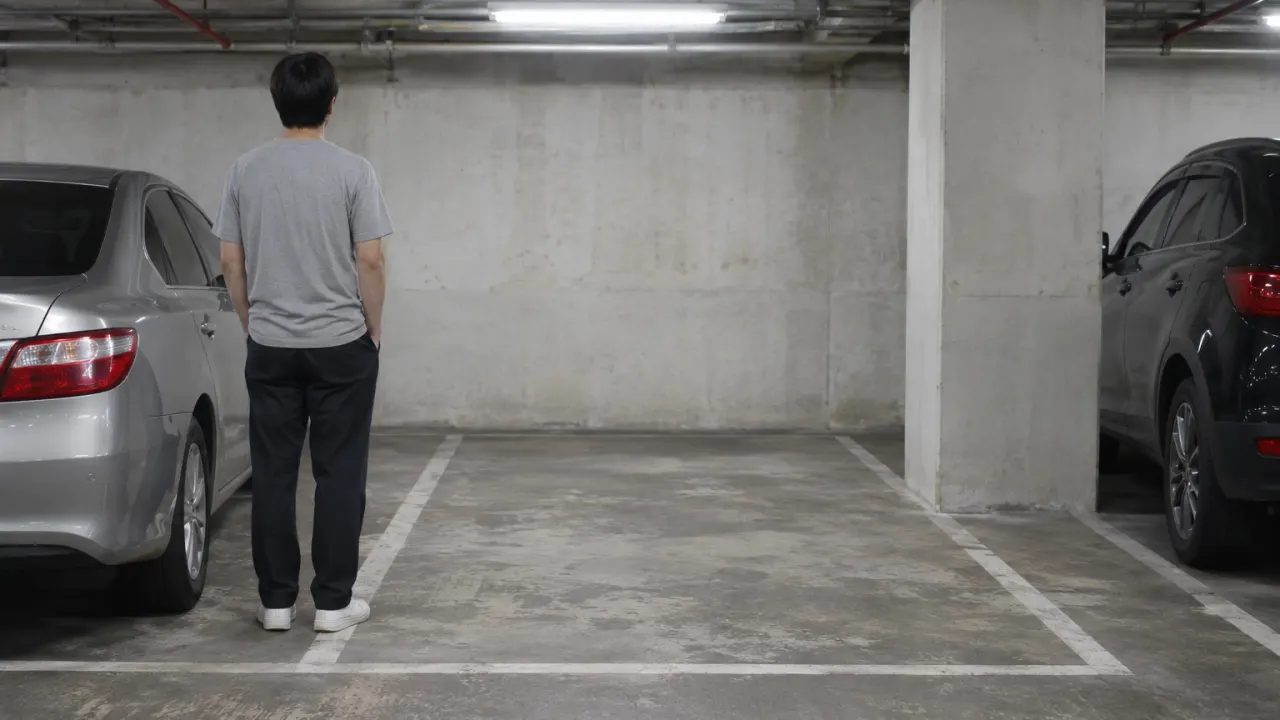
Taiwan's Condominium Administration Act (公寓大廈管理條例) defines, in art. 3(v), an "agreed exclusive-use area" (約定專用部分): a common area that the owners have agreed to let a specific unit owner use. Many basement "my space" spots are exactly that: ground everyone owns, which an agreement lets one person park in.
Disputes take three shapes. A buyer paid NT$2.5 million for space B2-17 off the plan, then finds no such number on the ownership certificate (an invented example). A neighbour from upstairs parks there every night. Or the management committee announces that every space will be redrawn by lottery. Each starts with one question. How does the space appear in the register and the building rules?
Three ways a space can be registered
| Registration | What the register shows | Basis for using the space |
|---|---|---|
| Part of the basement registered as a unit | Its own building number and certificate | Ownership itself |
| Whole basement registered as one unit, held in shares | A co-ownership share in that building number | An agreement among the co-owners |
| Common area | Common-area number and share on each unit's certificate | Building rules or another agreement |
Separate registration of a basement is possible. Under Regulations of the Land Registration art. 79(1)(iii), a basement shown as an exclusive unit on the drawings filed with the building authority, but without a door number, needs an address certificate from the household registration office for its first registration. The Act's definition of "resident" in art. 3(viii) includes anyone who has acquired ownership of a parking structure.
The third form has no certificate of its own. Common areas are grouped by purpose and use under the owners' agreement, given a separate building number, and registered as co-owned by the related unit owners; only a description section and common-area schedule are created, the building number, total area and share go on each unit's certificate, and no separate certificate is issued (art. 81). That is why "B2-17" never appears. The number lives only in the sale contract and the allocation list.
A unit may not be transferred or encumbered separately from its share of the common areas and the land (Act art. 4(2); Civil Code art. 799(5)), and common-area registration moves with the related units (Regulations art. 94).
What a buyer of a common-area space holds
Civil Code art. 799(3) lets building rules assign a common part to a specific owner unless a law provides otherwise. Act art. 23(2)(i) goes further: the scope and users of agreed exclusive-use areas have no effect unless written into the rules. Without that, the exclusive use has no effect under this provision, whatever the sale contract says; claims against the seller turn on the contract.
Some areas cannot be assigned at all. Common areas may not be used independently as exclusive units, and the building's footprint, connecting corridors, stairs and exits, and structural elements cannot become exclusive-use areas (art. 7(i)–(iii)). Agreed uses must also comply with the Act and planning and building laws (art. 9(3)).
Bought a resale flat? The question is whether the previous owner's space comes with it. Under Civil Code art. 799-1(4), rights and duties under the building rules bind successors; those under other agreements bind a specific successor who knew or could have known their content. A sale contract naming the basis for the space (a rule clause, an allocation agreement or a registered share) shows what the buyer knew, and where the allocation is written into the rules or minutes, those documents can be inspected under art. 35.
Where the whole basement is co-owned in shares, the co-ownership rules apply directly. Each co-owner may use the whole in proportion to the share unless a contract says otherwise (art. 818). An agreement dividing the spaces among co-owners binds a later buyer of a share once registered (art. 826-1(1)), and the buyer is jointly liable for burdens the seller incurred through use or management (art. 826-1(3)).
Who sold you the space matters too. Act art. 58(2) bars developers from selling common areas, including statutory parking spaces, to specific persons, or granting exclusive-use rights to anyone who is not a unit owner. Breach carries an administrative fine of NT$40,000 to NT$200,000 (art. 49(1)(viii)).
When someone else parks in your space
Write to the management committee first. Residents must use common areas according to their purpose and normal use, subject to any agreement (art. 9(2)). The committee must stop a resident who breaches this, may ask the authorities or sue for the necessary measures, and damages may be claimed (art. 9(4)). Stopping residents' violations is also listed among the committee's duties (art. 36(1)(v)).
Tenants count. "Resident" in art. 3(viii) covers tenants and others using a unit with the owner's consent, so the duty applies to a tenant's car too. A manager, committee chair or member who, without good reason, fails to carry out duties under art. 36(i) or (v)–(xii) in a way that clearly affects residents can be fined NT$1,000 to NT$5,000 (art. 48(iv)). A fine does not free the space, though.
Direct claims depend on your right. If the space is a unit you own, you may demand its return from anyone occupying it without right and the removal of interference (Civil Code art. 767(1)). A co-owner may assert ownership claims over the whole against third parties, but may claim recovery only for the benefit of all co-owners (art. 821). When the intruder is also a co-owner or unit owner, the rules and allocation agreement become the basis; keep a copy of both, plus dated photos.
When the committee wants a lottery
Management committees exist to carry out owners' meeting resolutions and manage the building (art. 3(ix)), and their resolutions may not conflict with the Act, the rules or owners' meeting resolutions (art. 37). If the rules assign spaces, a committee notice cannot erase that. Amending the rules belongs to the owners' meeting: unless the rules say otherwise, two-thirds of owners and two-thirds of ownership shares must attend, and three-quarters of those attending, by headcount and by share, must agree (art. 31). Lower thresholds for a reconvened meeting and written objections are in art. 32, covered in our column on management committees and building rules.
Here is the turning point. When applying for a building permit, the developer must file detailed drawings marking exclusive, common, exclusive-use and common-use areas, plus draft rules; draft rules signed by buyers count as the rules until the owners' meeting adopts its own (art. 56(1)–(2)). An owners' meeting resolution changing an exclusive-use area created this way has no effect without the consent of the owner using it (art. 33(iii)). The single exception: the arrangement clearly violates the public interest and the committee or manager has obtained a final judgment.
Where the rules assign nothing, each owner may use common areas in proportion to the share, subject to any agreement (art. 9(1)), so a lottery may be adopted by an owners' meeting that meets the art. 31 or 32 requirements.
Two court routes remain for an unfair outcome. If the rules are clearly unfair, considering location, area, purpose, actual use, whether an owner paid for the space and other circumstances, a dissenting owner may ask the court to revoke them within three months after the rules are adopted (Civil Code art. 799-1(3)). For a co-owned basement, a dissenting co-owner may ask the court to alter a clearly unfair management decision made by a majority of co-owners holding a majority of shares; once shares exceed two-thirds, headcount no longer matters (art. 820(1)–(2)).
Written notice must go out ten days before the meeting (for an urgent extraordinary meeting, a public notice of at least two days); minutes must reach each owner and be posted within fifteen days (art. 30(1); art. 34(1)). Interested parties may inspect or copy the rules and minutes when needed, and the committee may not refuse (art. 35).
What a Taiwan lawyer can do
A lawyer can compare the register transcript, sale contract, signed draft rules, current rules and minutes to identify which form applies and whether the rules record scope and users. The work can include certified letters, written objections and inspection requests, petitions to revoke rules or alter management, and lawsuits for return or removal of interference. Consultations on civil disputes are available at wei@hoveringlaw.com.tw. Hovering International Law Firm (昊鼎國際法律事務所), Taipei: 7F-2, No. 35, Sec. 1, Chengde Rd., Datong Dist., Taipei City 103. Taichung: 6F-1, No. 19, Guanqian Rd., North Dist., Taichung City 40453.
The three months run from the day the rules are adopted. If a lottery rule passed at a reconvened meeting, it counts as adopted once written objections lodged within seven days of the minutes being served do not exceed half of all owners and ownership shares (Act art. 32(2)). Count from that day.
Sources
Checked November 3, 2026. Taiwan laws are quoted from the Chinese originals on the Laws & Regulations Database (law.moj.gov.tw). The Condominium Administration Act was last amended May 11, 2022; the Regulations of the Land Registration, July 13, 2021.
- Condominium Administration Act, art. 3
- Condominium Administration Act, art. 4
- Condominium Administration Act, art. 7
- Condominium Administration Act, art. 9
- Condominium Administration Act, art. 23
- Condominium Administration Act, art. 30
- Condominium Administration Act, art. 31
- Condominium Administration Act, art. 32
- Condominium Administration Act, art. 33
- Condominium Administration Act, art. 34
- Condominium Administration Act, art. 35
- Condominium Administration Act, art. 36
- Condominium Administration Act, art. 37
- Condominium Administration Act, art. 48
- Condominium Administration Act, art. 49
- Condominium Administration Act, art. 56
- Condominium Administration Act, art. 58
- Civil Code, art. 767
- Civil Code, art. 799
- Civil Code, art. 799-1
- Civil Code, art. 818
- Civil Code, art. 820
- Civil Code, art. 821
- Civil Code, art. 826-1
- Regulations of the Land Registration, art. 79
- Regulations of the Land Registration, art. 81
- Regulations of the Land Registration, art. 94
Frequently Asked Questions
- My ownership certificate does not show my parking space number. Did I actually buy it?
- Common areas of a condominium building are registered under a separate building number as co-owned by the related unit owners, with no separate ownership certificate; the building number, total area and share are noted on each unit's certificate (Regulations of the Land Registration, art. 81). In that case you bought a share of the common area, and the right to use one particular space comes from the building rules or another agreement. The scope and users of an exclusive-use common area have no effect unless written into the building rules (Condominium Administration Act, art. 23(2)(i)), so read the rules together with your purchase contract.
- The management committee says all spaces will be redrawn by lottery next year. Do I have to accept that?
- A management committee resolution may not conflict with the Act, the building rules or a resolution of the owners' meeting (Condominium Administration Act, art. 37). If the rules already assign spaces, changing them means amending the rules through the owners' meeting. Where the exclusive-use area was created through the developer's permit drawings and draft rules under art. 56(1), an owners' meeting resolution changing it has no effect without the consent of the owner using it (art. 33(iii)), unless the arrangement clearly violates the public interest and the committee or manager has obtained a final court judgment saying so.
- Another resident keeps parking in my space. Who has to deal with it?
- For a common-area space used under an agreement, the management committee must stop a resident who breaches the rules on using common areas, may ask the authorities or sue for the necessary measures, and damages may be claimed (Condominium Administration Act, arts. 9(4) and 36(1)(v)). If the space is a unit you own, you may demand return from anyone occupying it without right and removal of interference (Civil Code art. 767(1)); a co-owner may assert ownership claims over the whole thing against third parties, but a claim to recover it may only be made for the benefit of all co-owners (art. 821).
This article provides general information and is not legal advice on any individual matter.


