
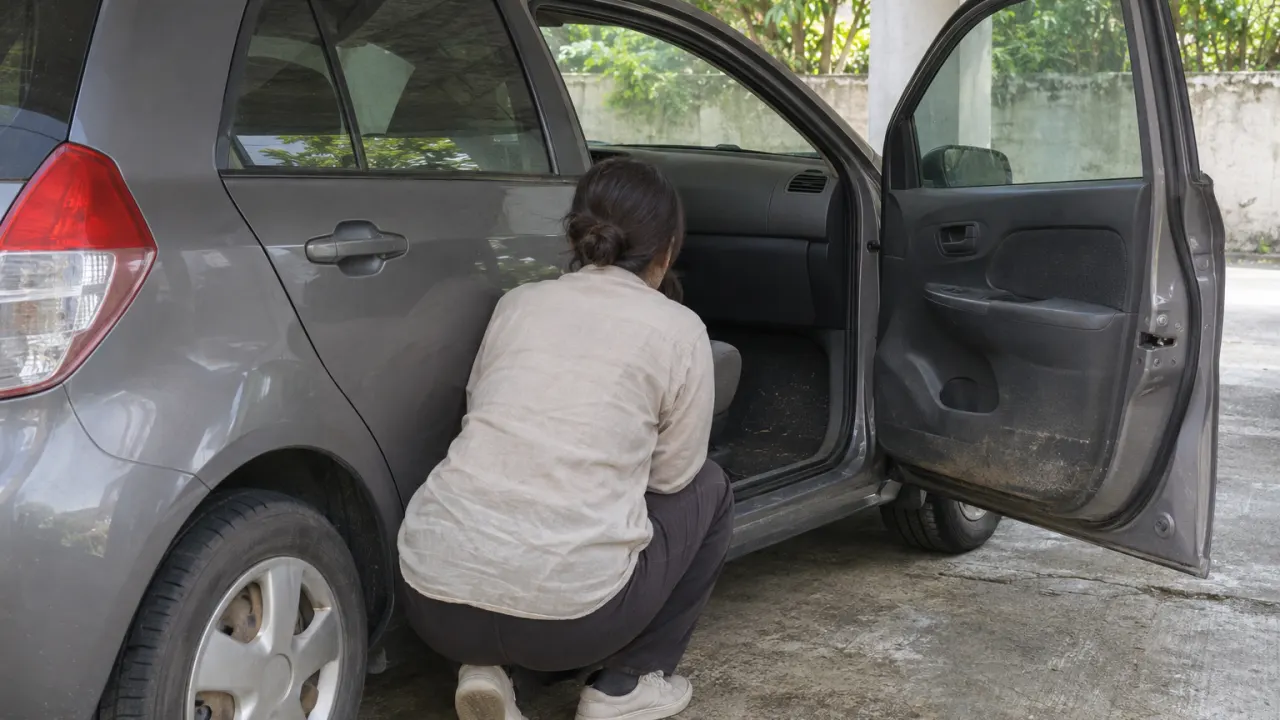
At its first service, the mechanic shows the owner of an SUV from a Taichung used-car lot rust on the seat rails and silt under the carpet. The odometer reads nearly 70,000 km less than a service record from two years earlier. The dealer's contract had "no" ticked in the flood-damage box (an invented example).
Three sets of rules meet here: the Civil Code warranty against defects, revocation for fraud, and, for dealer sales, the Ministry of Economic Affairs' used-car contract rules. Notice comes first.
Flood marks and a rolled-back odometer as defects
Under Civil Code Article 354(1), a seller warrants that when risk passes, normally on delivery (Article 373), the thing has no defect that destroys or reduces its value, its ordinary use or the use the contract contemplated. An insignificant reduction does not count. Flood or frame damage is usually argued here, as can a wound-back odometer.
Paragraph 2 adds promised quality. If the seller guaranteed "accident-free" or "genuine mileage", the car must have it when risk passes.
Seller knowledge is not an element of Article 354. "We didn't know" does not end the warranty.
Buyer knowledge counts. A buyer aware of the defect at signing has no claim. One who missed it through gross negligence has none either, unless the seller guaranteed there was no defect or intentionally concealed it (Article 355).
Inspect, notify, and two clocks
Article 356 requires the buyer to inspect promptly in the ordinary way and notify the seller immediately of any defect found. Without notice, the buyer is deemed to have accepted the goods, except for defects that ordinary inspection could not reveal. Those must be notified immediately once discovered, or the same deemed acceptance follows (Article 356(3)).
Could silt under the carpet have been spotted on delivery day? If a test drive and walk-around would not reveal it, it is arguably a later-discovered defect. A certified-contents letter (存證信函) fixes the notice's date and wording.
The deadline sits in Article 365(1): the right to rescind or reduce the price lapses if unused six months after the Article 356 notice, or five years after delivery.
Sellers can force the pace. Once a defect is asserted, the seller may set a reasonable period for the buyer to decide on rescission; failing to rescind within it forfeits the right (Article 361).
When the seller knew and stayed silent
Intentional concealment changes four rules:
- Article 356's inspection and notice duty does not apply (Article 357).
- The six-month period does not apply (Article 365(2)). The five years from delivery still do.
- Clauses excluding or limiting the warranty, "sold as is" included, are void (Article 366).
- The buyer may claim damages for non-performance instead of rescinding or cutting the price (Article 360, second clause).
Who proves the seller knew? Whoever asserts a favorable fact must prove it (Code of Civil Procedure Article 277), normally the buyer.
Rescission, price reduction, damages
Under Article 359, the buyer may rescind the contract (解除) or demand a price reduction, but only a reduction where rescission would be manifestly unfair.
On rescission, the car goes back and the price comes back with interest from receipt (Article 259(1)-(2)). A dealer contract's settlement clause (below) takes precedence, as that article allows. Rescission does not bar a damages claim (Article 260).
Another route is Article 360: if the car lacks a guaranteed quality, or the seller intentionally concealed the defect, the buyer may keep the car and claim damages for non-performance.
Revoking for fraud: a different clock
A person induced by fraud to make a declaration of intent may revoke it (撤銷) (Article 92(1)). A dealer who ticked "no" knowing about the flood, or sold on clocked mileage, gives the buyer grounds to revoke. A revoked juristic act is void from the start (Article 114(1)), and the seller must return the price as an unjust benefit (Article 179).
What if a previous owner clocked it without the dealer knowing? Fraud by a third party allows revocation only if the other party knew or could have known of it (Article 92(1), proviso). The warranty, which does not depend on the seller's knowledge, remains.
Time limits, with Article 93 governing fraud:
| Basis | Period | Runs from |
|---|---|---|
| Rescission or price cut (Art. 359; period, Art. 365) | 6 months | Art. 356 notice (not if the seller intentionally concealed the defect) |
| Rescission or price cut (Art. 359; period, Art. 365) | 5 years | Delivery |
| Revocation for fraud (Art. 92; period, Art. 93) | 1 year | Discovery of the fraud |
| Revocation for fraud (Art. 92; period, Art. 93) | 10 years | The declaration of intent |
Each right is exercised by declaration to the other party (Article 258(1) for rescission, Article 116 for revocation), and a declared rescission cannot be withdrawn (Article 258(3)).
Criminal fraud under Criminal Code Article 339 carries up to five years' imprisonment, short-term detention, or a fine of up to NT$500,000, which may be added to either; attempts are punishable.
Dealer sales: the Ministry's contract rules
Used-car lots count as business operators under Consumer Protection Act Article 2 (distributing goods as a business), and their printed contracts, prepared in advance for many consumers, are standard-form contracts. Under Article 17, the authority may publish mandatory and prohibited terms for an industry. Terms that breach them are void (paragraph 4), and mandatory terms form part of the contract even if left out (paragraph 5).
For used cars, the Mandatory and Prohibited Terms for Standard-Form Used Car Sale Contracts (中古汽車買賣定型化契約應記載及不得記載事項) were announced by the Ministry on August 18, 2011, effective March 1, 2012 (the Executive Yuan listing as of November 3, 2026).
Mileage is item 5(15): the delivery odometer reading is recorded, and the dealer ticks whether it guarantees that reading matches actual mileage. An unticked box counts as a guarantee, making mileage promised quality under Article 354(2) and opening Article 360 damages.
Item 8 covers disclosure. The dealer marks a major accident "no", "yes" or "unknown"; a major accident means damage to the engine, transmission, suspension or main body structure (frame, pillars, chassis, roof) or other major damage, meaning damage within listed areas: door pillars, radiator supports, the front-rail tip (劍尾), wheelhouse and rocker panels, the rear end panel and the trunk floor outboard of the spare-tire center bolt. Flooding has four grades, from water above the bonnet down to water above the underbody but below the floor mats. The dealer also guarantees no borrowed plates, no car assembled from dismantled vehicles, and the test-driven car being the one delivered.
Breach of any of these lets the buyer demand a price reduction or rescind, recovering the price less the value of use, plus interest from rescission to repayment (item 8(6)). "Unknown" does not end the Article 354 analysis, and a dealer who knew but ticked it faces the concealment question.
Among the prohibited terms, a contract may not change the Civil Code warranty periods unless the change favors the buyer (prohibited item 8), or call adverts "for reference only" (item 7). Article 22 of the Act holds business operators to their adverts, so a "no accidents, no flooding" listing is evidence. Deposits are capped at 10% of the price (item 3), and punitive penalties on the buyer are barred (item 9); a court may also cut an excessive penalty (Civil Code Article 252; see Penalty Clauses in Taiwan Contracts).
Buying from a private seller
Private sellers are generally not business operators, so the Ministry's rules stay out. The signed document and the Civil Code govern, Articles 354 to 366 and 92 included.
Blank boxes differ. An unticked mileage box means a guarantee only in a dealer contract. Buying privately, write accident-free, flood-free and genuine-mileage guarantees into the contract so that Articles 354(2) and 360 apply.
Complaints and mediation
A consumer may complain to the dealer, a consumer protection group or a consumer service center; the dealer must handle it properly within 15 days. If it is not, the consumer may go to the local consumer protection officer (Article 43), and if that also fails, to the mediation committee (Article 44). A complaint may not count as a declaration to the seller, so send one directly within the Article 365 and 93 periods.
Where a Taiwan lawyer fits
Counsel in Taiwan can match the disclosure boxes to service and insurance records, choose a route, draft notices, and handle mediation, litigation or a criminal complaint. Consultations on civil disputes are available at wei@hoveringlaw.com.tw. Hovering International Law Firm (昊鼎國際法律事務所), Taipei: 7F-2, No. 35, Sec. 1, Chengde Rd., Datong Dist., Taipei City 103. Taichung: 6F-1, No. 19, Guanqian Rd., North Dist., Taichung City 40453.
That day at the workshop is the discovery date. Six months from notice to the dealer is the window to rescind or cut the price. Prove the dealer intentionally concealed the defect, and only five years from delivery limits those remedies; revocation for fraud runs separately: one year from discovery, at most ten from the purchase.
Sources
Checked November 3, 2026. Taiwan laws and rules are cited from the Chinese originals.
- Civil Code Article 92
- Civil Code Article 93
- Civil Code Article 114
- Civil Code Article 116
- Civil Code Article 179
- Civil Code Article 252
- Civil Code Article 258
- Civil Code Article 259
- Civil Code Article 260
- Civil Code Article 354
- Civil Code Article 355
- Civil Code Article 356
- Civil Code Article 357
- Civil Code Article 359
- Civil Code Article 360
- Civil Code Article 361
- Civil Code Article 365
- Civil Code Article 366
- Civil Code Article 373
- Code of Civil Procedure Article 277
- Consumer Protection Act Article 2
- Consumer Protection Act Article 17
- Consumer Protection Act Article 22
- Consumer Protection Act Article 43
- Consumer Protection Act Article 44
- Criminal Code Article 339
- Executive Yuan, Mandatory and Prohibited Terms for Standard-Form Used Car Sale Contracts (MOEA announcement Jing-Shang-Zi No. 10002421600 of August 18, 2011, effective March 1, 2012)
- Same rules, original PDF
Frequently Asked Questions
- I found flood damage two months after delivery. Is it too late?
- A defect that ordinary inspection could not reveal must be notified to the seller immediately once discovered (Civil Code Article 356(3)). The right to rescind or reduce the price then lapses six months after that notice, and in any case five years after delivery (Article 365(1)). If the seller intentionally concealed the flooding, the notice duty and the six-month period do not apply (Articles 357 and 365(2)).
- My contract says the car is sold as is. Can I still claim?
- A clause excluding or limiting the seller's warranty is void if the seller intentionally concealed the defect (Civil Code Article 366). In a dealer's standard-form contract, item 8 of the prohibited terms published by the Ministry of Economic Affairs also bars changing the Civil Code warranty periods, except in the buyer's favor.
- Do the Ministry's used-car contract rules apply when I buy from a private seller?
- No. The rules rest on Article 17 of the Consumer Protection Act and apply to standard-form contracts used by business operators. A private person selling their own car is generally not one, so the signed contract and the Civil Code provisions on warranty and fraud decide the case.
This article provides general information and is not legal advice on any individual matter.


