
Three days, then twenty. After Taipei's Department of Urban Development takes a neighbor's complaint, the builder has three days from notice to judge whether the work endangers the house next door, and twenty days to issue a preliminary finding on whether construction caused the damage.
They come from article 6 of the Taipei City Rules for Handling Disputes over Damage to Neighboring Buildings from Construction (臺北市建築施工損鄰事件爭議處理規則), last amended on December 8, 2023. Those findings, and any assessment that follows, largely decide whether the city places the site under supervision (lieguan, 列管). Supervision ends on a settlement, or after failed city mediation plus a ground listed in art. 9, such as a court deposit, a lawsuit or a review-committee resolution.
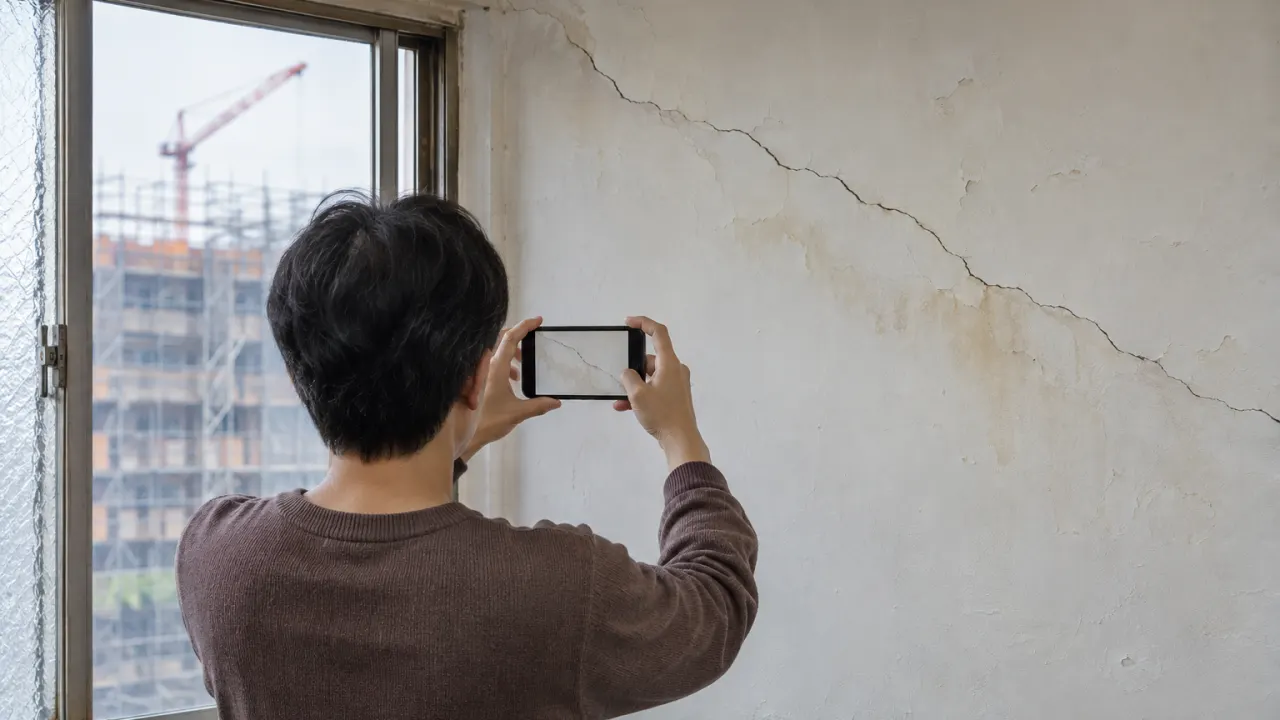
An American family owns and lives in the ground-floor flat of a 40-year-old walk-up in Yonghe, New Taipei (an invented example). Next door, a developer digs three basement levels. A month in, a diagonal crack runs across the living room wall. After rain, water seeps under the window frame. The site manager's answer: the crack was always there.
The duty of whoever digs
Civil Code art. 794 bars a landowner who excavates or builds from shaking or endangering the neighboring foundation, or damaging buildings and other structures on neighboring land.
Building Act art. 69 adds the engineering version. Excavation next to another building calls for measures against tilting or collapse as needed, and for digs of 1.5 meters or more, the design for those measures goes in with the permit application.
Permits are no shield. Under article 26, a permit only authorizes the work; an owner-applicant, designer, supervising architect or contractor who damages another's property remains liable under the law.
Who can be sued
Claims start from Civil Code art. 184. Paragraph 1 covers intentional or negligent harm to another's rights. Paragraph 2 covers breach of a law meant to protect others, unless the person proves no negligence. A neighbor may argue that art. 794 or Building Act art. 69 is such a law, which would put the burden of disproving fault on the builder.
A developer may answer with art. 189: whoever orders work is not liable for harm the contractor causes while doing it, unless at fault in ordering or directing it. Hence the contractor (Building Act art. 14) is a natural second defendant. Joint wrongdoers are jointly and severally liable (art. 185(1)).
What about pile driving or a deep dig? Article 191-3 imposes liability for harm from dangerous activities, tools or methods, unless the actor proves another cause or reasonable care. Which construction methods count is argued case by case.
The survey made before the first shovel
In Taipei, article 4 requires the builder to commission a condition survey of neighboring houses before the setting-out inspection is reported, or before a demolition starts. It is waived where, for example, no house stands within three times the excavation depth. Each surveyed owner gets a copy (art. 17).
New Taipei's procedure, revised with effect from July 1, 2024, requires a neighbor survey at the setting-out inspection for buildings with basements. A neighbor who ignores three notices, the last by registered mail, loses access to the city procedure for later damage unless there is a special reason (New Taipei City Procedure for Handling Damage to Neighboring Buildings from Construction, point 11).
Taipei: from complaint to supervision
Only the neighboring owner can apply (art. 3(5) and (7)), with proof of title; a tenant goes through the landlord. Missing documents must be supplied within 14 days (art. 5). The builder's findings are signed by the supervising architect and the contractor's engineer, then reviewed at the builder's cost by an association the owner picks from the department's published list. Danger, or a missed three-day deadline, brings a stop-work order under Building Act art. 58 (arts. 6 and 7). An owner who refuses entry after a registered notice sent seven days ahead may be told the site will not be supervised (art. 6(3)–(5)).
If the twenty-day finding blames construction, the site is supervised. If not, and your house was surveyed beforehand, you have 14 days to name an assessment body and lodge a NT$10,000 deposit. Who pays? The builder advances the fee. If construction damage is found, the builder bears it and the assessment body returns your deposit without interest; otherwise the fee is yours and the deposit goes toward it (art. 8(1)(i)). For unsurveyed houses, the builder commissions the assessment at its own cost within 60 days (art. 8(1)(ii)).
After supervision starts, the parties negotiate. Two failed rounds of city mediation let the builder ask to end supervision on a ground in art. 9(1)(iii): with two or fewer damaged households, by depositing twice the assessed repair compensation in their name; with more, by depositing the assessed amount for unsettled households once enough have settled or been paid. Other grounds: the owner skipped both rounds (assessed amount deposited), has already sued, or the review committee sent the case to court.
Timing can shut the door. A complaint filed after the builder reports the roof-slab inspection (for top-down construction, the last floor-slab inspection) gets only the safety steps (art. 13). The rules do not apply at all where the lot line lies more than three times the excavation depth from the excavation line (art. 21).
New Taipei's different numbers
| Item | Taipei City rules | New Taipei procedure |
|---|---|---|
| First report | 3 days (safety), 20 days (cause) | 7 days |
| Distance | Lot line over 3x depth from excavation line: rules do not apply (art. 21) | House edge over 4x depth from excavation line, or cause undeterminable: owner's own assessment within 2 months, at own cost (point 9) |
| Late complaint | After roof-slab inspection (top-down: last floor-slab inspection): safety steps only (art. 13) | Over 1 month after roof-slab inspection report: safety check, then outside the procedure if no danger (point 10) |
| Deposit to end supervision | 2x assessed amount for up to two households; assessed amount otherwise (art. 9) | 120% to 200%, accumulated by bracket (annex) |
Under point 4, the builder must negotiate first. Without agreement within 20 days of the Public Works Department's notice, an assessment body is chosen, by the owner if the builder will not cooperate, with the builder paying. After three failed rounds at the district mediation committee (department-led rounds may be counted) and a finding that the house is safe, the builder may deposit the bracketed amount with the court (point 8).
The civil claim after supervision
Both procedures send unresolved disputes to the courts, where the assessment report is weighed with other evidence.
The liable party restores the original condition, or pays its cost (art. 213(1) and (3)). Lost value falls under art. 196, and rent lost during repairs can be argued as lost profit under art. 216. Damages for distress under art. 195(1) cover personal interests such as health and privacy, not the house. A leak left for months can cut the award, since courts may reduce damages for the victim's contributory fault (art. 217(1)).
Two years is the clock. Under art. 197(1), the claim lapses two years after you learn of the damage and who is liable, and in any case ten years after the act.
Preserving evidence and mediation
Under Code of Civil Procedure art. 368, a court may preserve evidence at risk of loss or of becoming hard to use, or with the other side's consent. A party with a legal interest in, and need for, fixing the present condition may also seek an expert assessment or inspection. Before suit, apply to the district court where the evidence is (art. 369); see Preserving Evidence Before a Civil Suit in Taiwan.
Article 403(1) requires court mediation before suit for disputes between users of adjoining real property (item 1) and property disputes of NT$500,000 or less (item 11), subject to art. 406(1); others may apply voluntarily (art. 404). District mediation committees also hear civil disputes (Township and County-Administered City Mediation Act, art. 1), and a court-approved settlement has the effect of a final judgment (art. 27).
Working with a lawyer in Taipei
A Taiwan lawyer can meet each city deadline, compare the survey with the builder's findings, decide on naming an assessment body and paying the deposit, choose defendants, and handle evidence preservation, mediation and a damages suit. Consultations on civil disputes are available at wei@hoveringlaw.com.tw. Hovering International Law Firm (昊鼎國際法律事務所), Taipei: 7F-2, No. 35, Sec. 1, Chengde Rd., Datong Dist., Taipei City 103. Taichung: 6F-1, No. 19, Guanqian Rd., North Dist., Taichung City 40453.
For the Yonghe family, two dates matter. Reporting more than a month after the roof-slab inspection report leaves them outside the New Taipei procedure if the department's check finds no public-safety danger. A lawsuit must come within two years of learning of the damage and who is liable.
Sources
Checked November 3, 2026. Taiwan rules are quoted from the Chinese originals.
- Taipei City Rules for Handling Disputes over Damage to Neighboring Buildings from Construction (臺北市建築施工損鄰事件爭議處理規則), arts. 6–8 amended Dec. 8, 2023 — Taipei City law database
- New Taipei City Procedure for Handling Damage to Neighboring Buildings from Construction (新北市建築物施工損壞鄰房事件處理程序), fully revised May 16, 2024, in force July 1, 2024 — New Taipei City law database
- Same procedure — PDF published by the New Taipei City Public Works Department
- Civil Code, art. 184
- Civil Code, art. 185
- Civil Code, art. 189
- Civil Code, art. 191-3
- Civil Code, art. 195
- Civil Code, art. 196
- Civil Code, art. 197
- Civil Code, art. 213
- Civil Code, art. 216
- Civil Code, art. 217
- Civil Code, art. 794
- Building Act, art. 14
- Building Act, art. 26
- Building Act, art. 58
- Building Act, art. 69
- Code of Civil Procedure, art. 368
- Code of Civil Procedure, art. 369
- Code of Civil Procedure, art. 403
- Code of Civil Procedure, art. 404
- Township and County-Administered City Mediation Act, art. 1
- Township and County-Administered City Mediation Act, art. 27
Frequently Asked Questions
- The site manager says the cracks were already there. What can I use against that?
- Start with the pre-construction survey. Under article 4 of the Taipei City rules, the builder must commission a survey of neighboring houses before reporting the setting-out inspection (or before reporting the start of a demolition), and point 11 of the New Taipei procedure requires a survey report for buildings with basements at the setting-out inspection. You can also ask a court to preserve evidence by expert assessment or inspection (Code of Civil Procedure art. 368).
- The city decided not to place the site under supervision. Does that end my claim?
- No. Supervision (lieguan) is an administrative step. Under article 8 of the Taipei City rules, where the liability assessment finds no construction damage and the site is not supervised, a neighbor who disagrees is left to resolve it through legal channels. A damages claim rests on the Civil Code, including articles 184 and 794, and must be brought within two years of learning of the damage and who is liable (art. 197).
- The developer says the contractor did the work, not them.
- Under Civil Code art. 189, a party who orders work is not liable for harm the contractor causes while doing it, unless that party was at fault in ordering or directing the work. That is why the contractor is worth considering as a co-defendant, and people who jointly cause harm are jointly and severally liable (art. 185). Building Act art. 26(2) also makes the owner-applicant, designer, supervising architect and contractor each answerable under the law when they damage another's property.
This article provides general information and is not legal advice on any individual matter.


